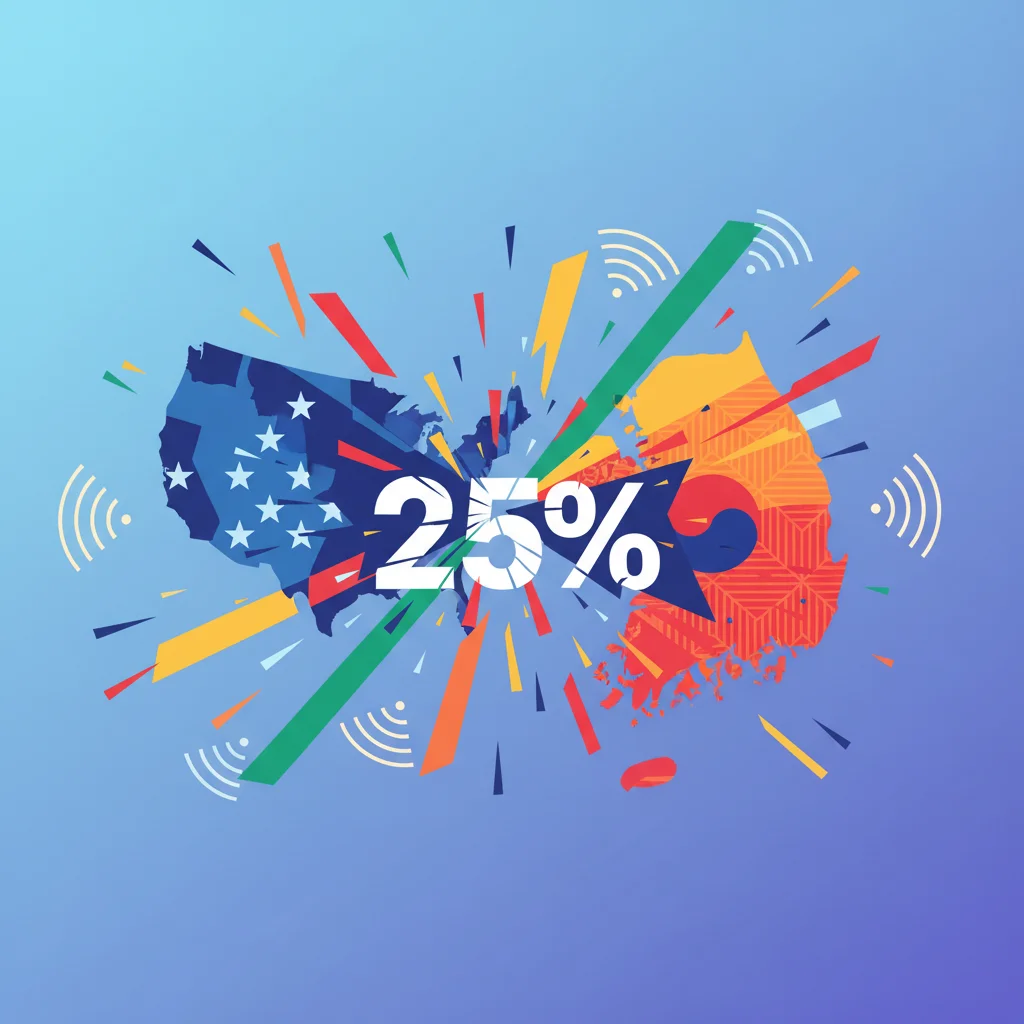
Trade War Tremors: Unpacking the New 25% US Tariffs on South Korea
In a move that sent ripples through the global financial markets, the White House has announced its intention to impose a steep 25% tariff on goods from South Korea. The administration accuses Seoul of “not living up to” a trade agreement renegotiated just last year, a claim that has left many analysts and business leaders scrambling to understand the implications. According to the Financial Times, this decision marks a significant escalation in trade tensions with a key Asian ally, threatening to disrupt supply chains and unsettle an already fragile global economy.
This development is more than just a headline; it’s a critical data point for investors, a strategic challenge for business leaders, and a complex puzzle for economists. The decision impacts everything from the price of consumer electronics and automobiles to the intricate dance of international diplomacy. In this comprehensive analysis, we will dissect the context behind this tariff threat, explore the potential economic fallout for both nations, and offer an expert perspective on what this means for the future of finance, investing, and global trade.
A Fraught History: The KORUS Agreement and the Path to New Tariffs
To fully grasp the gravity of this announcement, one must understand the foundation of the U.S.-South Korea trade relationship: the Korea-U.S. Free Trade Agreement (KORUS FTA). Originally signed in 2007 and implemented in 2012, KORUS was hailed as a landmark deal. However, it quickly became a target of criticism from the Trump administration, which cited a growing U.S. trade deficit with South Korea as evidence of an unfair pact.
This led to a tense period of renegotiation, culminating in a revised agreement in 2018. The updated terms included concessions from Seoul, such as doubling the cap on U.S. auto exports that can enter South Korea without meeting local safety standards and extending a 25% U.S. tariff on Korean trucks for an additional 20 years, until 2041. In return, South Korea was granted a permanent exemption from U.S. steel tariffs. It is this revised agreement that the White House now claims Seoul is failing to honor, though specific details of the alleged violations have not yet been made public.
The trade relationship between the two nations is substantial. Below is a snapshot of the U.S. trade in goods with South Korea over recent years, highlighting the figures at the center of the dispute.
| Year | U.S. Exports to South Korea (in billions USD) | U.S. Imports from South Korea (in billions USD) | Goods Trade Balance (in billions USD) |
|---|---|---|---|
| 2019 | $56.5 | $74.0 | -$17.5 |
| 2020 | $50.9 | $75.9 | -$25.0 |
| 2021 | $65.8 | $95.0 | -$29.2 |
| 2022 | $73.5 | $114.1 | -$40.6 |
Data sourced from the U.S. Census Bureau. These figures illustrate the widening trade deficit that has been a point of contention for the U.S. administration.
Beyond Borders: How Tata's Defence Ambitions are Reshaping India's Role on the World Stage
Economic Fallout: Analyzing the Ripple Effects
A 25% tariff is not a surgical strike; it’s a broadside that will be felt across numerous sectors. The immediate impact on the South Korean economy could be severe, potentially triggering a downturn in its export-driven market and causing volatility in the KOSPI, its benchmark stock index.
Impact on South Korea’s Industrial Giants
South Korea is home to some of the world’s most recognizable brands, many of which are deeply integrated with the U.S. market.
- Automotive Sector: Companies like Hyundai and Kia, which have a significant U.S. market share, would face immense pressure. A 25% tariff could either force them to absorb the cost, crushing profit margins, or pass it on to consumers, making their vehicles less competitive against American and other foreign brands.
- Electronics & Technology: Giants like Samsung and LG export a vast range of products to the U.S., from smartphones and televisions to semiconductors and home appliances. Tariffs would disrupt these supply chains, increase costs for American consumers, and potentially slow the pace of innovation.
- Steel and Manufacturing: Despite the previous exemption, a new broad-based tariff could once again hit South Korea’s steel industry, a critical component of its industrial base.
Consequences for the U.S. Economy
The notion that tariffs only harm the target nation is a common misconception in economics. American businesses and consumers will also feel the sting. U.S. manufacturers who rely on South Korean components—from specialized steel to advanced semiconductors—will see their input costs rise. This could lead to higher prices for finished goods, fueling inflation and reducing the competitiveness of American products on the global stage. This is a classic example of how protectionist measures can have unintended consequences, disrupting the very economy they are meant to protect.
The Investor’s Playbook: Navigating a Volatile Market
For those involved in finance and investing, geopolitical shocks like this demand a calm and strategic response. Knee-jerk reactions can be costly. Here are several considerations for navigating the market turmoil.
Sector-Specific Vulnerability
The most immediate impact will be on the stock market values of companies directly exposed to U.S.-South Korea trade. Investors should reassess their holdings in:
- South Korean automotive and tech giants (Hyundai, Kia, Samsung, LG).
- U.S. companies heavily reliant on Korean supply chains (e.g., tech hardware companies, automakers).
- U.S. companies that may benefit from reduced competition (e.g., domestic appliance or auto manufacturers).
Active trading in these sectors is likely to increase as institutional investors and hedge funds reposition their portfolios to mitigate risk and capitalize on the volatility. A thorough analysis of a company’s supply chain resilience is now more critical than ever.
Diversification and Hedging
This event underscores the timeless wisdom of portfolio diversification. Exposure across different geographic regions and asset classes can cushion the blow from a targeted trade dispute. Investors may also consider currency hedging, as the South Korean Won (KRW) is likely to weaken against the U.S. Dollar (USD) in the face of such economic pressure. According to a report by the Peterson Institute for International Economics, currency fluctuations are a major secondary effect of trade wars.
India's Tax Earthquake: Supreme Court Ruling Shakes Foreign Investment Landscape
The Future of Global Trade: A Push Towards New Technologies?
Repeated trade shocks are forcing a global rethink of how international commerce is conducted. The fragility of just-in-time supply chains and the complexities of cross-border settlements are being exposed. This is where innovations in financial technology may provide solutions.
The ongoing friction could accelerate the adoption of technologies designed to create more resilient and transparent trade networks. For instance, blockchain technology offers a compelling solution for supply chain management. By creating an immutable and transparent ledger, companies can track goods from factory to final destination with unprecedented accuracy, reducing fraud and improving efficiency. This could become a crucial tool for verifying compliance with complex trade regulations and tariffs.
Furthermore, the world of fintech is tackling the challenges of cross-border payments and trade finance. As traditional banking channels face uncertainty from geopolitical tensions, decentralized finance (DeFi) and other fintech platforms could offer alternative, more efficient ways to settle international transactions. While still nascent, this trend towards technological solutions in trade is a powerful undercurrent that long-term investors should monitor.
Ireland's Economic Juggernaut: Beyond the Headlines of a 12.5% Tax Rate
Conclusion: An Uncertain Road Ahead
The proposed 25% tariff on South Korea is a stark reminder that the landscape of global trade is shifting beneath our feet. It represents a significant challenge to a key U.S. ally and a source of profound uncertainty for the global economy. For businesses, it necessitates a critical re-evaluation of supply chain vulnerabilities. For investors, it demands a disciplined approach to risk management and an awareness of both the immediate market shocks and the long-term technological trends that may emerge from the disruption.
As Washington and Seoul navigate this new and perilous chapter in their relationship, the world will be watching closely. The outcome will not only determine the future of a vital economic partnership but also offer clues about the evolving rules of international commerce in the 21st century.

Related Posts

The End of an Era? Why America’s Future Looks More Like 1914 Vienna Than 1956 Suez
Beyond the Blizzard: Why the Natural Gas Price Shock is a Warning for the Global Economy