Solving the Financial Puzzle: A Strategic Guide to Today’s Economy and Investment Landscape
The Modern Economy: More Complex Than Any Crossword
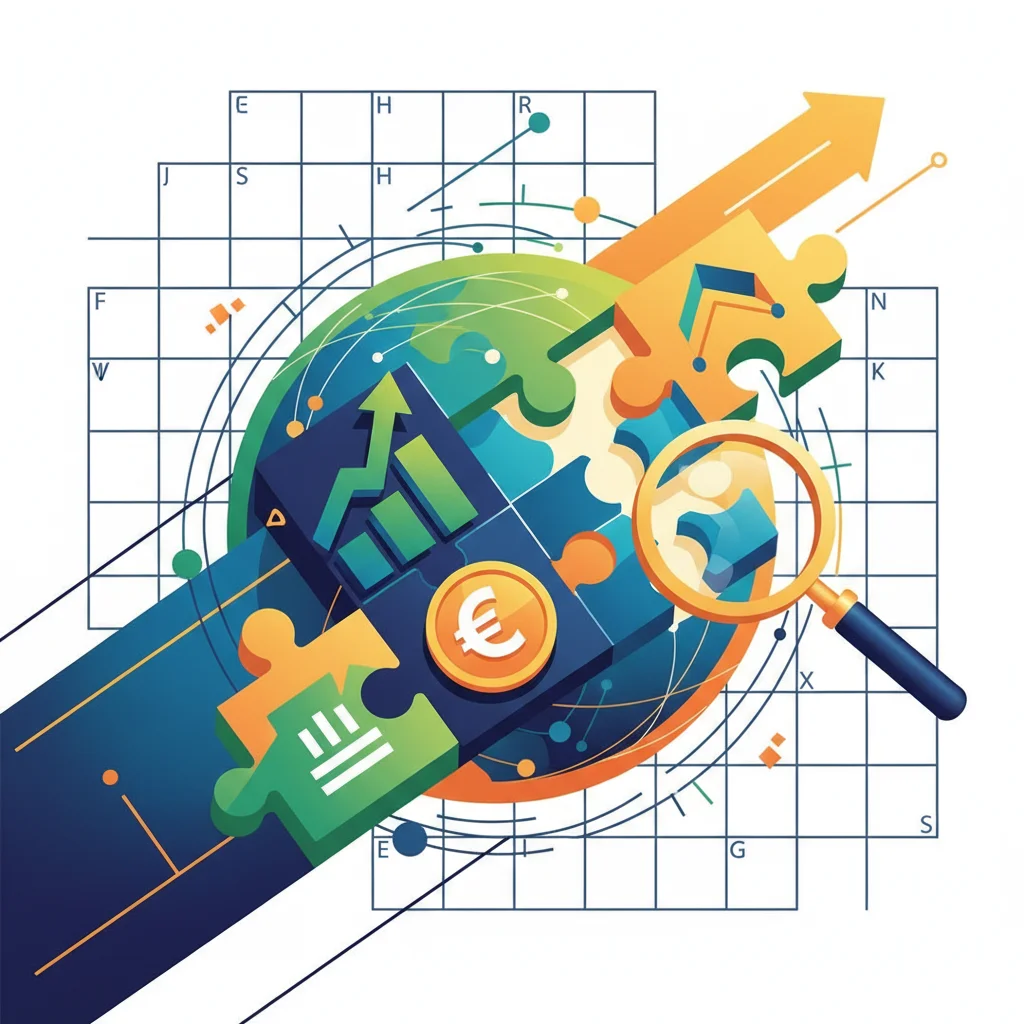
Navigating the contemporary financial world can often feel like tackling a cryptic crossword puzzle. The clues are complex, the answers are interconnected, and a single misstep can throw off the entire grid. From the fluctuating dynamics of the global economy to the disruptive power of financial technology, today’s investors and business leaders face a puzzle of unprecedented complexity. Understanding the key pieces—investing strategies, the role of modern banking, the intricacies of the stock market, and emerging forces like blockchain—is no longer optional. It is the fundamental requirement for building wealth and securing a competitive edge.
This guide serves as your key, helping you decipher the clues and fill in the blanks. We will explore the macroeconomic forces shaping our world, dissect the technological revolution in finance, and provide an expert perspective on how to strategically position yourself for success. Whether you are a seasoned investor, a C-suite executive, or simply someone keen to understand the economic currents, this analysis will provide the clarity needed to solve the financial puzzle of the 21st century.
The Corner Pieces: Understanding the Macroeconomic Framework
Before diving into specific sectors like fintech or trading, it’s crucial to establish the “corner pieces” of our puzzle: the major macroeconomic trends that define the playing field. These are the large-scale forces that influence everything from interest rates to consumer spending and corporate earnings. Currently, the global economy is navigating a post-pandemic landscape marked by persistent inflation, aggressive central bank policies, and geopolitical uncertainty.
Central banks, like the U.S. Federal Reserve and the European Central Bank, have been walking a tightrope. Their primary tool, interest rate hikes, is designed to cool inflation but risks triggering a recession. According to the World Bank’s Global Economic Prospects report, the global economy is set for the “slowest half-decade of GDP growth in 30 years.” This slowdown has profound implications for the stock market, as higher borrowing costs can squeeze corporate profits and dampen investor sentiment. Understanding these overarching economics is the first step toward making informed investment decisions.
Ireland's Economic Juggernaut: Beyond the Headlines of a 12.5% Tax Rate
Across the Board: The Evolution of Investing and Trading
With the macroeconomic context set, we turn to the strategies for navigating it. The world of investing has been democratized over the past decade, largely thanks to technology. Zero-commission trading apps have brought millions of new participants into the market, changing its dynamics in fundamental ways. However, this accessibility comes with its own set of challenges, including heightened volatility and the spread of misinformation.
Successful investing today requires a multi-faceted approach. While passive investing through index funds remains a popular and effective strategy for many, active management and thematic investing are gaining traction. This involves betting on long-term trends, such as artificial intelligence, renewable energy, or advancements in biotechnology. For finance professionals, the key is to balance traditional valuation metrics with an understanding of these disruptive technological shifts. The ability to analyze both a company’s balance sheet and its innovative potential is what separates successful investors from the rest.
Down the Grid: The FinTech Revolution Reshaping Banking
Perhaps no area of finance has been more profoundly transformed than banking and payments. The rise of financial technology, or fintech, has dismantled the traditional, branch-based model and replaced it with a seamless, digital-first experience. From mobile banking apps and peer-to-peer payment systems to automated “robo-advisors” that manage investment portfolios, fintech has put more power into the hands of consumers.
This revolution is not just about convenience; it’s about fundamentally changing the infrastructure of finance. A recent industry analysis highlights that global investment in fintech remains robust, signaling continued innovation in the sector. For established financial institutions, the challenge is to adapt or risk becoming obsolete. This has led to a wave of partnerships between legacy banks and agile fintech startups, creating a hybrid ecosystem that blends the trust and scale of traditional banking with the innovation and user-centric design of the new guard.
Beyond Borders: How Tata's Defence Ambitions are Reshaping India's Role on the World Stage
To better understand this shift, let’s compare the traditional financial ecosystem with the emerging fintech-driven model.
| Feature | Traditional Finance | FinTech-Driven Finance |
|---|---|---|
| Accessibility | Often requires physical presence (branches); limited by business hours. | 24/7 access via digital platforms (web, mobile); globally accessible. |
| Onboarding | Manual, paper-intensive processes; can take days or weeks. | Automated, digital identity verification; often completed in minutes. |
| Cost Structure | Higher overhead (branches, staff) leading to higher fees for services. | Lower operational costs, often resulting in lower or no fees for consumers. |
| Innovation | Slow, incremental changes due to legacy systems and regulation. | Rapid, iterative development focused on user experience and new products. |
| Data Utilization | Siloed data used primarily for internal risk assessment. | Data-centric approach using AI for personalization, credit scoring, and fraud detection. |
The Cryptic Clue: Demystifying Blockchain and Decentralized Finance (DeFi)
If fintech is a clear-cut clue, then blockchain is the cryptic one that leaves many scratching their heads. Often conflated with cryptocurrencies like Bitcoin, blockchain is a foundational technology with applications far beyond digital currencies. At its core, it is a decentralized, immutable ledger that can record transactions securely and transparently without the need for a central intermediary, like a bank.
This technology is the backbone of Decentralized Finance (DeFi), an emerging ecosystem of financial applications built on blockchain networks. DeFi aims to recreate traditional financial services—like lending, borrowing, and trading—in an open and permissionless way. While the sector is still nascent and carries significant risks, its potential to reduce costs, increase efficiency, and provide financial services to the unbanked is enormous. A report by Deloitte notes that DeFi is challenging financial institutions to “re-examine their business models.” For business leaders, ignoring the potential of blockchain is akin to ignoring the rise of the internet in the late 1990s. Understanding its principles is becoming a prerequisite for long-term strategic planning.
The Trillion-Dollar Blind Spot: Why Child Safety Online is the Next Frontier for Investors
Conclusion: Assembling the Pieces for a Coherent Strategy
The financial world is no longer a simple grid but a multi-dimensional puzzle. The solution lies not in mastering a single area but in understanding the interplay between them. The macroeconomic environment dictates the climate for the stock market. Advances in financial technology change how we interact with banking and investments. And disruptive innovations like blockchain are rewriting the fundamental rules of trust and transaction.
For investors and leaders, the path forward requires a commitment to continuous learning and adaptability. The key takeaways are clear:
- Stay Macro-Aware: Keep a firm grasp on global economics and central bank policies, as they form the foundation of any investment thesis.
- Embrace Technology: Leverage the tools and platforms offered by the fintech revolution to enhance efficiency and access, but remain critical and security-conscious.
- Look Beyond the Hype: Differentiate between speculative trends and foundational technological shifts. Understand the “why” behind innovations like blockchain, not just the “what.”
- Diversify Knowledge: The lines between finance, technology, and economics are blurring. A holistic understanding is your greatest asset in solving the complex, ever-evolving puzzle of the modern economy.
By assembling these pieces with a strategic and informed perspective, you can move from being a puzzled observer to a confident player, capable of navigating complexity and capitalizing on the opportunities of tomorrow.