Trade War Tremors: Why the New 25% Tariff on South Korea Shakes the Global Economy
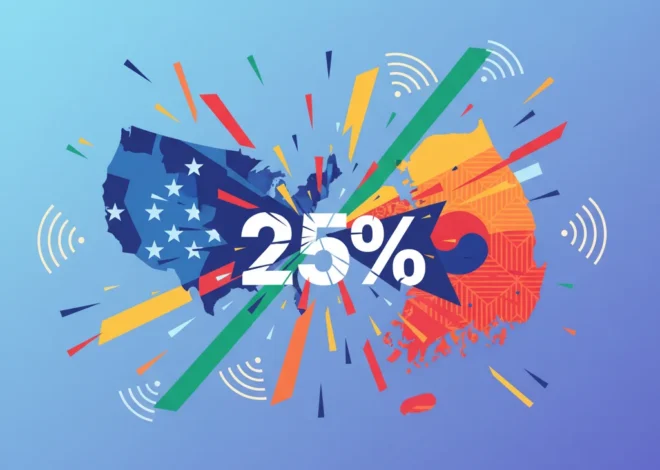
In a move sending shockwaves through the global financial markets, the White House has announced its intention to escalate trade tensions with a key Asian ally. Citing a failure by Seoul to “live up to” a trade agreement renegotiated just last year, the U.S. President is planning to impose a sweeping 25% tariff on South Korean goods. This decision is far more than a simple adjustment in economic policy; it’s a geopolitical tremor that threatens to disrupt supply chains, rattle investor confidence, and redefine a cornerstone alliance in the Indo-Pacific region. For investors, business leaders, and anyone engaged in the global economy, understanding the multifaceted implications of this move is not just important—it’s critical.
The announcement represents a significant escalation, moving beyond targeted tariffs on specific products like steel and washing machines to a broader, more punitive measure. This policy shift forces a critical re-evaluation of risk for companies and investors who have long benefited from the stable and predictable trade relationship between the two nations. The fallout will be felt not just in Seoul and Washington, but across the entire spectrum of global finance, from the bustling floors of the New York stock market to the intricate logistics of international shipping.
The Anatomy of a Trade Dispute: Deconstructing the “Agreement”
To grasp the gravity of the situation, we must first understand the foundation of the U.S.-South Korea trade relationship: the U.S.-Korea Free Trade Agreement (KORUS FTA). Originally implemented in 2012, the agreement was hailed as a landmark deal. However, it was renegotiated under the Trump administration, with a revised version taking effect in early 2019. The administration’s primary goal was to reduce the U.S. trade deficit with South Korea, particularly in the automotive sector.
The 2019 revisions included several key changes:
- Automotive Exports: South Korea agreed to double the cap on U.S. auto exports that can meet U.S. safety standards (rather than Korean ones) to 50,000 cars per manufacturer per year.
- U.S. Truck Tariffs: The U.S. extended its 25% tariff on Korean-made pickup trucks for an additional 20 years, until 2041.
- Pharmaceuticals: Adjustments were made to South Korea’s pricing policies for American pharmaceutical exports.
The current accusation that Seoul is “not living up to” this revised agreement is pointed, though specific details from the White House remain sparse. Analysts speculate the friction could stem from perceived non-tariff barriers, such as complex regulatory hurdles or customs procedures that continue to hinder U.S. exports, particularly in the automotive and agricultural sectors. According to data from the U.S. Census Bureau, the U.S. goods trade deficit with South Korea stood at $22.9 billion in 2021, a figure that has likely fueled the administration’s perception that the deal remains unbalanced. A 25% tariff is a blunt instrument designed to force compliance and fundamentally alter the trade calculus.
A Turning Tide? Unpacking the Nuances of UK Housing Affordability for First-Time Buyers
The Economic Ripple Effect: From Seoul to Wall Street
A 25% tariff is not a surgical strike; it’s a shockwave that will propagate through the global economic system. The immediate and most visible impact will be on South Korea’s export-driven economy, but the secondary effects will be felt far and wide, ultimately reaching the pockets of American consumers and the portfolios of global investors.
Impact on Key Industries
South Korea is a global powerhouse in manufacturing, and its largest corporations are deeply integrated into U.S. markets. The proposed tariffs would hit these sectors disproportionately hard. Below is a breakdown of the most vulnerable areas based on 2022 U.S. import data.
| Industry/Product Category | Key South Korean Companies | Approx. 2022 Export Value to U.S. | Potential Impact of a 25% Tariff |
|---|---|---|---|
| Automobiles & Parts | Hyundai, Kia, Hyundai Mobis | $28 Billion | Drastic price increases for U.S. consumers, loss of market share to competitors, potential relocation of production. |
| Electronics & Semiconductors | Samsung, LG, SK Hynix | $21 Billion | Higher costs for U.S. tech companies using Korean components, increased prices for consumer electronics like TVs and smartphones. |
| Industrial Machinery | Doosan, HD Hyundai | $9 Billion | Increased costs for U.S. construction and manufacturing sectors, delaying infrastructure projects. |
| Steel & Metals | POSCO, Hyundai Steel | $4 Billion | Compounded pressure on an already-taxed industry, making raw materials more expensive for U.S. manufacturers. |
Note: Export values are approximate and sourced from trade analysis reports.
For American consumers, the impact translates directly to higher prices on everything from a new Kia Telluride to a Samsung smartphone. For U.S. businesses, it means more expensive components, disrupting the intricate supply chains that have been optimized for efficiency over decades. This disruption in the flow of goods and capital is a classic recipe for market volatility, and investors in the stock market are taking note. The uncertainty surrounding the scope and duration of these tariffs will undoubtedly lead to cautious investing and erratic trading patterns.
Geopolitics, Alliances, and the Future of Trade
The U.S.-South Korea relationship is built on more than just trade; it is a cornerstone of American foreign policy in Asia. With a significant U.S. military presence and a shared commitment to containing North Korean aggression, the alliance has been a stabilizing force for over 70 years. Injecting this level of economic hostility into such a critical partnership is a high-risk maneuver. A protracted trade dispute could erode trust and goodwill, complicating cooperation on vital security matters. According to a report by the Council on Foreign Relations, maintaining a united front between Washington and Seoul is paramount to managing the North Korean nuclear threat.
This situation also raises broader questions about the future of global trade architecture. The post-WWII order, built on free trade and multilateral agreements, is being challenged by a rise in economic nationalism. This shift forces a paradigm change in how businesses manage risk. The traditional models of just-in-time manufacturing and globalized supply chains are proving fragile in the face of sudden policy shifts.
This is where emerging technologies may offer a path forward. The field of financial technology, or fintech, is rapidly developing solutions for more transparent and resilient cross-border transactions. Furthermore, blockchain technology holds immense promise for revolutionizing supply chain management. By creating an immutable and transparent ledger of a product’s journey from factory to consumer, blockchain can help companies better anticipate and respond to disruptions, verify compliance, and reduce friction in international trading.
The "Dreaded European Working Group": Is EU Bureaucracy a Threat to Global Economic Stability?
An Investor’s and Business Leader’s Guide to Navigating the Turmoil
In this volatile environment, passive observation is not an option. Both investors and corporate leaders must adopt proactive strategies to mitigate risk and identify potential opportunities.
For Investors and Finance Professionals:
- Assess Sector Exposure: Scrutinize portfolios for overexposure to the U.S. auto, consumer electronics, and industrial manufacturing sectors. Companies heavily reliant on South Korean components or sales are at immediate risk.
- Consider Currency Risk: Trade tensions will likely increase volatility in the U.S. Dollar/Korean Won (USD/KRW) currency pair. Those involved in international banking and finance should consider hedging strategies.
- Look for Domestic Beneficiaries: While many will suffer, some U.S. domestic producers who compete directly with South Korean imports (e.g., in steel or home appliances) may see a short-term benefit.
- Focus on Resilience: Prioritize investing in companies with diversified, resilient supply chains and a global manufacturing footprint that can adapt to shifting trade policies.
For Business Leaders:
- Conduct a Supply Chain Audit: Immediately map your entire supply chain to identify dependencies on South Korean suppliers, both direct (Tier 1) and indirect (Tier 2 and 3).
- Diversify Sourcing: Accelerate plans to diversify sourcing to other countries to reduce reliance on a single geographic region. This is no longer just a cost-saving exercise; it is a strategic imperative.
- Model Financial Scenarios: Work with your finance teams to model the impact of a sustained 25% tariff on your cost of goods sold (COGS), profit margins, and pricing strategies.
The Greenland Gambit: Unpacking the Financial Shockwaves of a Geopolitical Bombshell
Conclusion: A New Era of Economic Uncertainty
The plan to impose a 25% tariff on South Korea is a stark reminder that the landscape of global trade is fundamentally changing. The era of predictable, rules-based commerce is giving way to a more transactional and volatile environment where economic tools are increasingly wielded for political ends. This move will test the resilience of the U.S.-South Korea alliance, reshape global supply chains, and introduce a new layer of uncertainty into the financial markets. For everyone from the individual investor to the multinational CEO, the key to navigating this new reality will be adaptability, strategic foresight, and a clear-eyed understanding of the profound link between geopolitics and the global economy.