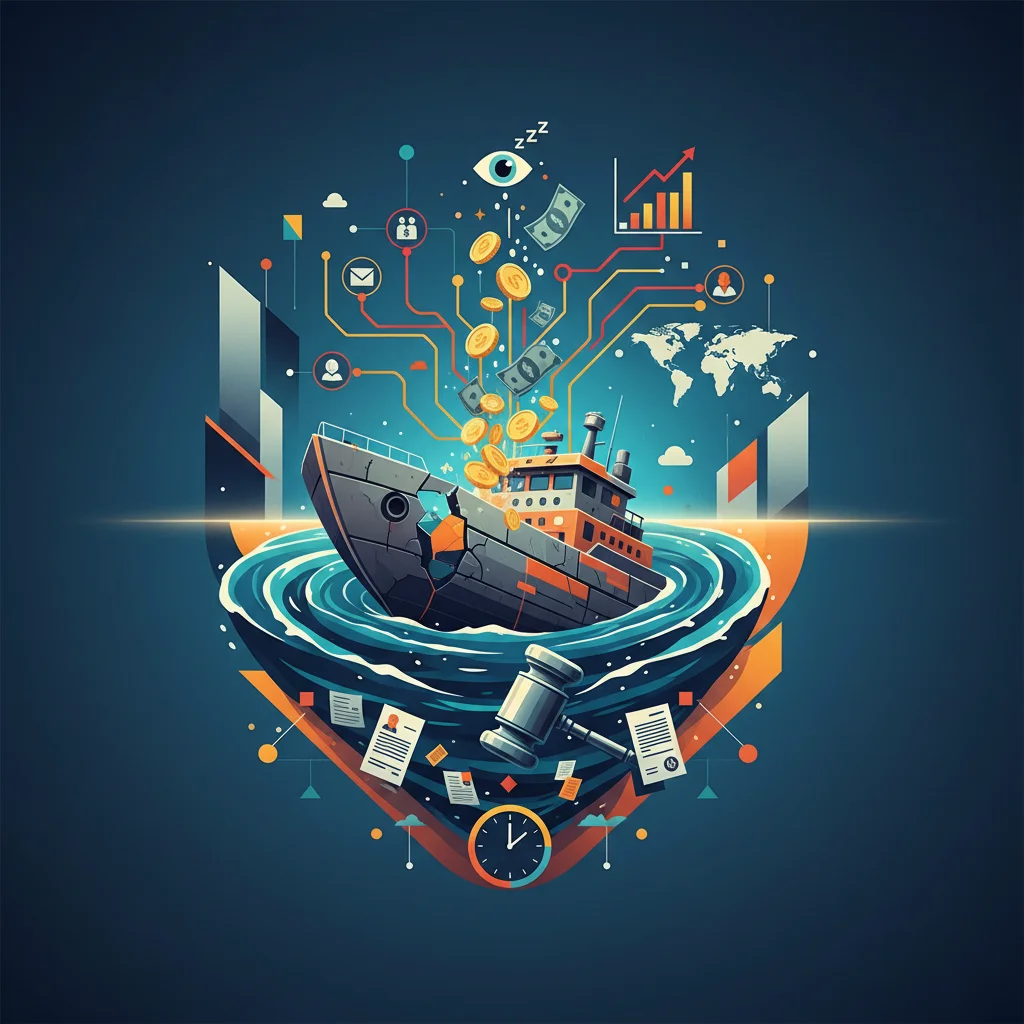
The Billion-Dollar Nap: How a Single Maritime Accident Exposes Deep Risks in the Global Economy
In the vast, churning expanse of the North Sea, a single moment of alleged negligence has triggered a legal and financial chain reaction. When the captain of a tanker, Vladimir Motin, stood in court to deny charges of gross negligence manslaughter following a fatal crash, the story made headlines. According to the BBC report, the core of the accusation is a lapse in human attention—a potential case of falling asleep at the helm. While the human tragedy is the immediate focus, for investors, finance professionals, and business leaders, this incident serves as a stark reminder of a much larger, often underestimated, category of risk: the profound financial vulnerability of our global supply chains to human error.
At first glance, a single tanker collision seems like a localized disaster. However, in an interconnected global economy, the ripples spread with astonishing speed and force. This event is not just a maritime legal case; it’s a case study in operational risk, a stress test for the insurance industry, and a powerful argument for the accelerated adoption of financial technology designed to safeguard the arteries of global trade. From the stock market fluctuations of logistics giants to the complex calculus of insurance underwriting, the financial consequences of a “billion-dollar nap” are intricate and far-reaching.
Deconstructing the Immediate Financial Fallout
When a vessel is involved in a fatal accident, the direct costs are staggering and multifaceted. Understanding these is crucial for anyone involved in investing in or financing the shipping, logistics, or insurance sectors. The liability is not merely a corporate fine; it’s a complex web of financial obligations that can cripple even large corporations.
Insurance, Liability, and the P&I Club Conundrum
The first line of financial defense is insurance. The maritime world relies on specialized insurers known as Protection and Indemnity (P&I) Clubs. These are mutual insurance associations that provide risk pooling for their members—the shipowners. A claim arising from an incident like the one in the North Sea would trigger a cascade of financial activity:
- Hull and Machinery (H&M) Insurance: Covers physical damage to the tanker itself. Repair or replacement costs can run into the hundreds of millions of dollars.
- P&I Coverage: This is where the most complex liabilities lie. P&I clubs cover a vast range of third-party claims, including crew injury or death, damage to other vessels or property (like docks or subsea cables), and pollution cleanup costs.
- Legal Costs: Defending a case of gross negligence manslaughter is an expensive, multi-year endeavor involving teams of maritime lawyers, expert witnesses, and court fees.
The charge of “gross negligence” is particularly perilous from a financial standpoint. It implies a conscious and voluntary disregard of the need to use reasonable care. If proven, it can sometimes allow insurers to deny claims, pushing the full, uncapped liability back onto the shipowner’s balance sheet—a catastrophic event for shareholders and creditors.
Human error remains the leading cause of shipping incidents. According to a safety and shipping review by Allianz Global Corporate & Specialty (AGCS), human error is a factor in an estimated 75% to 96% of marine incidents. This single statistic is a massive red flag for the entire financial ecosystem supporting global trade.
The Credit Score Paradox: Why Financial Health Makes You a Target for More Debt
The Macro-Economic Shockwaves: From Port to Portfolio
The impact of a single vessel being delayed or taken out of service extends far beyond the shipping company’s P&L statement. The 2021 Suez Canal blockage by the container ship Ever Given provided a dramatic lesson in supply chain fragility. The incident was estimated to have held up nearly $10 billion in trade for each day of the blockage, disrupting everything from automotive manufacturing to consumer electronics.
While the North Sea incident is on a smaller scale, the principle is the same. The North Sea is one of the world’s busiest and most critical shipping areas, a vital corridor for oil, gas, and container traffic. Any disruption can lead to:
- Commodity Price Volatility: Delays in oil or LNG tanker shipments can cause short-term price spikes, impacting energy markets and inflation metrics, which in turn influences economics and central bank policy.
- Inventory and Manufacturing Delays: Just-in-time manufacturing models are incredibly sensitive to shipping schedules. A delay can halt production lines, leading to lost revenue and increased costs for businesses downstream.
- Stock Market Reactions: The stocks of companies reliant on the affected shipping routes can suffer. Investors engaged in active trading will quickly sell off shares of logistics, retail, and manufacturing firms perceived to be exposed to the disruption.
A Comparative Look at Maritime Accident Causation
To understand the investment required to mitigate these risks, it’s helpful to see where the problems originate. The leading causes of maritime incidents highlight a clear pattern where technology can offer solutions.
| Primary Cause of Incident | Traditional Mitigation Method | Modern Technological Solution |
|---|---|---|
| Human Error (Fatigue, Distraction) | Strict work/rest hour regulations, manual bridge observation. | AI-powered fatigue monitoring (eye-tracking), automated collision avoidance systems, remote monitoring. |
| Mechanical Failure | Scheduled, time-based maintenance checks. | Predictive maintenance using IoT sensors, digital twins of vessel components, automated diagnostics. |
| Navigational Errors | Paper charts, manual course plotting, radar. | Integrated Bridge Systems (IBS), real-time weather routing, enhanced GPS, ECDIS (Electronic Chart Display). |
| Documentation & Compliance Fraud | Manual paper logs, periodic port state inspections. | Blockchain-based immutable ledgers for crew certification, cargo manifests, and maintenance records. |
This table illustrates a clear shift from reactive, manual processes to proactive, data-driven systems. This is the new frontier for investing in the maritime sector.
China's 5.2% Growth: A Triumph of Resilience or a Statistical Mirage?
The Fintech Revolution on the High Seas
The immense financial risk posed by human error is driving a wave of innovation at the intersection of maritime logistics and financial technology. This is not just about making ships safer; it’s about creating a more transparent, efficient, and insurable ecosystem.
Insurtech: Data-Driven Underwriting
The insurance industry is moving away from static, historical data to price risk. Insurtech startups are leveraging real-time data to create dynamic insurance models. By installing IoT sensors on vessels, insurers can monitor everything from engine performance and hull stress to a ship’s adherence to approved routes and speed limits. A vessel with a strong data-backed safety profile, utilizing modern anti-fatigue technology, could command significantly lower insurance premiums. This creates a powerful financial incentive for shipowners to invest in safety technology.
Blockchain: The Ultimate Ledger of Trust
One of the persistent challenges in maritime trade is the sheer volume of paperwork and the potential for fraud. A vessel’s seaworthiness depends on accurate maintenance logs, and a crew’s competence depends on valid certifications. Blockchain technology offers a solution: a decentralized, immutable ledger.
Imagine a system where a crew member’s training and work/rest hours are logged on a blockchain, making it impossible to tamper with the data. Or where every single maintenance check and part replacement is recorded transparently. For financiers, insurers, and regulators, this creates an unprecedented level of trust and verification, drastically reducing the risk of accidents caused by compliance failures. According to a report by the World Economic Forum, enhancing supply chain data collaboration through technologies like blockchain could unlock trillions in new value for the industry and society.
An Investor’s Guide to the New Maritime Reality
For the modern investor, this landscape presents both significant risks and compelling opportunities. The key is to look beyond a shipping company’s fleet size and dividend yield and analyze its commitment to operational excellence and technological adoption.
ESG Integration is Non-Negotiable: The “S” (Social) and “G” (Governance) in ESG are directly tied to maritime safety. A company with a poor safety record, recurring crew issues, or outdated bridge technology represents a massive governance failure and a poor long-term investment. Conversely, companies leading in safety and technology are more resilient and better positioned for the future.
Look to the Enablers: The most significant growth may not be in the shipping lines themselves, but in the tech companies that support them. Firms specializing in maritime IoT, AI-based navigation software, predictive analytics, and blockchain-based logistics platforms are the picks and shovels of this new industrial revolution at sea.
The case of Vladimir Motin and his tanker is more than a legal drama. It is a critical data point that illuminates the fragile nexus of human capital, global logistics, and financial markets. It underscores the urgent need for a paradigm shift in how we manage risk in an industry that forms the backbone of the global economy. For the astute investor and the forward-thinking business leader, the message is clear: the future of maritime finance and success will be built on a foundation of data, transparency, and a relentless focus on mitigating the oldest and most unpredictable variable of all—human error.

Related Posts

Gold Shatters the $5,000 Ceiling: What’s Driving the Unprecedented Rally and What It Means for Your Portfolio

The Trillion-Dollar Meltdown: Why Greenland’s Ice Is a Ticking Time Bomb for the Global Economy