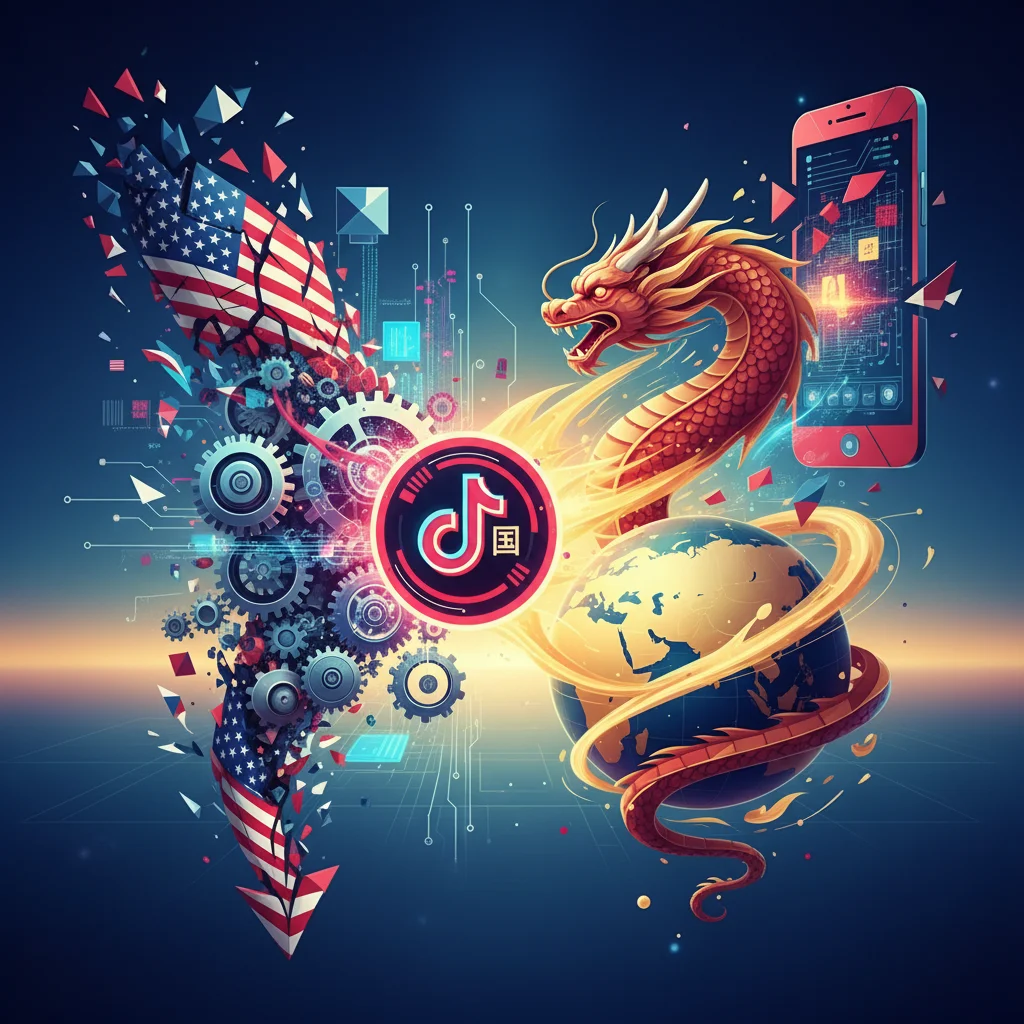
The TikTok Paradox: How a US Crackdown Became a Strategic Gift to China
In the high-stakes theater of international politics and global commerce, few stories have been as captivating as the 2020 showdown between the Trump administration and TikTok. Billed as a decisive move to protect American national security, the effort to force a sale of the wildly popular social media app was meant to be a powerful blow against China’s growing technological influence. Yet, a closer examination of the resulting deal reveals a startling and counterintuitive outcome: Washington’s compromise didn’t just fail to neutralize the threat; it inadvertently stabilized and strengthened one of Beijing’s most important global technology assets.
This episode serves as a critical case study for investors, policymakers, and business leaders on the complexities of the modern global economy. It highlights the immense difficulty of untangling deeply integrated digital supply chains and demonstrates how well-intentioned policy can backfire, producing the opposite of its intended effect. The saga of the “TikTok deal” is not just about a social media app; it’s a lesson in corporate strategy, geopolitical maneuvering, and the future of international finance.
The Anatomy of a Compromise
To understand why the deal was a strategic victory for ByteDance, TikTok’s parent company, we must first dissect the terms of the agreement that emerged from the political firestorm. The initial demand from the White House was unequivocal: ByteDance was to divest its US TikTok operations entirely to an American company. This was framed as the only way to sever the app’s ties to the Chinese government and protect the data of over 100 million American users.
However, what transpired was not a clean-cut sale but a complex restructuring. The proposal involved creating a new US-based entity, TikTok Global, with American companies Oracle and Walmart taking a combined 20% stake. Oracle was positioned to become TikTok’s secure cloud provider in the US, ostensibly to wall off American user data from China. On the surface, it looked like a win for American interests.
But the devil, as always, was in the details. A closer look at the ownership and control structure reveals a very different picture. The following table breaks down the proposed arrangement versus the administration’s original goal:
| Feature | Original US Demand (Forced Sale) | Proposed TikTok Global Deal |
|---|---|---|
| Majority Ownership | 100% American-owned | 80% retained by ByteDance (source) |
| Core Technology Control | Full control of source code and algorithms by US entity | Source code and algorithms remain with ByteDance in China |
| Data Security Solution | Data infrastructure fully migrated and controlled by US owner | US data hosted by Oracle, but core logic still tied to Chinese-owned code |
| Outcome for ByteDance | Forced exit from the US market; loss of a key asset | Existential threat removed; global operations stabilized |
This structure effectively allowed ByteDance to retain control over its most valuable asset: the powerful recommendation algorithm that drives TikTok’s addictive user experience. While Oracle would oversee the data infrastructure, the intellectual property—the “secret sauce” of the platform—would remain firmly in Chinese hands. This distinction is critical. In the world of financial technology and AI, the underlying code and algorithms are where the true value and control reside.
The Price of Power: How a Trump Megadonor's Firm Scored the First Venezuelan Oil Deal
The Illusion of Control: Why the Deal Favored Beijing
The core failure of the deal was its inability to address the fundamental national security concern: the link between ByteDance and the Chinese Communist Party. By allowing ByteDance to keep majority ownership and, crucially, control of the source code, the deal created an illusion of security while preserving the status quo in all the ways that mattered.
1. The Algorithm is Everything
TikTok’s success is not just its user base; it’s the unparalleled effectiveness of its AI-powered content recommendation engine. This algorithm is a product of immense investment and data analysis. Transferring ownership of the US operations without also transferring ownership and control of this core technology is like buying a high-performance race car but leaving the engine with the original owner. The compromise meant that updates, improvements, and the fundamental logic of the app would still originate from ByteDance’s engineers, subject to Chinese laws and influence. For investors evaluating tech companies, understanding where the core intellectual property resides is a fundamental part of due diligence in investing.
2. A Corporate Lifeline
Prior to the deal, ByteDance faced an existential crisis. The threat of being banned from its most lucrative market sent shockwaves through the company and the broader Chinese tech sector. This uncertainty put a halt to its planned IPO, which was anticipated to be one of the largest in history. The Oracle-Walmart deal, however flawed from a US security perspective, was a massive gift to ByteDance. It removed the immediate threat, stabilized the company’s future, and paved the way for it to continue its global growth trajectory. As one analyst noted, the compromise “has stabilised one of Beijing’s most important technology companies” by resolving its most pressing political problem.
The Fallout for the Stock Market and Global Investing
The ripple effects of the TikTok drama extended far beyond the realms of technology and politics, directly impacting the stock market and reshaping the landscape for global investors. The proposed deal, and the uncertainty surrounding it, offered a real-time lesson in geopolitical risk.
Oracle and Walmart saw their stock prices react to the news, as investors tried to price in the potential benefits of associating with TikTok’s massive user base. However, the saga also injected a new layer of volatility into the market. It became clear that a single executive order could threaten a multi-billion dollar enterprise overnight. This has profound implications for anyone involved in international trading and investment.
For investors in Chinese tech, the episode was a double-edged sword. On one hand, ByteDance’s survival demonstrated that even under extreme pressure, Chinese tech giants could navigate US political threats. On the other, it underscored the immense regulatory risk these companies face when operating abroad. The chilling effect on Chinese companies seeking to list on US exchanges was palpable, contributing to a broader trend of financial decoupling and complicating the flow of capital between the world’s two largest economies. The traditional models of global banking and finance are being tested as they must now account for sudden, politically motivated market interventions.
Solving for Alpha: The Hidden Financial Lessons in Your Daily Crossword
A Lesson in the Geopolitical Chess Game
Ultimately, the TikTok deal was less of a resolution and more of a temporary truce in the ongoing US-China tech war. Washington secured a cosmetic victory, allowing it to claim it had “done something” about TikTok. Meanwhile, Beijing, by initially opposing a full sale and approving the watered-down compromise, successfully protected the core assets of its national tech champion. It played a strategic long game, sacrificing a small equity stake to preserve its most valuable technological prize.
This incident revealed the asymmetry in the conflict. While the US focused on corporate ownership, China focused on protecting its intellectual property. Beijing’s export control laws, which were updated to cover recommendation algorithms, were a clear signal that it considered this technology a strategic national asset (source). It was a masterful stroke of geopolitical hardball, leveraging domestic law to influence an international business deal.
The entire affair demonstrates a critical evolution in modern economics: the battlefield has shifted from trade tariffs on physical goods to control over data, algorithms, and the digital infrastructure that underpins the global economy. For businesses and investors, this means that geopolitical risk analysis is no longer a niche concern but a central component of any sound financial strategy.
Political Chess: How Delayed Elections Could Impact the UK Economy and Your Investments
Conclusion: A Strategic Misstep with Lasting Consequences
The attempt to force TikTok’s sale was a landmark moment in US-China relations, but not in the way its architects intended. Instead of a decisive blow for American interests, the resulting compromise proved to be a strategic gift to Beijing. It allowed ByteDance to escape an existential threat, retain control of its core technology, and continue its march toward global tech dominance, all while providing a veneer of American oversight.
The lessons are clear and far-reaching. For policymakers, it shows that addressing the national security challenges posed by foreign technology requires more than blunt instruments like forced sales; it demands a sophisticated approach that understands the nature of algorithmic power. For business leaders and investors, it is a stark reminder that the intersection of technology, finance, and geopolitics is now the most critical and volatile arena in the global market. The TikTok paradox—where an act of aggression inadvertently strengthens the target—will be studied for years as a defining moment in the new cold war of technology.

Related Posts
TikTok’s Great Wall: Inside the Deal That Split a Tech Giant and Redefined US-China Investing

Weaponizing Wall Street’s Safest Asset: A Radical Plan to Fund Ukraine with US Debt