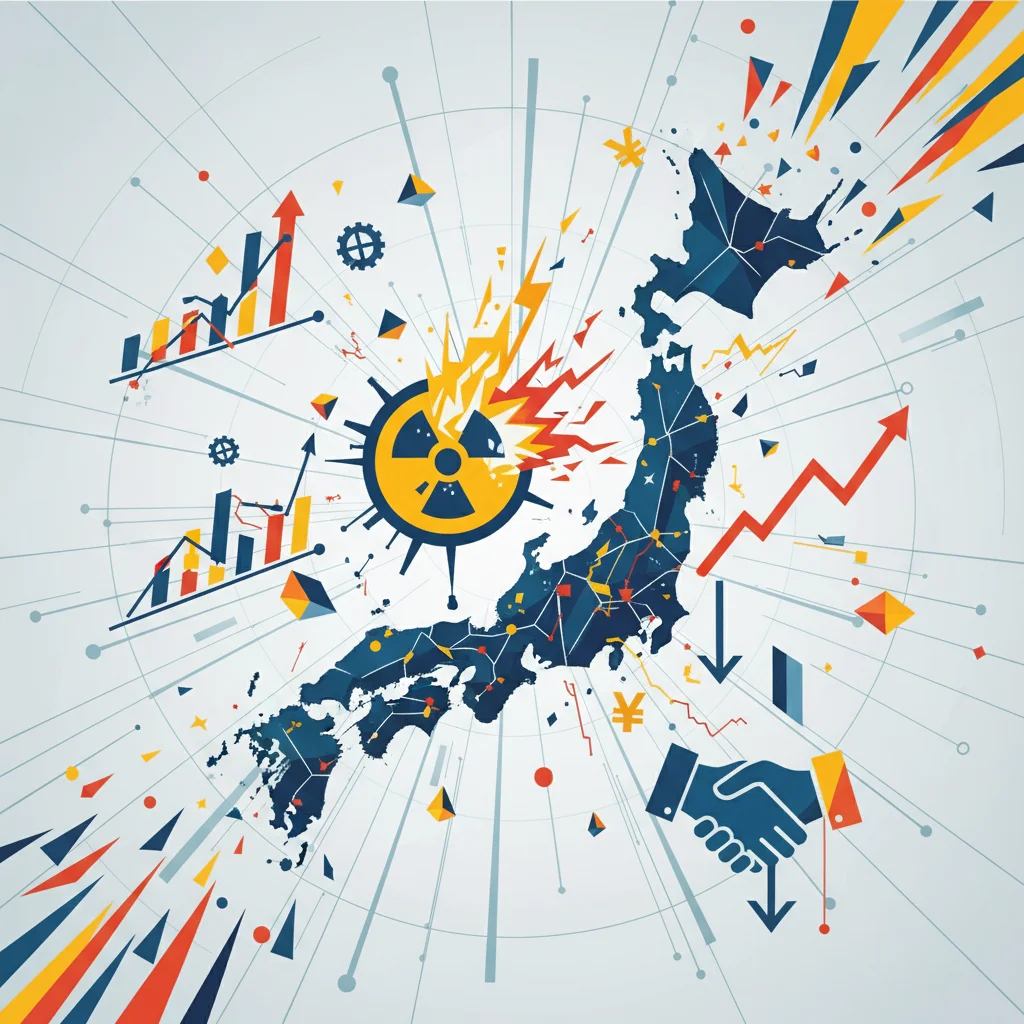
Cracks in Confidence: How a Nuclear Scandal Shakes Japan’s Economy and Investor Trust
In the high-stakes world of finance and investing, trust is the ultimate currency. It’s the invisible asset that underpins stock market valuations, secures banking relationships, and drives economic growth. When that trust is broken, the fallout can be catastrophic, extending far beyond a single company’s balance sheet. A recent scandal in Japan serves as a stark reminder of this principle, where a deliberate act of data manipulation at a nuclear power plant has sent shockwaves through the nation’s energy sector, corporate boardrooms, and the global investment community.
More than a decade after the devastating Fukushima Daiichi nuclear disaster, Japan has been cautiously navigating a return to nuclear power. The policy, championed by Prime Minister Fumio Kishida’s government, is not just about energy—it’s a cornerstone of the nation’s economic strategy. Restarting reactors is seen as crucial for ensuring energy security, reducing reliance on costly fossil fuel imports, and meeting ambitious climate targets. However, this entire “nuclear renaissance” now hangs in the balance, threatened not by a natural disaster, but by a self-inflicted wound to corporate integrity.
The Epicenter of the Scandal: Data, Deception, and a Damaged Reactor
The controversy centers on Hokuriku Electric Power and its Shika nuclear plant, located on the Noto peninsula, which was struck by a powerful earthquake on New Year’s Day. In the aftermath, the company’s public statements were meant to be reassuring. Yet, what unfolded was a textbook case of corporate malfeasance that has profoundly damaged public and investor confidence.
The company has since admitted to manipulating crucial seismic data. Internal documents were altered to downplay the severity of the ground tremors experienced at the plant. Specifically, data points showing ground motion exceeding the reactor’s design tolerance were deliberately omitted or altered. The goal was simple and cynical: to make the earthquake’s impact appear less severe than it was, thereby fast-tracking the plant’s safety review process for a potential restart.
To understand the gravity of this, consider the following comparison of the initially presented data versus the later-revealed reality.
| Metric | Company’s Initial (Altered) Report | Actual Data (Revealed Later) |
|---|---|---|
| Seismic Ground Motion | Presented as within the reactor’s design tolerance | Exceeded the plant’s quake-resistance design standards in some locations |
| Internal Review Process | Data was “simplified” and “re-evaluated” to downplay severity | Original, unaltered data showed a more significant seismic event |
| Implication for Safety | The plant’s structural integrity was not fundamentally challenged | The earthquake’s force potentially compromised key safety infrastructure |
This wasn’t a simple rounding error; it was a calculated deception. As one expert noted, “They were changing the data to fit their story (source).” For a nation still haunted by the memory of Fukushima, where a tsunami overwhelmed a nuclear plant’s defenses, such a breach of safety protocol and public trust is unforgivable. It strikes at the very heart of the social license required to operate nuclear facilities.
Solving the Financial Grid: What the FT Crossword Teaches Us About Modern Investing
The Economic Fallout: A Chain Reaction of Risk
The implications of this scandal extend deep into the realms of economics and finance. Japan’s economic stability is intrinsically linked to its energy policy. As the world’s fourth-largest economy and a major energy importer, volatility in global energy prices directly impacts its trade balance, inflation, and corporate profitability.
1. The Stalling of the Nuclear Restart Program
The primary economic risk is the potential derailment of the national nuclear restart program. Each reactor that remains offline represents a continued reliance on liquefied natural gas (LNG) and coal, commodities with volatile prices and significant carbon footprints. A delay or halt to the restarts would mean:
- Higher Energy Costs: Japanese businesses and consumers would continue to face elevated energy bills, squeezing corporate margins and household disposable income.
- Trade Deficit Pressure: A larger bill for imported fossil fuels would put downward pressure on the yen and widen the trade deficit, a key metric for the health of the national economy.
- Climate Goal Jeopardy: Japan’s commitments under the Paris Agreement become significantly harder to achieve without a substantial nuclear energy component in its power mix.
2. Investor Confidence and Stock Market Jitters
For those involved in trading and investing, this event is a flashing red light. The immediate impact was on Hokuriku Electric’s stock, but the contagion is a real concern.
- Sector-Wide Devaluation: Investors will now apply a higher risk premium to all Japanese utility companies, questioning the integrity of their safety and operational reporting. This could lead to a broad sell-off in the sector.
- The ESG Failure: This is a classic governance failure. ESG (Environmental, Social, and Governance) investing frameworks are designed to penalize companies with such poor oversight. Global funds with strict ESG mandates may be forced to divest from Hokuriku and re-evaluate their entire Japanese portfolio.
- Foreign Investment Hesitation: The recent boom in the Japanese stock market has been fueled by renewed interest from foreign investors, encouraged by governance reforms. This scandal undermines that narrative and could cause a flight of “hot money,” which is sensitive to such risks.
Modern financial technology (fintech) platforms and AI-driven analytics are increasingly used by investors to scan for such governance risks by analyzing news sentiment, regulatory filings, and corporate communications. However, this case reveals the limitations of technology when faced with deliberate, internal deception, highlighting the irreplaceable value of rigorous, old-fashioned due diligence.
The £69 Billion Challenge: How Reforming UK Disability Benefits Could Unlock Economic Growth
A Crisis of Governance in a Reforming Nation
This incident does not exist in a vacuum. It is the latest in a series of corporate scandals that have plagued Japan for decades, from the Olympus accounting fraud to the Kobe Steel data falsification. These events have created a perception of a corporate culture that sometimes prioritizes saving face over transparently addressing failures.
The timing is particularly damaging. The Tokyo Stock Exchange and the Japanese government have been on a crusade to improve corporate governance, urging companies to improve shareholder returns, increase board independence, and enhance transparency. These reforms have been a key pillar of the investment thesis for Japan. The Hokuriku scandal directly challenges the credibility of this reform movement. It suggests that while the rules may be changing on paper, the underlying culture at some firms remains resistant to true transparency and accountability.
The government’s response will be critical. A lenient approach would signal that the reforms are superficial. Conversely, a strong, decisive regulatory crackdown could serve as a powerful deterrent and, paradoxically, reinforce the long-term investment case by proving that the new governance standards have teeth. For the banking and finance sectors that fund these large infrastructure projects, regulatory clarity and enforcement are paramount to managing their own risk exposure.
Conclusion: The High Price of Broken Trust
The story of Hokuriku Electric’s data manipulation is a powerful lesson in economics and investing. It demonstrates that a company’s most valuable asset isn’t on its balance sheet; it’s the trust it holds with the public, regulators, and the financial markets. By falsifying safety data, the company didn’t just compromise a power plant; it compromised the integrity of Japan’s energy strategy, the credibility of its corporate governance reforms, and the confidence of global investors.
As the investigation unfolds, the financial and economic consequences will become clearer. For business leaders and finance professionals, this serves as a potent case study on the tangible stock market impact of intangible factors like ethics and governance. The path forward for Japan is fraught with challenges. It must now work doubly hard to rebuild trust, not only in its nuclear program but in the fundamental promise of a more transparent and accountable corporate Japan. The world of finance is watching, and its verdict will be rendered in the cold, hard language of capital flows.
Heathrow's £33 Billion Gambit: A High-Stakes Bet on the UK's Economic Future

Related Posts

The Politicization of the Portfolio: How State Interference Puts US Companies and Investors at Risk

Beyond the Balance Sheet: Why Major Economic Decisions Can Never Escape Politics