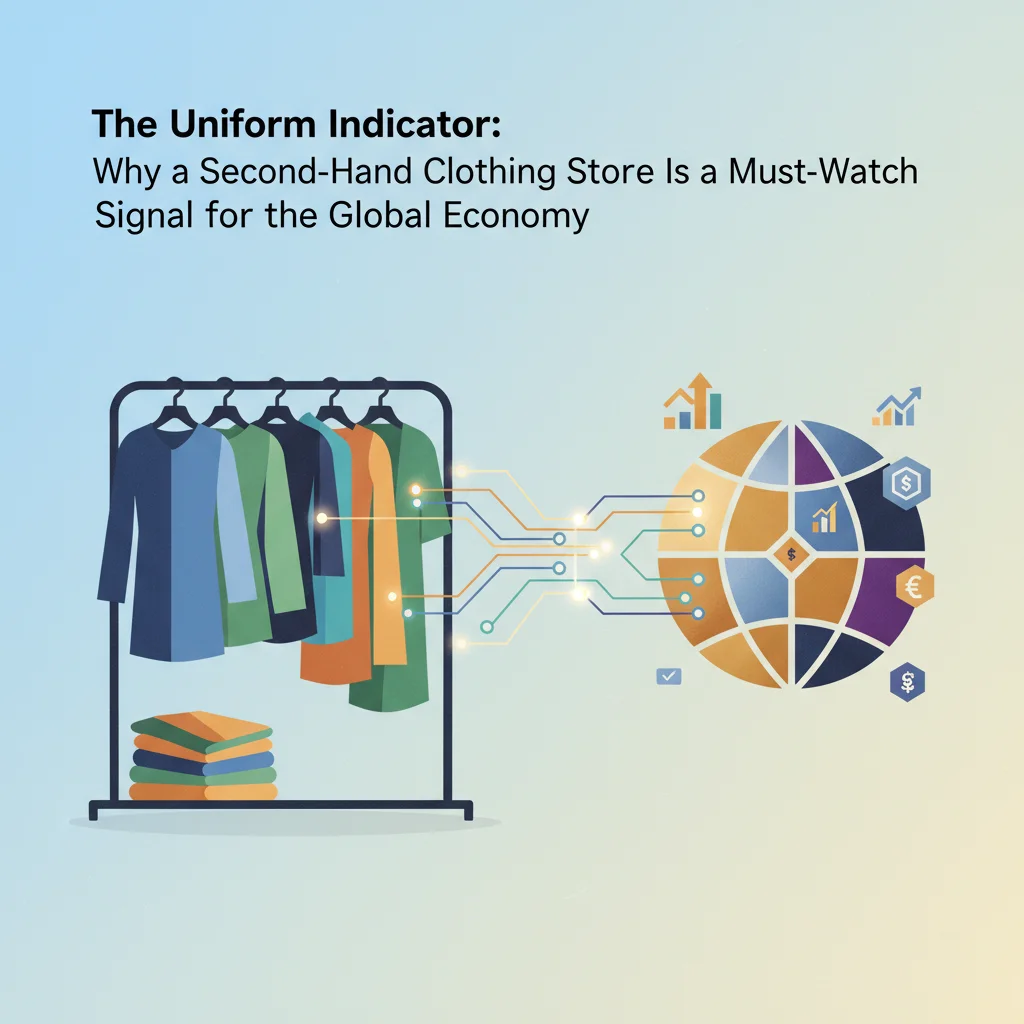
The Uniform Indicator: Why a Second-Hand Clothing Store Is a Must-Watch Signal for the Global Economy
In the quiet corners of the market, far from the frenetic energy of the trading floor, the most potent economic indicators often emerge. They don’t appear in analyst reports or flash across terminal screens. Instead, they manifest in the real-world choices of everyday people. A recent report about a council-run, second-hand school uniform store in the Queensgate Centre now supporting about 100 families a week is one such signal. While it may seem like a trivial local news item, for astute investors, finance professionals, and business leaders, it is a profound real-time data point on the state of our economy.
This surge in demand is not merely a story about community support; it is a clear reflection of mounting financial pressure on households. It’s a micro-narrative that speaks volumes about macro-economic realities, including persistent inflation, wage stagnation, and a fundamental shift in consumer behavior. Understanding the “why” behind this single data point can unlock critical insights into broader market trends, investment opportunities, and the future trajectory of key sectors within the global economy.
The Macro-Economic Pressure Cooker: From CPI to School Blazers
For months, central banks and financial institutions have been grappling with inflation. We discuss Consumer Price Index (CPI) fluctuations, producer price inflation, and monetary policy adjustments in abstract terms. However, the story of this uniform store is where these high-level economics concepts meet the pavement. The rising cost of essentials—food, energy, and housing—erodes disposable income, forcing families to make difficult choices. A new school uniform, once a standard back-to-school purchase, has become a luxury for an increasing number of people.
This phenomenon is a direct consequence of economic policies and market forces. When interest rates rise to combat inflation, the cost of borrowing for mortgages and loans increases, further squeezing household budgets. This is the core of modern banking and its impact on the populace. The decision to seek a second-hand blazer is not made in a vacuum; it is the final, tangible result of a long chain of economic events. For professionals in finance, tracking these “on-the-ground” indicators provides a qualitative richness that quantitative data alone cannot capture. It’s the human texture behind the numbers, signaling distress long before it appears in quarterly earnings reports or GDP figures.
Nvidia's Tightrope Act: Navigating the US-China Tech War for AI Supremacy
The Circular Economy: A Paradigm Shift from Necessity to Investment Thesis
The success of this uniform exchange is also a powerful testament to the rise of the circular economy. What begins as a cost-saving measure for families is part of a much larger, structural shift in consumption. The “re-commerce” market is no longer a niche segment but a burgeoning industry with significant implications for the retail sector and the stock market.
Companies specializing in second-hand goods, from clothing to electronics, are gaining market share. This trend is driven by two powerful forces: economic necessity and a growing consumer consciousness around sustainability. Investors are taking note, recognizing that businesses built on circular models offer resilience in a volatile economic climate. They tap into a consumer base that is both price-sensitive and environmentally aware.
Below is a breakdown of the ripple effect, illustrating how a single micro-event can signal broad market shifts.
| Micro-Indicator | Immediate Cause | Broader Economic Implication | Investment & Business Angle |
|---|---|---|---|
| Increased demand for second-hand uniforms | Reduced household disposable income due to inflation | Weakening consumer confidence and spending power in non-essential retail | Bullish for discount retail & re-commerce; bearish for mid-tier premium brands |
| Council-run store supports 100 families/week (source) | Inability of families to afford new goods | Indicates wage growth is not keeping pace with the true cost of living | Opportunity for fintech solutions focused on budgeting, micro-loans, and financial aid |
| Community reliance on shared resources | Search for value and sustainability | Growth of the circular economy and collaborative consumption models | Long-term investing thesis in sustainable brands and platforms enabling the second-hand market |
This shift challenges the traditional linear model of “produce, use, dispose.” For business leaders, ignoring this trend is perilous. Companies that integrate trade-in programs, repair services, or certified pre-owned offerings are better positioned to capture this evolving consumer demographic. The success of the humble uniform store is a clear signal that value, durability, and affordability are becoming the dominant drivers of purchasing decisions.
The Fintech Response: Technology as a Financial Lifeline
Where there is financial strain, there is an opportunity for innovation, particularly in financial technology. The challenges faced by the families visiting the Queensgate Centre store highlight critical gaps that fintech is uniquely positioned to address. Traditional banking services often fall short for those living on tight budgets, but new technologies can offer powerful tools for financial empowerment.
Consider the following fintech-driven solutions:
- Automated Budgeting and Savings Apps: Platforms that help families track expenses, identify savings opportunities, and automatically set aside small amounts for predictable large costs like school supplies.
- “Buy Now, Pay Later” (BNPL) for Essentials: While often associated with discretionary spending, responsible BNPL services could be adapted to help families manage the cost of essential, non-discretionary items without resorting to high-interest debt.
- Digital Community Marketplaces: Technology platforms that expand the concept of the local uniform store to a regional or national level, using AI to match supply and demand for second-hand goods efficiently.
- Blockchain for Charitable Transparency: For the more forward-thinking organizations, blockchain technology could offer a solution for tracking donations and ensuring that resources reach their intended recipients with complete transparency, thereby boosting donor confidence and participation. While still nascent, its potential for revolutionizing supply chain and aid distribution is a topic of growing interest in both tech and finance circles.
The evolution of fintech is not just about optimizing trading algorithms or developing new payment rails for corporations; it is fundamentally about democratizing access to financial tools. The economic pressures that drive a family to a second-hand store are the very same pressures that create a demand for more accessible, intelligent, and empathetic financial technology.
Ethereum's Holding Pattern: Decoding the Sideways Squeeze and What Investors Should Watch Next
Implications for Investors and Business Leaders
So, what are the actionable takeaways for those navigating the complex worlds of finance and business? The “Uniform Indicator” points toward several key strategic considerations:
- Re-evaluate the Consumer Discretionary Sector: Companies selling non-essential, full-priced goods are facing significant headwinds. Investors should look for signs of weakening demand, rising inventory, and increased promotional activity. A successful trading strategy might involve identifying the most vulnerable players in this space.
- Identify Leaders in the Value and Re-commerce Space: The shift towards second-hand and value-oriented retail is not a temporary blip. It’s a long-term trend. Businesses that are central to this ecosystem—from discount retailers to online re-commerce platforms—are well-positioned for growth. As one report on the council-run store highlights, this is a needs-based service, making it resilient (source).
- Invest in Enabling Technologies: The growth of the circular economy and the need for better financial management tools will be powered by technology. This creates opportunities in logistics software, payment platforms, and, of course, consumer-facing fintech.
- Embrace ESG as a Core Strategy: The convergence of economic pressure and environmental awareness means that Environmental, Social, and Governance (ESG) factors are more important than ever. The social good provided by the uniform store is a clear example. Companies that demonstrate a genuine commitment to social and environmental responsibility will build stronger brand loyalty and prove more resilient in the long run.
Beyond Pura Vida: Unpacking the Investment Risk of an Assassination Plot in Costa Rica
In conclusion, the seemingly minor news of a busy second-hand uniform store offers a panoramic view of our current economic landscape. It is a powerful reminder that the most sophisticated financial analysis must be grounded in the reality of human experience. From the pressures of inflation and the intricacies of the global economy to the opportunities in the stock market and the innovative potential of financial technology, the entire narrative is encapsulated in the simple, practical choice a family makes when buying a school uniform. For those who know how to read them, these signs are invaluable, offering clarity and foresight in an uncertain world.