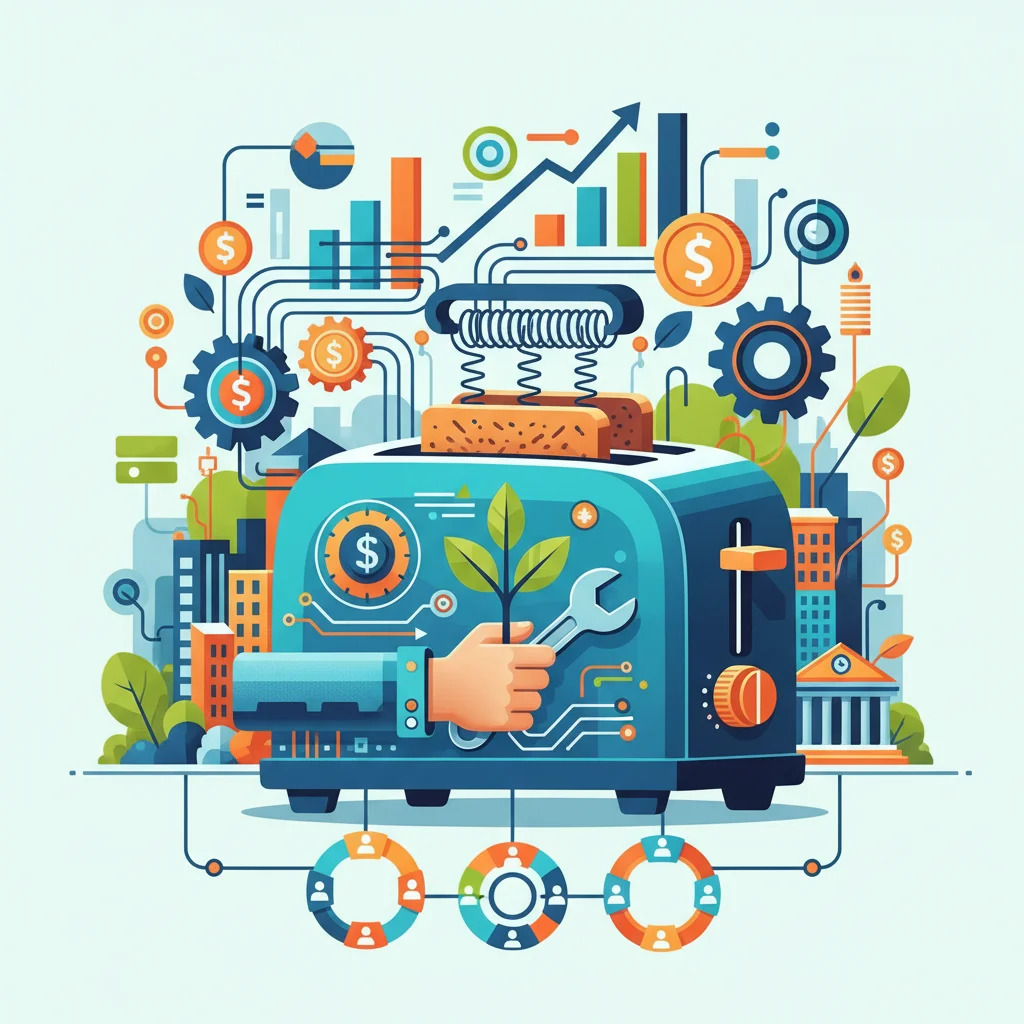
The Repair Cafe Economy: Why Your Broken Toaster Signals the Next Frontier in Finance and Investing
From Broken Appliances to a Blueprint for Economic Resilience
In a modest community hall, a quiet revolution is taking place. It doesn’t involve complex trading algorithms or high-stakes corporate mergers. Instead, it revolves around a broken kettle, a faulty lamp, and a toaster that has seen better days. This is the scene at the NEPHRA Repair Cafe, a local initiative dedicated to giving discarded items a second chance. On the surface, it’s a heartwarming story of community spirit and thrift, saving residents money and reducing landfill waste. But for the astute investor, finance professional, or business leader, it’s something far more significant: a powerful, tangible manifestation of the burgeoning circular economy.
This small-scale operation is a microcosm of a profound shift in global economics, challenging the very foundations of our century-old linear model of “take, make, dispose.” As we confront volatile supply chains, resource scarcity, and mounting environmental pressures, the principles demonstrated in this community hall are scaling up into a multi-trillion-dollar economic opportunity. Understanding this transition is no longer an intellectual exercise in sustainability; it is a critical component of modern financial analysis, risk management, and forward-thinking investment strategy. The future of the global economy won’t just be built in boardrooms and on trading floors; it’s also being soldered together, one repaired appliance at a time.
The Unsustainable Economics of a Throwaway World
For decades, the global economy has operated on a simple, yet profoundly wasteful, premise. We extract raw materials, manufacture products, sell them to consumers, and then, after a relatively short lifespan, they are discarded. This linear model fueled unprecedented growth in the 20th century, but its hidden liabilities are now coming due, creating systemic risks that reverberate through the stock market and national economies.
The economic consequences are stark. Dependence on virgin resources creates immense price volatility and geopolitical vulnerability. The 2021 Suez Canal blockage and subsequent supply chain disruptions were a stark reminder of how fragile this system is. Furthermore, the cost of waste management is a ballooning liability for municipalities and corporations alike. This model is not just environmentally untenable; it is becoming economically irrational.
The circular economy offers a direct counter-narrative. It is a regenerative system where resources are kept in use for as long as possible, extracting the maximum value from them whilst in use, then recovering and regenerating products and materials at the end of each service life. The Repair Cafe, which successfully mends items from vacuum cleaners to coffee machines (source), is the most basic, yet essential, loop in this system: maintenance and repair.
To better understand the fundamental differences, consider the following comparison of these two economic models:
| Feature | Linear Economy (“Take-Make-Dispose”) | Circular Economy (“Reduce-Reuse-Recycle-Repair”) |
|---|---|---|
| Resource Model | Extraction-based; finite resource depletion | Regenerative; focuses on stewardship of existing resources |
| Product Lifecycle | Designed for obsolescence; short-term use | Designed for durability, repairability, and disassembly |
| Business Driver | Volume of sales | Performance, services, and value retention |
| Economic Risk | High exposure to resource price volatility and supply chain disruption | Reduced input costs, new revenue streams, enhanced brand loyalty |
| Financial Goal | Maximize short-term profit through new production | Maximize long-term value creation and system resilience |
Titans in Transition: A Spanish Power Play, a Retail Reckoning, and AIG's High-Stakes Bet
Investing in Durability: The Circular Economy as a Modern Financial Thesis
The transition from a linear to a circular model is not just an operational challenge; it is one of the most compelling investment theses of our time. Environmental, Social, and Governance (ESG) investing has moved from a niche concern to a core pillar of portfolio management, and circularity is a critical, measurable component of the “E” in ESG. Investors are increasingly recognizing that companies built on circular principles are better insulated from risk and positioned for long-term growth.
Leading companies on the stock market are already proving the financial viability of this approach. Outdoor apparel brand Patagonia built a billion-dollar empire while championing product repair through its “Worn Wear” program. Tech giants like Dell and Apple have invested heavily in closed-loop recycling, recovering valuable materials from old devices to build new ones, thereby reducing their reliance on volatile commodity markets. These aren’t acts of corporate charity; they are sophisticated business strategies that enhance supply chain security, reduce production costs, and build immense brand loyalty with a new generation of conscious consumers.
For finance professionals, evaluating a company’s “circularity” is becoming a new frontier of analysis. It requires looking beyond traditional balance sheets to assess factors like:
- Percentage of recycled or renewable materials used in production.
- Product-as-a-service (PaaS) revenue models (e.g., leasing equipment instead of selling it).
- Investment in reverse logistics and take-back programs.
- Modularity and repairability of product design.
These metrics are leading indicators of a company’s resilience and innovative capacity in a resource-constrained world.
Fintech and Blockchain: The Digital Rails of a Regenerative Economy
The vision of a global circular economy cannot be realized with analog tools. It requires a sophisticated digital infrastructure to track, manage, and monetize assets throughout their extended lifecycle. This is where financial technology (fintech) and blockchain are emerging as critical enablers, transforming abstract economic theory into a functional, transparent market.
Imagine a future where every product has a digital “passport” stored on a blockchain. This immutable ledger would record its material composition, manufacturing date, every repair conducted (perhaps at a future, digitally-connected version of the NEPHRA cafe (source)), and changes in ownership. This creates unprecedented transparency. Suddenly, a second-hand market for products and components can operate with the same level of trust as a market for new goods. This isn’t just a concept; it’s the future of asset management and trading.
Financial technology platforms are essential for facilitating the micro-transactions that will power this economy. Think of fintech apps that seamlessly connect consumers with certified local repair technicians, handle warranties, and process payments. Or consider new banking products, like “green bonds” or specialized loans, designed specifically to finance a company’s transition to a circular business model. This fusion of financial technology and sustainable principles creates a powerful engine for change.
The Silent War on the Dollar: Why Legal Attacks on the Fed Threaten Global Financial Stability
Here’s how emerging technologies are set to revolutionize the circular economy:
| Technology | Application in the Circular Economy | Impact on Finance & Investing |
|---|---|---|
| Blockchain | Creates transparent, immutable “product passports” for tracking materials and repairs. | Enables trusted secondary markets, validates ESG claims, and creates new asset classes for trading. |
| Fintech Platforms | Facilitate peer-to-peer repair services, product-as-a-service subscriptions, and micro-payments. | Opens new revenue streams, improves financial inclusion for small repair businesses, and provides data for credit scoring. |
| AI & Machine Learning | Predicts component failure, optimizes reverse logistics, and automates sorting of recycled materials. | Increases operational efficiency, reduces risk for investors, and provides data for algorithmic trading based on sustainability metrics. |
| Internet of Things (IoT) | Sensors on products provide real-time data on performance, usage, and maintenance needs. | Supports preventative maintenance models, enhances asset value, and informs insurance and financing models. |
From Community Hall to Boardroom: Actionable Insights for a Circular Future
The success of the NEPHRA Repair Cafe, which relies on volunteer repairers and serves dozens of people monthly (source), provides a powerful lesson: there is immense latent demand for longevity and value preservation. The challenge for business leaders and investors is to scale this principle from the local to the global.
For Business Leaders: The journey towards circularity begins with a mindset shift from selling units to delivering value. Start by asking critical questions: How can we design our products to be easily repaired or upgraded? Can we shift to a subscription or leasing model? How can we create a take-back program that is not a cost center, but a valuable source of materials? The companies that answer these questions first will build the most resilient and beloved brands of the 21st century.
For Investors and Finance Professionals: Integrating circularity into your analysis is now a necessity for robust risk management. Look for companies that are actively decoupling their revenue growth from virgin resource consumption. Analyze their R&D spending on sustainable materials and circular design. A company that boasts about its recycling rates is good; a company that can demonstrate a declining reliance on raw material inputs while growing its bottom line is a long-term winner.
Beyond Charity: The High-Yield Economics of a Warm Home
The small act of repairing a household appliance is a vote against a fragile, wasteful economic system. When scaled by technology, championed by innovative companies, and funded by forward-thinking capital, it becomes the blueprint for a more stable, efficient, and profitable global economy. The insights aren’t just in complex financial models; they’re in the gratitude of someone whose vacuum cleaner has been given a new lease on life (source), multiplied by millions. This is the new economics of permanence, and it’s a trend that no serious financial professional can afford to ignore.

Related Posts
The Great Rupture: Mark Carney’s Blueprint for Navigating a Fractured Global Economy
Beyond the Balance Sheet: Why a Community Warm Space is a Critical Indicator for the Modern Investor
