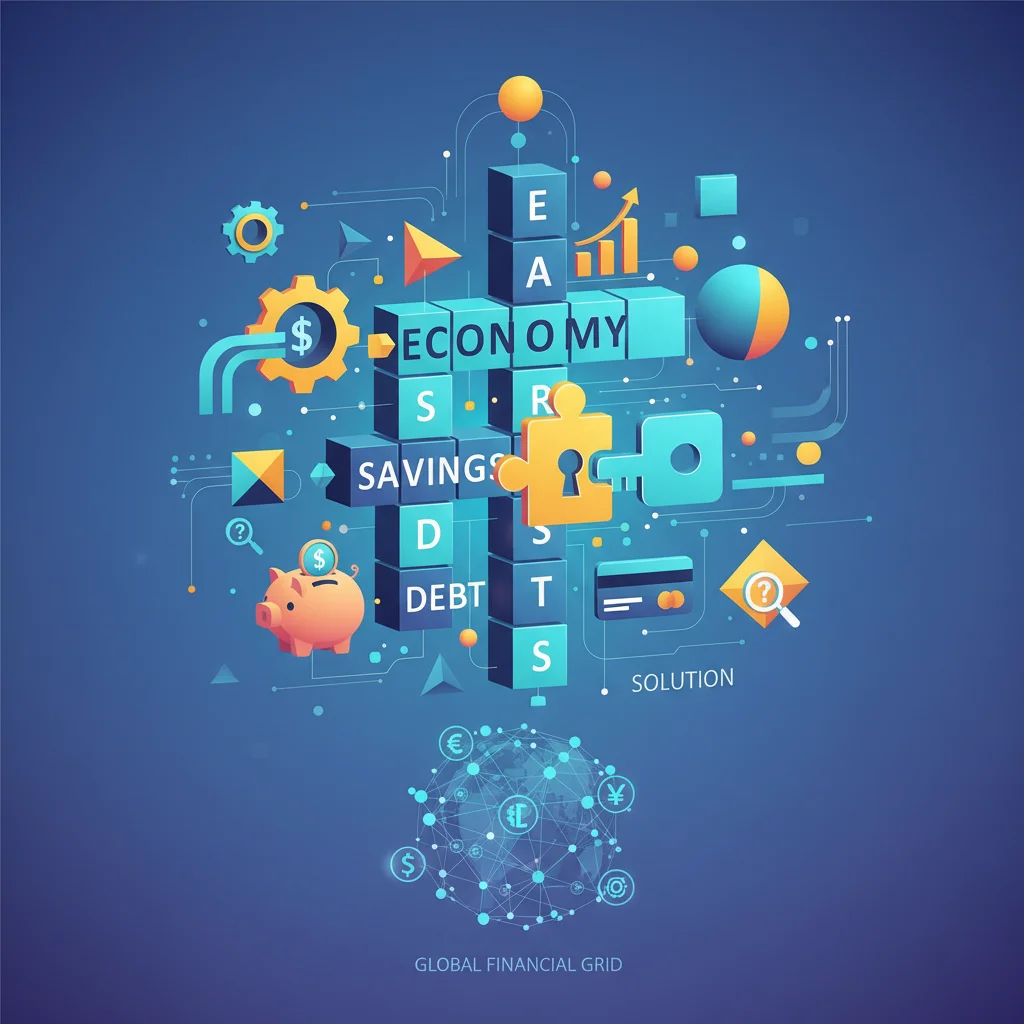
Solving the Financial Puzzle: A Crossword-Clue Guide to the Modern Economy
The Ultimate Challenge: Decoding the Global Financial Grid
Every morning, millions of enthusiasts turn to a familiar grid of black and white squares, a challenge of wit and vocabulary: the crossword puzzle. The latest puzzle from the Financial Times is a testament to this enduring ritual. Each clue is a self-contained mystery, yet the true magic lies in the intersection. Answering 14-Across might just give you the crucial letter you need to solve 5-Down. It’s a game of logic, pattern recognition, and seeing the bigger picture.
The world of finance and investing operates on a remarkably similar principle. It’s a vast, interconnected grid of concepts, trends, and forces. Understanding the stock market requires more than just knowing what a P/E ratio is; it demands an appreciation for the macroeconomic “across” clues that influence entire sectors, and the specific industry “down” clues that define individual company performance. For investors, finance professionals, and business leaders, treating the economy like a puzzle to be solved isn’t just an analogy—it’s a strategic mindset.
In this guide, we’ll deconstruct the modern financial puzzle. We’ll examine the major clues—from sweeping economic policies to disruptive financial technology—and explore how they interlock to shape our world. By the end, you’ll have a clearer framework for making sense of the market’s complexities and filling in your own financial grid with greater confidence.
The “Across” Clues: Grand Forces Shaping the Entire Board
In a crossword, the “across” answers often form the foundational structure of the puzzle. They are the long, anchoring words that everything else connects to. In finance, these are the macroeconomic forces—the sweeping trends and policies that dictate the rules of the game for everyone.
Clue: Central bank’s primary lever (8, 6) – MONETARY POLICY
Monetary policy is arguably the most significant “across” clue on the board. Set by central banks like the U.S. Federal Reserve or the European Central Bank, it involves managing the supply of money and credit to control inflation and stabilize the economy. The primary tools are interest rates. When rates are low, borrowing is cheap, encouraging spending and investing, which can fuel economic growth. When rates are high, borrowing becomes expensive, slowing the economy to combat inflation.
For investors, every word from a central bank governor is scrutinized. A hint of a rate hike can send bond yields soaring and growth-oriented tech stocks tumbling. According to the Federal Open Market Committee (FOMC), their decisions are data-dependent, meaning they react to indicators like employment figures and inflation reports. This makes understanding these economic reports crucial for anticipating the next move in the global game of banking and finance.
The Plushie Portfolio: How a UK Toy Brand Became an Unlikely Economic Indicator in China
Clue: Global events that shake the market (11, 4) – GEOPOLITICAL RISK
No market exists in a vacuum. A conflict in the Middle East can spike oil prices, a trade dispute between major economies can disrupt supply chains, and a national election can rewrite regulatory frameworks overnight. This is geopolitical risk—the impact of politics and international relations on financial markets. It’s an unpredictable and powerful force that can override even the most carefully crafted economic forecasts. This risk factor has become increasingly prominent, impacting everything from energy prices to the availability of key manufacturing components like semiconductors.
Clue: The natural ebb and flow of growth (8, 6) – ECONOMIC CYCLES
Economies breathe. They expand, they peak, they contract, and they find a trough before starting all over again. This is the economic cycle. Understanding where we are in this cycle is fundamental to strategic investing. During an expansion, companies report strong earnings, unemployment is low, and the stock market tends to perform well. In a contraction (or recession), the opposite is true. Different asset classes perform differently in each phase. For example, consumer staples and healthcare stocks are often considered “defensive” because people need their products regardless of the economic climate, making them more resilient during a downturn.
The “Down” Clues: Vertical Disruptors Changing the Game
If macro forces are the “across” clues, then technological and industry-specific trends are the “down” clues. They represent deep, vertical shifts that intersect with and are influenced by the broader economic environment. These are often where the most dramatic innovation and growth in financial technology occur.
Clue: Digital revolution in banking and payments (7, 10) – FINTECH DISRUPTION
For decades, traditional banking was a static, brick-and-mortar industry. The rise of fintech has completely rewritten the rules. From mobile payment apps and peer-to-peer lending platforms to robo-advisors that provide automated investment management, technology is making financial services more accessible, efficient, and user-centric. This disruption is a major “down” clue that intersects directly with consumer behavior and regulatory policy. The global fintech market is projected to grow significantly, with a compound annual growth rate (CAGR) of around 16.8% from 2024 to 2030, according to a report by Grand View Research.
The Venezuelan Paradox: Why U.S. Sanctions Unexpectedly Pushed Oil Prices Down
Clue: A decentralized digital ledger (10) – BLOCKCHAIN
Initially synonymous with cryptocurrencies like Bitcoin, blockchain technology is a far more profound concept. It’s a secure, transparent, and decentralized way to record transactions. Its potential applications in finance are immense: faster and cheaper cross-border payments, tokenization of real-world assets like real estate, and decentralized finance (DeFi) platforms that aim to recreate the entire financial system without intermediaries. While still in its early stages and facing regulatory hurdles, blockchain represents a fundamental architectural shift that could redefine trust and ownership in the digital economy.
Clue: The rise of the machines in markets (11, 7) – ALGORITHMIC TRADING
A significant portion of daily trading on the stock market is no longer executed by humans. It’s handled by complex algorithms executing trades in fractions of a second. High-Frequency Trading (HFT) uses powerful computers to analyze market data and execute a large number of orders at extremely high speeds. This has fundamentally changed market dynamics, increasing liquidity but also raising concerns about volatility and fairness. For the average investor, it’s a reminder that the “market” is no longer just a collection of human decisions, but a complex interplay between human psychology and machine logic.
Solving the Puzzle: A Framework for Your Financial Strategy
So, how do you put all these pieces together to fill in your own financial grid? It’s not about having all the answers at once. It’s about having a sound strategy for finding them.
1. Diversification: Don’t Bet on a Single Clue
The golden rule of investing is the strategic equivalent of working on multiple sections of the puzzle at once. By diversifying across different asset classes (stocks, bonds, real estate), geographies, and industries, you reduce your reliance on any single part of the economy performing well. If the tech sector (a “down” clue) is struggling, perhaps the energy sector (influenced by a different set of “across” clues) is thriving.
2. Due Diligence: Checking Your Letters
In a crossword, you might pencil in an answer you’re unsure about. In investing, this is a recipe for disaster. Due diligence is the process of researching an investment thoroughly before committing capital. This means reading financial statements, understanding the business model, analyzing the competition, and assessing the leadership team. It’s the methodical, patient work of confirming your answers before you write them in pen.
3. Long-Term vs. Short-Term Approaches: Patience is a Virtue
It’s tempting to try and solve the puzzle quickly through rapid-fire trading. However, for most people, a long-term investment approach is more akin to the steady, satisfying process of completing a difficult puzzle over time. The table below compares these two dominant approaches to the market.
A comparison of long-term investing and short-term trading strategies highlights their fundamental differences:
| Aspect | Long-Term Investing | Short-Term Trading |
|---|---|---|
| Goal | Wealth accumulation through compounding and economic growth. | Profit from short-term price fluctuations and market volatility. |
| Time Horizon | Years to decades. | Days, weeks, or months. |
| Analysis Method | Fundamental analysis (company health, economics, industry trends). | Technical analysis (chart patterns, price movements, market sentiment). |
| Risk Profile | Lower (market risk is smoothed over time). | Higher (exposed to daily volatility and timing risk). |
| Time Commitment | Lower ongoing commitment after initial research. | High daily commitment, requires constant monitoring. |
Maduro on Trial: The High-Stakes Legal Battle Redefining Global Finance and Presidential Power
The Final Grid: A Lifelong Pursuit
The global financial grid is a puzzle that is never truly finished. New clues emerge every day—a novel technology, a shift in consumer behavior, a surprising economic report. The solutions of yesterday may not fit the grid of tomorrow. But that is what makes it so compelling.
By embracing a strategic mindset, understanding the interplay between the grand “across” forces and the disruptive “down” trends, and committing to a disciplined approach, you can navigate the complexities with greater clarity. The goal isn’t to find every answer overnight, but to become a better solver over time, patiently and intelligently filling in the squares to build a more secure financial future.