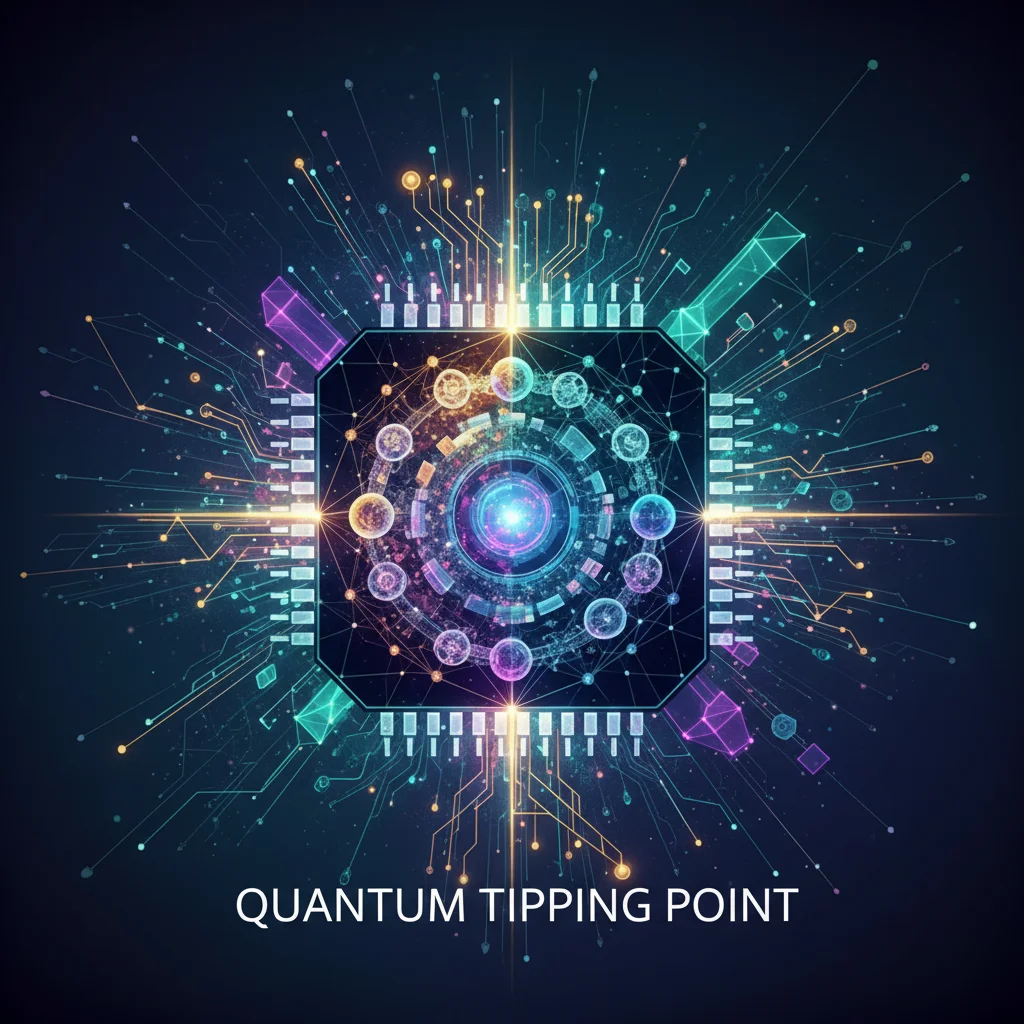
The Quantum Tipping Point: Are We Finally Entering the Era of Useful Quantum Computers?
For decades, quantum computing has felt like a technology perpetually “just around the corner.” It’s been the stuff of science fiction, academic papers, and breathless headlines promising to revolutionize everything from medicine to finance. But for many in the trenches—developers, entrepreneurs, and tech leaders—it has remained an abstract concept, a fascinating but distant dream.
The core promise is staggering: to solve problems that are computationally impossible for even the most powerful supercomputers today. Yet, this promise has been shadowed by immense skepticism and the looming threat of a “quantum winter”—a period where slow progress leads to dwindling funding and interest. The technical hurdles, from building stable quantum bits (qubits) to correcting the constant errors they produce, are monumental.
But what if the narrative is changing? What if, quietly and without a single “Sputnik moment,” we’ve crossed a crucial threshold? Recent breakthroughs suggest we are moving from the theoretical realm of “quantum supremacy” to the much more practical and exciting era of “quantum utility.” This is the point where these incredible machines start doing something genuinely *useful*—something that gives us an advantage over classical computers, right now. This isn’t about replacing your laptop; it’s about unlocking new frontiers in science and innovation. Let’s dive into the evidence and explore what this shift means for the future of technology.
From a Distant Dream to Tangible Reality
The conversation around quantum computing has historically been dominated by the concept of “quantum supremacy.” This term, coined by John Preskill in 2012, describes the moment a quantum computer performs a calculation that a classical computer practically cannot. Google claimed to have achieved this in 2019, but the demonstration involved a highly specific, abstract problem with no immediate real-world application. It was a monumental scientific achievement, but it didn’t silence the skeptics asking, “But what can you *do* with it?”
This is where the new paradigm of “quantum utility” comes in. The focus is no longer on a single, contrived benchmark. Instead, the goal is to find specific, high-value problems where today’s noisy, imperfect quantum computers can provide a genuine advantage. It’s a more pragmatic, results-oriented approach.
As Bob Sutor, a vice-president at quantum company Infleqtion, puts it, this moment feels similar to the early days of classical computing. “It’s like 1951, you’ve got the first couple of commercial computers, and people are starting to find useful things for them to do,” he told the Financial Times (source). It’s not about perfection; it’s about finding the first killer apps.
The Proof is in the Problems: Recent Breakthroughs
Talk is cheap, but results speak for themselves. In the past year, several teams have published groundbreaking results that move quantum utility from theory to practice.
Quantinuum: Cracking the Code of Molecules
In a landmark experiment, scientists at quantum company Quantinuum, collaborating with Harvard University, used a quantum computer to simulate the properties of a complex molecule. This wasn’t just any simulation; they achieved a level of chemical accuracy that is notoriously difficult for classical computers. Ilyas Khan, Quantinuum’s founder, boldly called it a moment of “indisputable quantum utility” in a recent paper.
Why does this matter? Understanding molecular behavior at this level is the holy grail for drug discovery and materials science. It could dramatically accelerate the development of new medicines, more efficient batteries, and novel industrial catalysts. This is a direct line from a quantum calculation to solving a multi-trillion dollar industry challenge.
IBM: Unraveling the Mysteries of Magnetism
Meanwhile, IBM took a different but equally challenging problem. Their team used a 127-qubit ‘Eagle’ processor to model the behavior of spins in a magnetic material. This type of problem is a classic example of something that becomes exponentially harder for traditional computers as the system size increases. IBM’s quantum computer, however, produced results that matched the predictions of theory, demonstrating its power in tackling complex physics problems (source). Such research is fundamental to developing new data storage technologies and advanced electronics.
To better understand the advantage quantum systems offer, let’s compare the classical and quantum approaches to these complex simulation problems.
| Problem Domain | Classical Computing Approach | Quantum Computing Advantage |
|---|---|---|
| Molecular Simulation (Drug Discovery) | Uses approximations and heuristics. Becomes inaccurate and exponentially slow for complex molecules. | Directly simulates quantum interactions. Can achieve “chemical accuracy” for problems intractable for classical machines. |
| Materials Science (Magnetism) | Relies on simplified models. Struggles to capture the full quantum state of many interacting particles. | Models the system’s quantum state natively. Can handle the massive complexity of interacting spins more efficiently. |
| Optimization Problems (Finance, Logistics) | Often finds “good enough” solutions, but may not find the true optimal one for highly complex scenarios. | Explores a vast solution space simultaneously. Has the potential to find truly optimal solutions for complex systems. |
Think of this moment as the equivalent of the early days of artificial intelligence research. The initial breakthroughs in neural networks happened decades before we got practical applications like ChatGPT. What happened in between? An entire ecosystem of software, hardware, and platforms had to be built. We’re at the beginning of that S-curve for quantum. The biggest opportunities for startups and entrepreneurs in the near term may not be in building the quantum computers themselves, but in creating the essential tools, algorithms, and middleware that will connect these powerful machines to the industries that need them. This is the “picks and shovels” phase of the quantum gold rush.
The Hybrid Future is Here: Quantum in the Cloud
So, how will developers and companies actually *use* these machines? You won’t be buying a quantum computer to sit in your server room anytime soon. The future is hybrid, and it lives on the cloud.
The most promising and practical approach involves a tight integration of classical and quantum hardware. In this model, a complex problem is broken down. The parts that classical computers are good at—data preparation, managing workflows, and interpreting results—are handled by traditional servers. The core, computationally impossible part of the problem is then sent as a job to a quantum processor via a cloud API.
This hybrid model makes quantum computing accessible. Major players like IBM, Google, Amazon (AWS), and Microsoft (Azure) are already offering cloud-based access to their quantum hardware. This allows developers, researchers, and startups to experiment with quantum programming and build algorithms without the multi-million dollar expense of building a quantum computer.
This is a game-changer. It lowers the barrier to entry and fosters a community of developers who can start building the quantum software of the future. This ecosystem is essential for discovering new applications and pushing the technology forward, creating a virtuous cycle of progress and innovation.
The EV Throne Has a New King: How BYD Dethroned Tesla and What It Means for Tech
What Quantum Utility Means for Key Industries
The dawn of quantum utility isn’t just an academic curiosity; it has profound implications across the tech landscape. As these machines become more powerful and accessible, their impact will ripple through various sectors.
Artificial Intelligence and Machine Learning
One of the most exciting frontiers is Quantum Machine Learning (QML). Many complex AI and machine learning tasks are fundamentally optimization problems—finding the best possible solution from a vast sea of options. Quantum computers, with their ability to explore many possibilities at once, are theoretically perfect for this. While still in its early days, QML could lead to breakthroughs in training more powerful AI models, discovering novel drug compounds, and solving logistical nightmares in supply chain management through advanced automation.
Cybersecurity
This is the double-edged sword of quantum computing. A sufficiently powerful quantum computer could theoretically break much of the encryption that protects our digital world today. This long-term threat is a massive driver of research in quantum-resistant cryptography. For cybersecurity professionals, the rise of quantum utility is a clear signal: the time to start planning for a post-quantum world is now. This involves understanding the risks and beginning the transition to new, quantum-safe encryption standards.
Finance and Beyond
The financial industry relies on complex modeling for risk analysis, portfolio optimization, and pricing derivatives. These are exactly the kinds of problems where quantum computers could offer a significant edge, providing more accurate simulations and finding optimal investment strategies that are invisible to classical algorithms.
The Journey is Just Beginning
We are not at the destination, but the journey has undeniably taken a significant turn. The shift from chasing the abstract goal of “supremacy” to demonstrating tangible “utility” is the most important development in quantum computing in a decade. The evidence is mounting that these machines are no longer just scientific curiosities. They are becoming powerful tools capable of tackling real-world problems beyond the reach of our best supercomputers.
For tech professionals, developers, and entrepreneurs, this is a call to attention. The era of quantum utility will not arrive with a single bang, but as a steadily growing wave of innovation. It will be driven by a hybrid cloud infrastructure, a new generation of quantum-aware software, and a deep collaboration between physicists, computer scientists, and industry experts.
The question is no longer *if* quantum computers will become useful. The question now is: Are you ready for when they do?
Yann LeCun's AI Heresy: Why a Godfather of AI is Betting Against the ChatGPT Hype