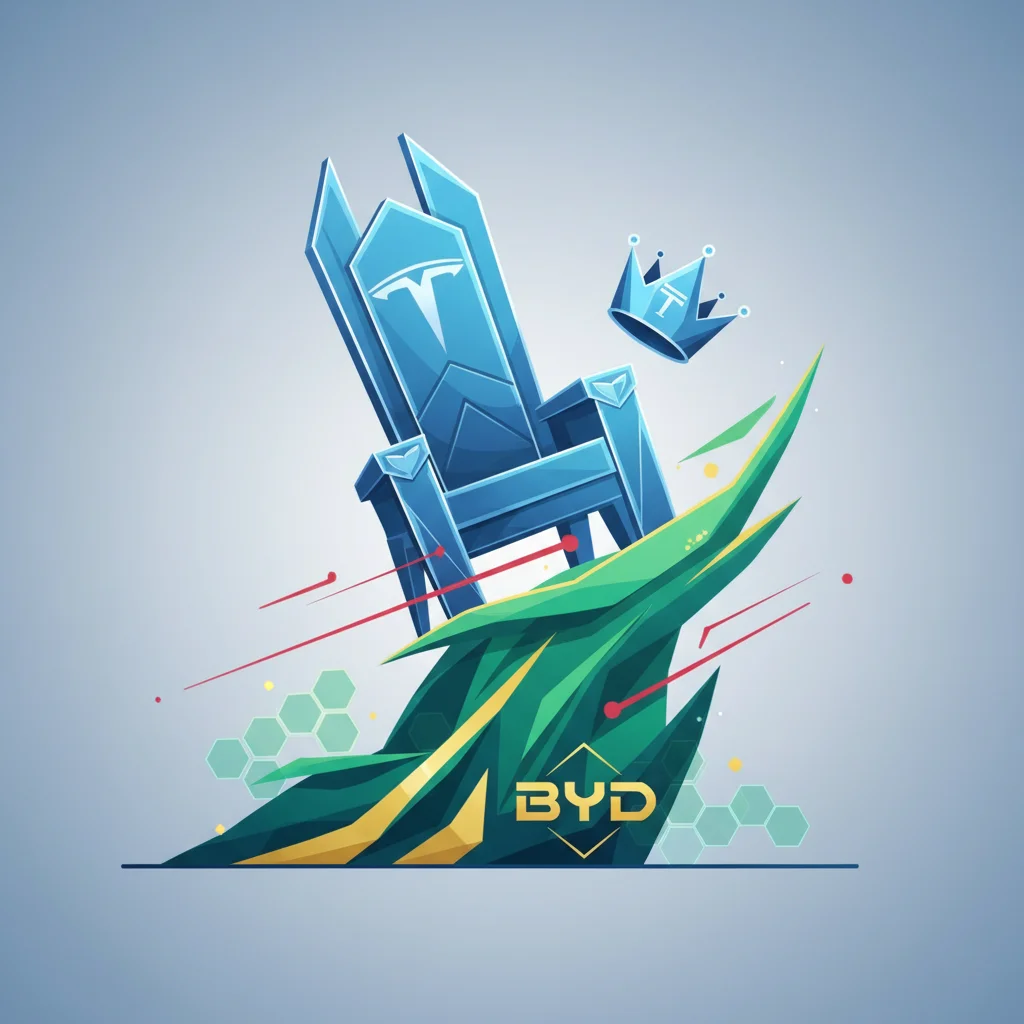
The EV Throne Has a New Contender: How BYD’s Master Plan is Dethroning Tesla
For years, the electric vehicle landscape has had one undisputed king: Tesla. Led by the ever-present Elon Musk, the American innovator didn’t just build an EV company; it built a global movement, forever changing our perception of what a car could be. But as the saying goes, the throne is a precarious seat. From the East, a challenger has emerged, not with a sudden coup, but with a relentless, strategic march. That challenger is China’s BYD, and it’s on the verge of officially overtaking Tesla as the world’s top seller of electric vehicles—a seismic shift that would mark the first time the Chinese firm has outpaced its American rival in annual sales.
This isn’t just a headline about car sales. It’s a gripping story of two clashing philosophies, a masterclass in global strategy, and a preview of the future of technology, manufacturing, and innovation. It’s a battle fought not just on the asphalt, but in the realms of software, artificial intelligence, and hyper-efficient automation. For developers, entrepreneurs, and tech professionals, understanding this shift is crucial, as it reveals the fault lines and opportunities in the next wave of technological disruption.
A Tale of Two Titans: The Numbers Behind the Power Shift
The raw numbers paint a stark picture of a rapidly changing market. While Tesla has long been the poster child for exponential growth, BYD’s acceleration is simply breathtaking. In the final quarter of 2023, BYD sold a record 526,409 fully electric vehicles, sailing past Tesla’s 484,507 deliveries for the same period. While Tesla still narrowly held the crown for the full year, the trend is undeniable.
Let’s break down the recent sales data to see just how close this race has become.
| Metric | BYD (Build Your Dreams) | Tesla |
|---|---|---|
| Q4 2023 EV Sales | 526,409 (source) | 484,507 (source) |
| Full Year 2023 EV Sales | 1.57 million | 1.81 million |
| Primary Strategy | Vertical integration, price diversity | Software-first, premium branding |
| Key Geographic Strength | China, emerging markets | North America, Europe |
While Tesla grew its deliveries by an impressive 38% in 2023, BYD’s growth has been on another level. This isn’t a story of Tesla failing; it’s a story of BYD executing a fundamentally different, and astoundingly effective, playbook.
The Contrasting Blueprints for Dominance
At the heart of this rivalry are two profoundly different corporate philosophies. Understanding them is key to understanding not just *what* is happening, but *why*.
Tesla: The Software and AI Powerhouse
Tesla’s approach has always been to position itself as a tech company that happens to make cars. Their vehicles are essentially sophisticated computers on wheels, powered by cutting-edge software and a centralized architecture. This strategy has several key pillars:
- A Software-as-a-Service (SaaS) Mindset: Tesla’s value proposition isn’t just the hardware you drive off the lot. It’s the continuous improvement via over-the-air (OTA) updates and the promise of future capabilities, most notably the Full Self-Driving (FSD) subscription. This transforms a one-time purchase into an ongoing revenue stream, a classic SaaS model.
- AI and Machine Learning at the Core: The pursuit of autonomous driving is Tesla’s north star. Every Tesla on the road acts as a data-gathering node, feeding petabytes of real-world driving data back to the company’s cloud infrastructure. This data is the lifeblood for training their artificial intelligence and machine learning models, creating a powerful feedback loop that competitors struggle to replicate.
- Manufacturing Innovation: Tesla’s focus on innovation isn’t limited to code. With inventions like the “Gigapress,” they’ve revolutionized car manufacturing through massive-scale automation, reducing the number of parts, welds, and production steps required to build a car’s frame.
Tesla’s strategy is a high-risk, high-reward bet on a future where the car’s intelligence and software capabilities are its primary differentiators. From Assembly Lines to Agile Sprints: Why Big Auto is Learning to Code Like a Startup
BYD: The Master of the Supply Chain
If Tesla is the visionary architect, BYD is the master builder. Backed by Warren Buffett’s Berkshire Hathaway, BYD started not as a car company, but as a battery manufacturer. This DNA is the secret to its success.
- Radical Vertical Integration: This is BYD’s superpower. The company doesn’t just assemble cars; it manufactures its own batteries (the innovative “Blade Battery”), electric motors, power electronics, and even the semiconductor chips that run them. This control over its supply chain gives it a massive cost advantage and insulates it from the geopolitical shocks and shortages that have plagued other automakers.
- A Car for Everyone: Unlike Tesla’s initial top-down approach, BYD offers a dizzying array of models at nearly every price point. From the sub-$15,000 Seagull hatchback that is dominating the Chinese market to the luxurious Yangwang U8 SUV that can float on water, BYD’s strategy is to capture the entire market, not just the premium segment.
- Pragmatic Technology: While Tesla chases the holy grail of full autonomy, BYD focuses on delivering reliable, affordable, and feature-rich vehicles *today*. Their innovation is less about moonshots and more about relentless, incremental improvements in battery efficiency, cost, and safety.
The Tech Stack Showdown: From AI to Cybersecurity
The competition extends deep into the technology stack that powers these modern marvels. For developers and tech professionals, the differing approaches offer a fascinating case study.
The technological philosophies of Tesla and BYD can be viewed as two different approaches to solving the same complex equation. Here’s a comparative look:
| Technology Focus Area | Tesla’s Approach | BYD’s Approach |
|---|---|---|
| Core Brain (AI/ML) | Centralized “Vision-only” system; massive data fleet for machine learning model training (Project Dojo). | More distributed, pragmatic system using a combination of sensors; focus on advanced driver-assistance systems (ADAS) over full autonomy. |
| Software & OS | Proprietary, vertically integrated OS. Focus on user experience, OTA updates, and a future App Store. A walled garden. | More open system, often based on Android Automotive. Focus on integrating popular third-party apps and services for the local market. |
| Manufacturing Tech | High-risk, high-reward automation like Gigapresses. Focus on simplifying the product for manufacturability. | Relentless process optimization and cost control through deep supply chain integration and efficient automation. |
| Cybersecurity | Heavy investment in a centralized security team, bug bounty programs, and end-to-end encryption due to the car’s deep connectivity. | Focus on securing a more complex supply chain of components and integrating security into both hardware and software layers. |
The demand for skilled talent in this race is immense. Both companies are aggressively hiring experts in programming (especially C++ and Python), cloud architecture, and, critically, cybersecurity. As vehicles become more connected and autonomous, they become more attractive targets for malicious actors, making robust security a non-negotiable feature. Nvidia's Shock Move: Is the AI Chip Giant Acquiring a Rival… or Just Its Brains?
The Global Ripple Effect: What This Means for Startups and Innovators
The titanic struggle between BYD and Tesla isn’t happening in a vacuum. It’s sending shockwaves across the entire tech and automotive landscape.
For EV startups, the message is clear: the game has changed. Competing on price with BYD is nearly impossible due to their scale and vertical integration. Competing on pure brand cachet with Tesla is equally challenging. The most successful new entrants will likely be those who find a specific, underserved niche—whether it’s rugged off-road EVs, ultra-luxury vehicles, or commercial fleet solutions. The era of a general-purpose EV startup easily capturing market share is likely over.
For developers and software engineers, however, the field is wide open. The “software-defined vehicle” is no longer a buzzword; it’s a reality. This creates a burgeoning ecosystem for:
- In-car infotainment applications.
- Cloud-based battery analytics and fleet management platforms.
- Third-party services for charging, navigation, and insurance that integrate via APIs.
- Specialized AI algorithms for everything from driver monitoring to predictive maintenance.
This is a new frontier of programming, blending the rigor of automotive-grade code with the agility of consumer tech. The AI Gold Rush: Navigating the Boom, the Bubble, and the Tectonic Shift Ahead
The Race is Just Getting Started
BYD’s ascent to the top of the EV sales chart is a monumental achievement and a testament to its brilliant strategy and relentless execution. It signals a new era of multipolar competition in the automotive world, where innovation can come from anywhere and scale can be a devastating competitive weapon.
But this is just one lap in a much longer race. Tesla’s deep moat in software, AI, and brand loyalty remains formidable. Its upcoming projects, like a more affordable “Model 2” and the much-hyped Cybertruck ramp-up, could change the calculus once again. Meanwhile, traditional automakers are finally hitting their stride, and a new wave of tech giants are eyeing the industry.
The true winner in this contest is, ultimately, the consumer and the planet. This fierce competition is accelerating the pace of innovation, driving down prices, and pushing the world toward a more sustainable, electrified future. The throne may be contested, but the forward march of progress is unstoppable.

Related Posts
The 2026 Crystal Ball: Decoding the Tech Trends, Power Plays, and Wild Cards Shaping Your Future

The Unbreakable Asset: What a Gaza Bookshop Teaches Investors About Real Value in a Crisis