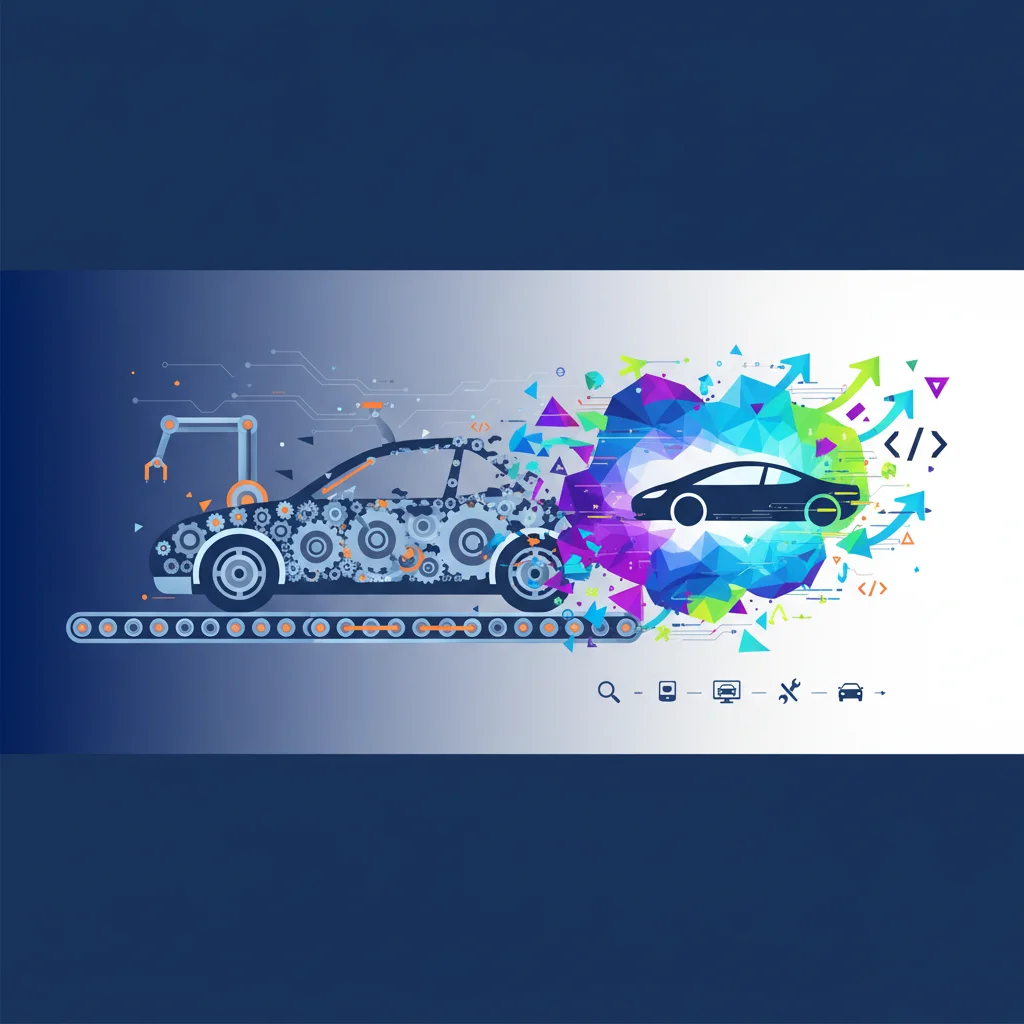
From Assembly Lines to Agile Sprints: Why Big Auto is Learning to Code Like a Startup
Imagine you have a brilliant idea for a new car. You sketch it out, build a business case, and get the green light. How long do you think it takes for that car to go from a concept on a screen to a physical vehicle in a showroom? Seven years? Maybe six?
For most of the last century, the answer for Western automakers has been a staggering four to five years. It’s a slow, deliberate, and incredibly expensive marathon of design, engineering, prototyping, and testing. This process, honed over decades, was built on a foundation of mechanical perfectionism. But in the age of electric vehicles and software-defined everything, this marathon is starting to look like a traffic jam. While giants like Ford, Volkswagen, and Renault have been stuck in the slow lane, a new generation of Chinese EV companies has been speeding past them in the express lane, launching new models in as little as two years.
This isn’t just a story about cars. It’s a classic tale of disruption, where legacy industries are being forced to unlearn a century of habits and adopt the playbook of the tech world. The automotive industry is undergoing a seismic cultural shift, trading its rigid, sequential processes for the agile, iterative, and software-centric methodologies that define modern **startups**. And the blueprint for this revolution is coming directly from China.
The Old Guard’s Dilemma: The Waterfall on Wheels
To understand the scale of this change, you first need to appreciate the traditional way of building a car. It’s a classic example of a “waterfall” methodology, a term familiar to anyone in **software** development. Each stage must be completed perfectly before the next one begins.
- Concept & Design: Years spent on market research, sketches, and clay models.
- Engineering: Siloed teams of mechanical, electrical, and chassis engineers work sequentially on their specific parts.
- Prototyping: Dozens of multi-million dollar physical prototypes are built, shipped around the world, and crash-tested into oblivion.
- Tooling & Manufacturing: Factory lines are retooled, a process that can take over a year.
- Software Integration: Often one of the last steps, where software is shoehorned into the already-finalized hardware.
This process is meticulous and prioritizes physical quality and safety above all else. But it’s also incredibly rigid. A change in one area can cause a cascade of delays and costs down the line. In a market where consumer tech expectations are shaped by yearly smartphone releases, a five-year development cycle means a car’s infotainment system and features can feel dated the moment it hits the showroom.
Enter “China Speed”: The Car as a Minimum Viable Product
Chinese EV makers like Nio, Xpeng, and BYD didn’t grow up with this legacy. They were born in the digital age and built their companies more like tech firms than traditional car manufacturers. Their approach, dubbed “China Speed,” has cut development times in half, to an average of just 2.5 years (source).
How do they do it? By embracing principles that would be right at home in Silicon Valley:
- Agile Teams: Instead of large, siloed departments, they use small, cross-functional teams that are empowered to make decisions quickly. Hardware, software, and design engineers work in parallel, not in sequence.
- Digital First, Physical Last: They have radically reduced their reliance on expensive physical prototypes. Instead, they use sophisticated digital twins, powered by **artificial intelligence** and **machine learning** algorithms, to simulate everything from crash tests to aerodynamic performance in the **cloud**.
- The MVP Mindset: They don’t aim for perfection at launch. They launch a “Minimum Viable Product” (MVP)—a car that is safe and functional—and then continuously improve it over its lifespan via over-the-air (OTA) software updates. This is a **SaaS** (Software as a Service) model applied to a 4,000-pound piece of hardware.
This table breaks down the fundamental differences in approach:
| Aspect | Traditional Western Model | Modern “China Speed” Model |
|---|---|---|
| Development Time | 4-5 years | 2-3 years |
| Methodology | Waterfall (Sequential) | Agile (Parallel & Iterative) |
| Team Structure | Large, siloed departments | Small, cross-functional, empowered teams |
| Prototyping | Heavy reliance on physical models | Digital twins & AI-powered simulation |
| Software Approach | Integrated late in the process | Core to the vehicle from day one |
| Launch Philosophy | Launch a “perfect” finished product | Launch an MVP, improve with OTA updates |
The AI Atlantic: Is the Landmark US-UK Tech Deal Sinking or Still Sailing?
The Tech Stack Fueling the Automotive Revolution
This new model of car creation is fundamentally a technology and data challenge. It’s not just about changing org charts; it’s about deploying a modern tech stack that enables speed, collaboration, and **innovation**.
At the heart of it all is the concept of the Software-Defined Vehicle (SDV). The car is no longer just a mechanical object with some computers in it; it’s a powerful, connected computing platform on wheels. This shift places a huge emphasis on **programming** and software architecture.
Powering this is a suite of advanced technologies:
- Artificial Intelligence (AI) and Machine Learning (ML): AI is the engine of speed. ML models can run thousands of virtual crash test simulations overnight, a process that would take months and millions of dollars with physical prototypes. AI is also used in generative design, where algorithms suggest optimal, lightweight parts that a human engineer might never conceive of.
- Cloud Computing: Global engineering teams can’t work in parallel without a centralized platform. The **cloud** acts as the single source of truth for design files, simulation data, and software code, enabling real-time collaboration across continents.
- Automation: From automated code testing to robotic process automation in virtual manufacturing planning, **automation** is key to eliminating bottlenecks and reducing human error throughout the development lifecycle.
- Cybersecurity: When a car’s core functions—from braking to acceleration—are controlled by software that can be updated over the internet, robust **cybersecurity** becomes non-negotiable. Protecting the vehicle from remote threats is a paramount challenge that requires a completely new set of skills within the auto industry.
Can the Titans Learn to Dance?
Faced with this existential threat, Western automakers are finally waking up and making radical changes. They are, in essence, trying to build nimble **startups** within their own colossal organizations.
Ford, for example, has created a top-secret “skunk works” team in California, tasked with developing a next-generation, low-cost EV platform from the ground up. The goal is to compete with Chinese EVs and Tesla on price, with CEO Jim Farley acknowledging the company needs a smaller, focused team with the “best talent” to get it done (source).
Renault has gone a step further by spinning off its EV and software division into a separate company called Ampere. Its explicit mission is to function like a tech company, aiming to slash development times to just two years and cut costs by 40 percent for its next generation of vehicles. They are betting that organizational and cultural separation is the only way to truly break free from old habits.
Even the German giant Volkswagen is overhauling its processes. Its new “Scalable Systems Platform” is a core part of a strategy to reduce its average development time from a sluggish 50 months down to a more competitive 36 months.
These initiatives are a clear admission that their old ways are no longer sustainable. The race is on to see if these legacy behemoths can foster genuine **innovation** and agility or if their internal efforts will be crushed by the weight of their own corporate bureaucracy.
Waymo's 0 Billion Gambit: Is the Robotaxi Revolution Finally Hitting the Streets?
The Road Ahead is Paved with Code
The battle for the future of the automobile will not be won on the factory floor alone. It will be won on servers, in code repositories, and through the clever application of **artificial intelligence**. The car is rapidly becoming the most sophisticated consumer electronic device we own, and the companies that succeed will be those that master the art of integrating hardware and software at lightning speed.
For developers, entrepreneurs, and tech professionals, this transformation represents a massive opportunity. The automotive industry is hungry for talent in **AI**, **cloud** architecture, **cybersecurity**, and user experience design. The skills that built the modern internet are now the skills required to build the modern car.
The Transatlantic Tech Dream on Hold: Why the US-UK AI Pact Stalled and What It Means for Innovation
The great automotive deceleration is over. Western carmakers are hitting the brakes on their old, slow processes and flooring it towards a future defined by software, speed, and a startup mindset. The question is no longer *if* they can change, but if they can change fast enough.

Related Posts

The AI Detection Myth: Why You Can’t Spot AI-Generated Text (And What to Do About It)

The Subscription Bubble is Bursting: What the Streaming Wars Teach Startups About SaaS, AI, and Survival