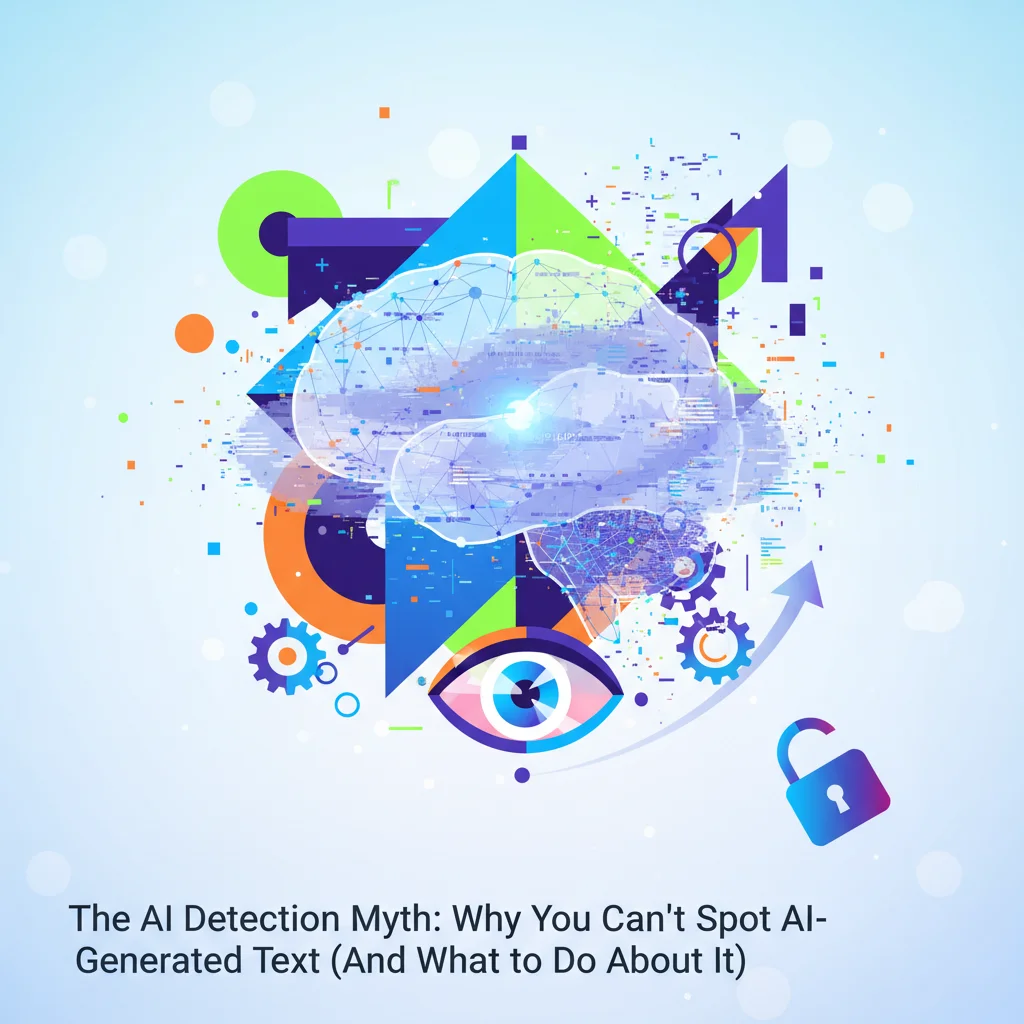
The AI Detection Myth: Why You Can’t Spot AI-Generated Text (And What to Do About It)
Have you ever read an email, a social media post, or even a news summary and had a nagging feeling in the back of your mind? “This sounds… a little too perfect. A little too generic. Was this written by a human or a machine?”
If you have, you’re not alone. In the age of sophisticated artificial intelligence and large language models (LLMs) like GPT-4, the line between human and machine-generated text has blurred to the point of being invisible. We’re all playing a high-stakes version of the Turing Test every day, and most of the time, we’re losing.
The immediate reaction from many in the tech world has been to build a better mousetrap: AI detection software. Dozens of tools have emerged, promising to scan a piece of text and give you a definitive “human” or “AI” score. But here’s the uncomfortable truth, underscored by a recent deep-dive from the Financial Times: these detectors are fighting a losing battle. In fact, focusing on detection might be the wrong approach entirely.
The real key to navigating this new world isn’t about identifying the author’s nature, but understanding the author’s intent. It’s not about the content, but the context.
The Great AI Detection Arms Race
The explosion of generative AI has created a classic technological arms race. For every advancement in AI-powered text generation, there’s a corresponding push to develop AI-powered detection. On one side, models are trained on trillions of data points to master the nuance, style, and even the deliberate imperfections of human writing. On the other, detection tools are trained to spot the statistical “tells”—the subtle watermarks of machine-generated prose.
The problem? The generators will always be one step ahead. Why? Because the goal of generative AI is to perfectly mimic a target (human writing), while the goal of a detector is to hit a constantly moving target. It’s like trying to prove a negative. As the models get better, their output becomes statistically less distinguishable from the real thing, leaving detectors with fewer and fewer signals to latch onto.
Early AI text was easy to spot. It was often repetitive, lacked common sense, and had a strangely formal, encyclopedic tone. But modern systems are far more sophisticated. They can adopt personas, inject colloquialisms, and even write code or poetry. The “tells” we once relied on—flawless grammar, overly complex vocabulary, lack of personal voice—are rapidly disappearing.
Why Even the Best Detectors (and Humans) Fail
The core challenge lies in the nature of language itself. Unlike an image, which can be subtly watermarked with invisible pixels, text is a stream of discrete choices (words). AI models are built on probability, choosing the most likely next word in a sequence. While this can sometimes lead to predictable or “vanilla” prose, it’s also remarkably effective at sounding human.
Research has shown just how difficult this task is. A study cited by the FT found that human judges tasked with separating human from AI text performed only slightly better than a coin toss, with an accuracy of around 55% (source). AI detectors often don’t fare much better, and they are notoriously unreliable, frequently flagging human-written text as AI-generated (a “false positive”), especially if it’s formulaic or written by a non-native English speaker.
To illustrate the challenge, consider the evolving characteristics of AI-generated text:
| Characteristic | Early AI Models (e.g., GPT-2) | Modern AI Models (e.g., GPT-4 & beyond) |
|---|---|---|
| Consistency | Often lost track of context in long passages. | Maintains remarkable coherence and context over thousands of words. |
| Tone & Style | Tended to be formal, generic, and encyclopedic. | Can adopt specific personas, tones (humorous, professional, empathetic), and writing styles on command. |
| “Human” Errors | Grammatically perfect, which was often a red flag. | Can be prompted to include common grammatical quirks, colloquialisms, and a more natural, less perfect flow. |
| Factual Accuracy | Prone to “hallucinations” or making up facts. | Still prone to hallucinations, but can be improved with techniques like RAG (Retrieval-Augmented Generation), making facts harder to dispute without external checking. |
As you can see, the features that once made AI text stand out are being systematically engineered away. The pursuit of a perfect detector is a chase after a ghost in the machine.
The AI Atlantic: Is the Landmark US-UK Tech Deal Sinking or Still Sailing?
Context is King: The Real Differentiator
If we can’t rely on the content itself, what’s left? Context. The circumstances surrounding the creation and distribution of a piece of text are now more important than ever.
Consider these two scenarios:
- A well-written, helpful, but slightly generic welcome email from a SaaS company you just signed up for.
- A highly personalized, emotionally charged email from your “CEO” urgently requesting a wire transfer to a new vendor, citing a confidential M&A deal.
In the first case, does it matter if it was written by AI? Not really. It’s a low-stakes communication where automation is expected and even beneficial. The context (a transactional email) makes the use of AI perfectly acceptable.
In the second case, the context (urgent financial request, appeal to authority and secrecy) is a massive red flag, regardless of how flawlessly the email is written. This is where the danger lies. The cybersecurity threat from AI isn’t just about volume; it’s about the quality of social engineering attacks. Spear-phishing emails can now be crafted at scale, with perfect grammar and personalized details scraped from public profiles, making them incredibly convincing. A report mentioned by the FT highlights that the lack of classic “tells” like typos makes these new attacks far more potent.
This principle extends beyond cybersecurity. For entrepreneurs and tech professionals, the context of AI use determines its value and ethical standing:
- For Startups: Using AI to generate marketing copy, social media updates, or first-draft blog posts is a powerful form of automation that levels the playing field. The context is efficiency. The risk is creating a bland, soulless brand voice if not guided by human strategy.
- For Developers: Using AI assistants like GitHub Copilot for programming can dramatically boost productivity. The context is a tool-assisted workflow. The risk is blindly trusting the generated code without understanding or testing it, potentially introducing subtle bugs or security vulnerabilities.
- For Cloud & SaaS Providers: Integrating generative AI features into your product is a key driver of innovation. The context is value-add. The ethical imperative is to be transparent with users about when and how AI is being used to generate responses or content on their behalf.
Hacking the BBC: Why the Future of Broadcasting is a Software Problem
A New Digital Literacy: Asking the Right Questions
Since we can no longer reliably ask, “Is this AI?”, we must equip ourselves with a new set of critical thinking tools. The focus must shift from the *what* to the *why*, *who*, and *how*.
Here are the questions we should be asking in this new era:
| Question | Why It Matters |
|---|---|
| Who is the source? | Is the author or publisher reputable? Do they have a history of accuracy? An anonymous account on social media should be treated with more skepticism than a signed article from an established institution. |
| What is the intent? | Is the goal to inform, persuade, entertain, or deceive? Content designed to provoke a strong emotional reaction (fear, anger) should be scrutinized heavily, as this is a common tactic of misinformation campaigns. |
| Can the information be verified? | Does the text cite sources? Can you find two or three other independent, reliable sources that corroborate the key claims? For critical information, never trust a single source. |
| Does this use of AI add value? | In a business or creative context, is the AI being used as a powerful tool to augment human capability, or is it being used as a shortcut that diminishes quality and originality? |
This is a fundamental shift from passive consumption to active investigation. It requires more effort, but it’s the only sustainable path forward in a world saturated with synthetic media.
The Transatlantic Tech Dream on Hold: Why the US-UK AI Pact Stalled and What It Means for Innovation
Conclusion: Embrace the Augmentation, Not the Deception
The quest to build an infallible AI detector is a dead end. It’s a technological solution to what is fundamentally a human problem: trust. As machine learning models become an ever-more-integrated part of our digital infrastructure, from the cloud services we use to the apps on our phones, we must adapt our mindset.
The future isn’t a dystopian world where we’re constantly trying to unmask robotic impostors. It’s a world of augmentation, where AI is a tool—a powerful, complex, and sometimes unpredictable one—that can be used for good or for ill. Our collective challenge is not to “catch” the AI, but to build a culture and a technological framework built on transparency, accountability, and critical thinking.
So, the next time you read something and wonder if it was written by a machine, stop. Instead, ask yourself if it’s true. Ask yourself who it benefits. And ask yourself if it matters. The answers to those questions will tell you everything you need to know.

Related Posts
The New Digital Wall: Why the US Banning Tech Critics Should Alarm Everyone in Tech
From Assembly Lines to Agile Sprints: Why Big Auto is Learning to Code Like a Startup