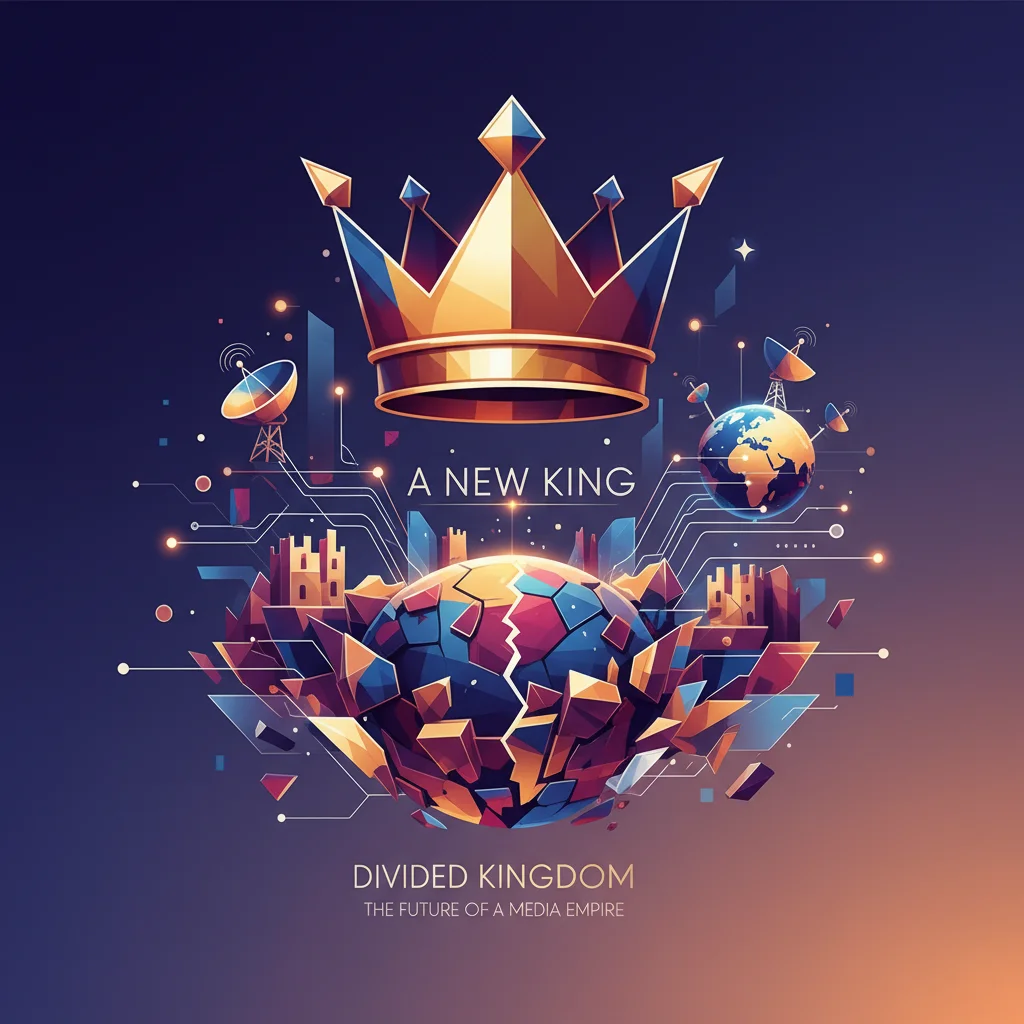
The Murdoch Succession: A New King, a Divided Kingdom, and the Future of a Media Empire
The curtain has fallen on one of the most formidable eras in media history. With Rupert Murdoch stepping down, the vast empire he meticulously built over seven decades now rests in the hands of his eldest son, Lachlan. This transition is far more than a simple changing of the guard; it’s a seismic event with profound implications for global media, politics, and the world of finance. For investors, business leaders, and anyone interested in the intersection of power and capital, the unfolding drama within the Murdoch dynasty is a case study in corporate succession, strategic pivots, and the high-stakes future of legacy media in a digitally disrupted world.
For decades, the Murdoch name has been synonymous with influence, controversy, and immense wealth. The empire, now split into Fox Corporation and News Corp, controls some of the world’s most powerful media assets, from the influential Wall Street Journal and The Times of London to the ratings juggernaut Fox News. Rupert Murdoch’s leadership was characterized by a swashbuckling, risk-taking style and a keen instinct for political leverage. Now, as Lachlan takes the helm, the central question echoing in boardrooms and on trading floors is: Can the son replicate the father’s success, or will a new vision—and new rivalries—redefine the empire for a new generation?
A Kingdom Divided: The Heirs and the Rebel
The narrative of the Murdoch succession has long been framed as a real-life “Succession,” a captivating struggle between siblings with vastly different ideologies and ambitions. While Rupert Murdoch has six children, the focus has always been on the three from his second marriage: Elisabeth, Lachlan, and James. Elisabeth forged her own successful path in television production. The primary schism, however, developed between the two sons, Lachlan and James, whose divergent paths offer a clear window into the ideological battle for the soul of the empire.
Lachlan, the heir apparent, is often seen as the continuity candidate. Having returned to the family business in 2014 after a self-imposed exile, he is viewed as a staunch defender of his father’s conservative-leaning media philosophy. His leadership at Fox Corporation suggests a commitment to the profitable, right-leaning formula that has made Fox News a dominant force. In contrast, James Murdoch has publicly and dramatically broken with the family’s political line. His resignation from the News Corp board in 2020, citing “disagreements over certain editorial content,” was the culmination of years of growing discomfort with the direction of outlets like Fox News, particularly concerning climate change denial and political polarization (source).
This ideological chasm is not merely a family squabble; it represents two distinct strategies for the future of media and has significant implications for anyone investing in the companies. Below is a comparison of the two brothers’ strategic visions:
| Aspect | Lachlan Murdoch (The Heir) | James Murdoch (The Rebel) |
|---|---|---|
| Core Philosophy | Continuity with Rupert’s vision; focus on profitable, conservative-leaning news and sports content. | Progressive and future-focused; critical of the family’s political influence and editorial direction. |
| Business Strategy | Doubling down on core assets like live news (Fox News) and sports, which are seen as more resilient to streaming disruption. | Advocates for embracing new media models, sustainability (ESG), and digital transformation. Has invested in tech and media startups since leaving. |
| Political Stance | Aligns with the traditional conservative stance of Fox News, viewing it as a key pillar of the business model. | Publicly criticizes the family’s outlets for promoting disinformation, especially on climate and politics. |
| Current Role | Chairman of News Corp and Executive Chair and CEO of Fox Corporation. | Founder of Lupa Systems, a private investment company focused on media and technology ventures. |
James’s departure and subsequent investments in alternative media and technology ventures signal a belief that the old model is not sustainable. He is betting on a future where media companies must adapt to a new economy, one driven by different values and technologies. Lachlan, meanwhile, is betting that the power of live programming and a dedicated, politically-aligned audience is a durable moat against the tides of change.
High Stakes on the High Seas: Decoding the Economic Fallout of the US Blockade on Venezuela
Lachlan’s New Order: Navigating a Treacherous Landscape
With Lachlan firmly in control, the strategic direction of both Fox Corp and News Corp is becoming clearer. The focus is on consolidation and fortification. At Fox, this means leaning heavily into the live-event model of news and sports, which is less susceptible to the on-demand pressures that have eroded traditional entertainment. This strategy acknowledges a fundamental shift in the media economy: advertisers and subscribers will pay a premium for can’t-miss live content.
However, this path is fraught with peril. The $787.5 million settlement with Dominion Voting Systems over false election claims was a stark reminder of the financial and reputational risks associated with Fox News’s brand of partisan commentary (source). Managing these legal and political risks while maintaining the loyalty of a core audience is the central challenge of Lachlan’s tenure. Any misstep could have a direct impact on the stock market valuation of Fox Corporation and spook institutional investors who are increasingly wary of governance and reputational liabilities.
For News Corp, which holds publishing assets like the Wall Street Journal and HarperCollins, the challenge is different. It involves navigating the transition from print to digital, a battle legacy media has been fighting for two decades. Success here will depend on leveraging sophisticated data analytics, paywall strategies, and other forms of financial technology to monetize content effectively. Lachlan must prove he can foster innovation in this sector while his primary focus appears to be on the television assets of Fox.
The Investor’s Dilemma: Stability vs. Stagnation
For those in finance and investing, the Murdoch succession presents a complex picture. On one hand, Lachlan’s leadership offers a degree of predictability. Investors know the playbook: a focus on high-margin news and sports, a conservative political alignment, and a defense of existing business models. This could be seen as a safe, if uninspired, bet in a turbulent market. The dual-class share structure, which gives the Murdoch family near-total voting control despite owning a smaller portion of the equity, ensures that this strategic direction is unlikely to be challenged by activist investors (source).
On the other hand, this very stability could be a precursor to stagnation. The media landscape is being radically reshaped by streaming giants, AI-driven content creation, and the decentralizing potential of technologies like blockchain for content ownership and distribution. A strategy that prioritizes the defense of legacy assets over bold innovation could leave the Murdoch empire vulnerable in the long run. The core audience for cable news is aging, and younger generations consume media in fundamentally different ways. The question for investors is whether Lachlan’s continuity plan is a prudent defense or a failure to adapt to a new era of financial technology and media consumption.
The performance of News Corp (NWS) and Fox Corp (FOXA) on the stock market will be the ultimate arbiter of Lachlan’s success. Wall Street will be watching key metrics: subscriber growth in digital publishing, advertising revenue at Fox News, the cost of legal battles, and any moves toward digital diversification. The current corporate structure, a result of the 21st Century Fox sale to Disney, was designed to insulate the most profitable assets. Now, it’s up to Lachlan to prove these streamlined entities can grow, not just endure.
The Singapore Secret: How a National Balance Sheet Forged a Global Economic Powerhouse
Conclusion: An Empire at a Crossroads
The transition from Rupert to Lachlan Murdoch marks the end of a chapter written by one of media’s most iconic and controversial figures. The new chapter is just beginning, and its narrative is one of continuity versus change, of family loyalty versus ideological conviction. Lachlan Murdoch has inherited a powerful, profitable, but deeply challenged empire. His leadership will be defined by his ability to navigate the treacherous waters of political polarization, technological disruption, and intense competition.
For the broader world of business and economics, the Murdoch saga serves as a powerful reminder that even the most entrenched empires are not immune to the forces of change. The decisions made in the coming years will not only determine the fate of the Murdoch dynasty but will also shape the media and political landscapes for a generation. Investors and observers alike will be watching closely, as the battle for the future of this media kingdom is a high-stakes game with global consequences.
The Unsung Hero of Global Finance: How an EU Rulebook Revolutionized Investing for Everyone

Related Posts
The Revolving Door Spins Too Fast: Why the EY-Shell Auditor Exit Is a Red Flag for Investors

Hong Kong’s Legal Crossroads: Decoding the Economic Stakes of the Jimmy Lai Trial
