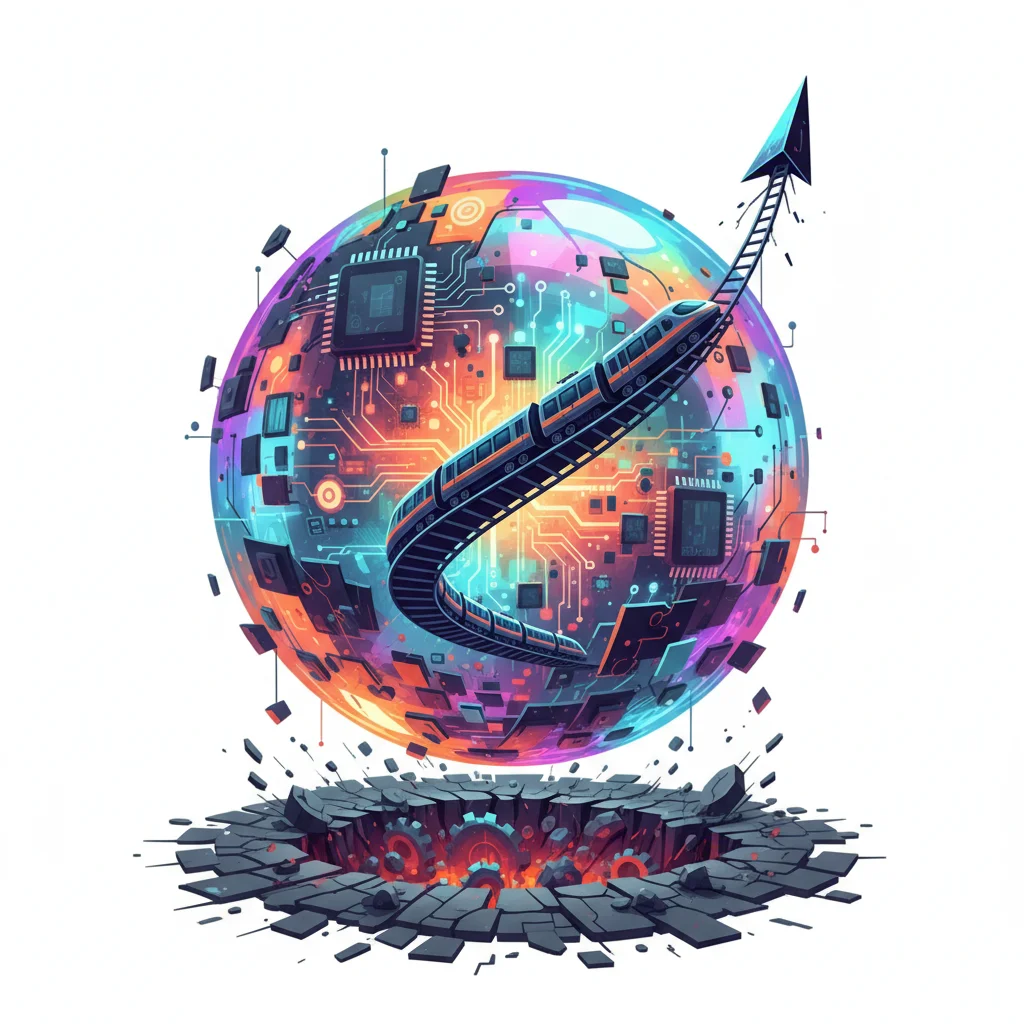
The AI Bubble: Is Silicon Valley’s Hype Train Heading for a Crash?
It’s impossible to ignore. The past year has felt like a whirlwind of non-stop chatter about artificial intelligence. From ChatGPT writing poems and code to NVIDIA’s stock price rocketing into the stratosphere, the excitement is palpable. Every startup is an “AI startup,” every pitch deck is sprinkled with “LLM,” and venture capitalists are writing checks so fast you’d think their pens were on fire. It feels like we’re on the cusp of a technological revolution that will reshape everything.
But amidst the roar of the crowd, a quieter, more cautious question is being whispered in the boardrooms of Silicon Valley and the trading floors of Wall Street: Are we in an AI bubble?
It’s a question with so much weight that the Financial Times named “bubble” its word of the year. When the high priests of the financial world start openly acknowledging the excesses, it’s time for everyone—from developers and entrepreneurs to investors and casual observers—to pay close attention. Are we witnessing the birth of a new digital age, or are we riding a wave of hype that’s about to come crashing down on the shore?
Echoes of 2000: Is History Repeating Itself?
For anyone who was around during the late 1990s, the current climate feels eerily familiar. The dot-com boom was a period of “irrational exuberance,” where any company with a “.com” in its name could secure millions in funding, often without a clear path to profitability. The focus was on growth at all costs, acquiring “eyeballs,” and capturing market share. The fundamentals, like revenue and profit, were often seen as quaint, old-fashioned concerns.
We all know how that story ended. The NASDAQ crashed, vaporizing trillions in market value and leaving a graveyard of failed startups like Pets.com and Webvan in its wake. Today, we see parallels. Startups are achieving billion-dollar “unicorn” valuations with little more than a clever wrapper around an OpenAI API. The narrative is that generative AI will change the world, and if you’re not investing now, you’ll miss the next Google or Amazon.
The numbers themselves are staggering. Take NVIDIA, the company making the essential “picks and shovels” (in this case, GPUs) for the AI gold rush. Its stock has surged, pushing its valuation past the trillion-dollar mark, a feat once reserved for a tiny handful of the world’s most established companies (source). While NVIDIA is wildly profitable, the valuations of many of the startups using its chips are based more on promise than present-day performance.
To put it in perspective, let’s compare the two eras:
| Metric | Dot-Com Bubble (Late 1990s) | AI Boom (2020s) |
|---|---|---|
| Key Technology | The Commercial Internet, Web Browsers | Generative AI, Large Language Models (LLMs) |
| Investor Mindset | FOMO; “Get big fast,” “Eyeballs over profit” | FOMO; “Build the AGI,” “Every company will be an AI company” |
| “Picks & Shovels” Play | Cisco (networking gear), Sun Microsystems (servers) | NVIDIA (GPUs), Cloud Providers (AWS, Azure, GCP) |
| Path to Profitability | Often unclear or non-existent; focused on user acquisition | Frequently reliant on future API monetization or enterprise SaaS models |
| Market Darling Example | Pets.com (IPO’d and failed within 2 years) | AI startups raising massive seed rounds pre-product |
The parallels are hard to dismiss. The same breathless excitement, the same venture capital frenzy, and the same focus on a single, transformative technology. But does that guarantee the same painful outcome?
The Bundestag Blackout: How a 4-Hour Outage Signals a New Era of Digital Geopolitics
Today, the situation is reversed. We have global high-speed internet, powerful pocket-sized computers, and massive, scalable cloud infrastructure. The foundation is already built. This means AI-powered software and services can be deployed and scaled to millions of users almost instantly. The risk isn’t that the technology is a fantasy; the risk is that we’re terrible at picking which of the thousands of new companies will successfully harness it to build a sustainable business. The revolution is real, but many of the revolutionaries will not survive the war.
Why This Time Might Actually Be Different
While the bubble talk is warranted, it’s equally important to understand the powerful arguments against a simple repeat of 2000. The core technology driving this boom—machine learning—isn’t just a promise. It’s already here, creating tangible value across countless industries.
First, the impact is both broad and deep. AI isn’t just about creating chatbots. It’s about revolutionizing drug discovery, optimizing global supply chains, creating sophisticated cybersecurity defenses, and enabling a new era of scientific research. This isn’t just about selling pet food online; it’s about fundamental automation and enhancement of complex human tasks. The potential for productivity gains across the entire economy is immense, a fact that even cautious economists acknowledge.
Second, the key players are different. The dot-com boom was fueled by a flood of unproven startups. Today’s AI race is being led by some of the largest and most profitable companies in history: Microsoft, Google, Amazon, and Apple. These tech titans are pouring billions from their existing, massively profitable businesses into AI research and development. They have the resources, data, and distribution channels to weather market volatility in a way the startups of the 90s never could. Microsoft’s multi-billion dollar partnership with OpenAI is a prime example of this new dynamic (source).
Finally, the barrier to entry at the foundational level is astronomically high. Training a state-of-the-art LLM like GPT-4 requires thousands of specialized GPUs, armies of PhD-level researchers, and electricity bills that can run into the tens of millions of dollars. This is a far cry from two developers launching a website from their garage. This high-cost barrier creates a natural moat for the companies at the top, suggesting a potential for more durable, long-term market power.
Beyond the Hype: How Giant Heat Pumps Are a Trojan Horse for AI and Cloud Innovation
Navigating the Hype: A Guide for a Bubbly World
So, what does this mean for those of us in the trenches—the developers, entrepreneurs, and tech professionals building the future? Whether it’s a bubble or not, the landscape has fundamentally changed. Here’s how to think about it:
- For Entrepreneurs & Startups: The era of “build it and they will come” is over (if it ever truly existed). Funding may seem easy to come by, but the market will eventually demand real value. Focus on solving a painful, specific problem for a well-defined customer. A thin wrapper on a public API is not a defensible business. Ask yourself: What is your unique data source? What is your proprietary algorithm? How does your solution integrate into a customer’s workflow in a way that creates a sticky, indispensable product? True innovation comes from application, not just access to the underlying tech.
- For Developers & Tech Professionals: Your skills have never been more valuable, but the required skill set is evolving. Proficiency in programming languages like Python is table stakes. Now, you need a deep understanding of machine learning frameworks, cloud architecture for AI/ML workloads, and the ethics of building intelligent systems. Specializing in areas like prompt engineering, model fine-tuning, or MLOps can make you an invaluable asset in this new economy.
- For Investors: The easy money has been made. The next phase will require more discipline. It’s crucial to look past the buzzwords and scrutinize the business fundamentals. Does the company have a viable go-to-market strategy? Is the total addressable market large enough? Most importantly, does the team possess the unique technical and business acumen to navigate a fiercely competitive market? The “picks and shovels” plays, while expensive, may still be safer than betting on a thousand different gold miners.
The current AI boom is a paradox. It is simultaneously overhyped and underestimated. The valuations of many companies are likely inflated and destined for a painful correction. Yet, the long-term impact of artificial intelligence on society will likely be even more profound than the most bullish analyst can currently predict.
More Than a Taskforce: Why the UK's AI Superpower Dream Depends on Women in Tech
The Correction is Coming, But It Won’t Be the Apocalypse
Let’s assume the “bubble” does pop. It’s unlikely to look like the cataclysm of 2000. Instead of a sudden, market-wide crash, we’re more likely to see a “great consolidation” or a “flight to quality.”
Many of the undifferentiated, “me-too” AI startups will run out of cash and either fold or be acquired for their talent by the tech giants. Investment will dry up for ideas without a clear path to revenue, and the market will begin to reward real traction over ambitious roadmaps. We will see a separation between the companies that use AI to solve real business problems and those that are simply “AI for AI’s sake.”
But the underlying technological progress will not stop. The research will continue, the models will become more powerful, and the cost of inference will continue to fall. The companies that survive the correction will be stronger, more focused, and built on the solid foundation of genuine customer value. The internet didn’t disappear after the dot-com crash; it became more essential than ever, giving rise to the giants we know today. The same will be true for AI.
The AI bubble, or boom, or whatever you choose to call it, isn’t a simple story of success or failure. It’s a messy, chaotic, and exhilarating process of technological discovery and market correction. The key is to keep your eyes on the horizon, focus on building things of lasting value, and remember that even after a bubble pops, the technology that inflated it is often just getting started.

Related Posts

Beyond the Steel: Why Trump’s ‘Golden Fleet’ is a Multi-Billion Dollar Bat Signal for the Tech Industry
The $4.75 Billion Power Play: Why Alphabet is Buying an Energy Company to Fuel the AI Revolution