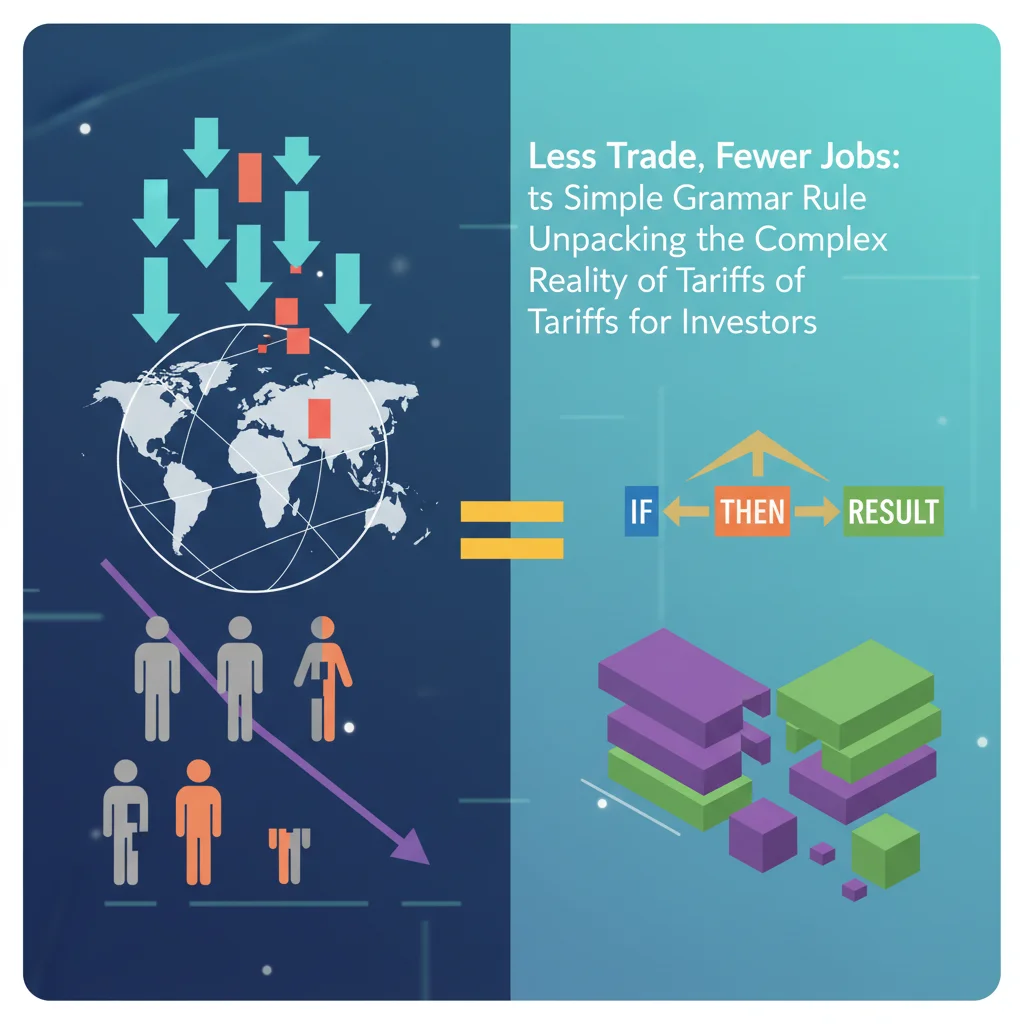
Less Trade, Fewer Jobs: The Simple Grammar Rule Unpacking the Complex Reality of Tariffs for Investors
In the world of finance and economics, we often grapple with complex models and dense data to understand market movements. Yet, sometimes the most profound insights come from the simplest of principles. A recent letter to the Financial Times by Professor Emeritus Richard Stubbs of McMaster University provided a perfect example, using a basic grammar rule to cut through the noise of international trade policy. His observation? Tariffs on a country like China will result in “less trade, but fewer jobs.”
This isn’t just a clever play on words; it’s a powerful framework for understanding the cascading consequences of protectionist policies. “Less” applies to uncountable nouns (like trade, water, or information), while “fewer” applies to countable ones (like jobs, dollars, or companies). The distinction brilliantly separates the abstract, macroeconomic impact from the tangible, human cost. For investors, business leaders, and anyone engaged in the global economy, grasping this concept is crucial for navigating an increasingly fragmented world. This article will delve into this grammatical truth to explore the multifaceted impact of tariffs on the economy, the stock market, and your investment strategy.
The Anatomy of a Tariff: More Than Just a Tax
At its core, a tariff is a tax imposed on imported goods or services. The primary goal is typically to make foreign products more expensive, thereby encouraging consumers and businesses to buy domestically produced alternatives. The stated intentions behind tariffs are often compelling: to protect nascent domestic industries, safeguard national security by reducing reliance on foreign powers, and shield domestic jobs from what is perceived as unfair foreign competition.
However, the economic reality is far more intricate. When a tariff is imposed, it doesn’t just appear as a line item on a government ledger. It sets off a chain reaction that ripples through the entire economic ecosystem. Consider a tariff on imported steel.
- Upstream Impact: Domestic steel producers may benefit from reduced competition, potentially leading to higher profits and stock prices.
- Downstream Impact: Companies that use steel as a raw material—automakers, construction firms, appliance manufacturers—now face higher input costs. They must choose between absorbing these costs (squeezing profit margins), passing them on to consumers (fueling inflation), or reducing production.
- Consumer Impact: The end result is often higher prices for everyday goods, from cars to washing machines, reducing the purchasing power of households.
This intricate web of effects is why the seemingly simple act of imposing a tariff can have profound and often unintended consequences on everything from corporate earnings to the broader health of the economy.
The Investor's Crossword: Decoding Market Signals to Solve the Financial Puzzle
“Less Trade”: The Uncountable Disruption to the Global Flow
Professor Stubbs’s use of “less trade” perfectly captures the broad, systemic impact of tariffs. Trade is not a series of discrete transactions but a continuous, flowing system—an uncountable volume of goods, services, and capital crisscrossing the globe. Tariffs act like dams in this river, slowing the flow and causing the overall volume to shrink.
When trade barriers are erected, the global economy becomes less efficient. The principle of comparative advantage, a cornerstone of modern economics, posits that countries prosper by specializing in what they produce most efficiently and trading for the rest. Tariffs directly undermine this principle, forcing nations to produce goods domestically that could be acquired more cheaply from abroad. The result is a misallocation of capital and labor, leading to slower economic growth. During the height of the U.S.-China trade war, for instance, the International Monetary Fund (IMF) estimated that the cumulative effect of the conflict could reduce the level of global GDP by 0.8% by 2020. This represents hundreds of billions of dollars in lost economic output.
Furthermore, tariffs rarely exist in a vacuum. They almost invariably invite retaliation. When one country imposes tariffs, its trading partners often respond in kind, targeting the first country’s key exports. This “tit-for-tat” escalation creates a vicious cycle that further constricts global trade, disrupts complex supply chains, and introduces a high degree of uncertainty into the stock market. For businesses that rely on international sales and global supply chains, this environment makes long-term planning and investing incredibly difficult.
“Fewer Jobs”: The Countable and Painful Human Cost
While “less trade” describes a macroeconomic phenomenon, “fewer jobs” points to the direct, countable, and often painful human impact. This is the great paradox of protectionism: policies enacted to save jobs frequently result in a net loss of employment across the wider economy.
How does this happen? Research consistently shows that while tariffs may create or preserve a small number of jobs in the protected industry, they destroy a far greater number elsewhere. A 2019 study on the impact of the 2018 tariffs found that while they likely increased manufacturing employment in protected sectors by a small amount, the costs to consumers and the effects of retaliatory tariffs led to a net reduction in jobs and real wages (source). The jobs lost in agriculture, port operations, logistics, and manufacturing sectors that rely on imported components far outweighed the gains in steel or aluminum production.
To illustrate this disparity, consider the following breakdown of intended versus actual outcomes of a hypothetical tariff policy.
| Policy Action & Intended Outcome | Actual Economic Result |
|---|---|
| Intention: Protect 10,000 jobs in the domestic widget industry by placing a 25% tariff on imported widgets. | Outcome 1: An estimated 8,000 jobs are saved/created in widget manufacturing. |
| Intention: Boost domestic widget production and corporate profits for local firms. | Outcome 2: Companies using widgets (e.g., tech, auto) face higher costs, leading to an estimated 25,000 job losses in those larger sectors. |
| Intention: Level the playing field with foreign competitors. | Outcome 3: Foreign countries retaliate with tariffs on agricultural exports, causing 15,000 job losses in the farming and logistics sectors. |
| Net Intended Impact: +10,000 Jobs | Net Actual Impact: -32,000 Jobs (8,000 – 25,000 – 15,000) |
This table demonstrates how the concentrated benefits to one small sector are often dwarfed by the diffuse, but much larger, costs spread across the rest of the economy. The jobs are countable, and unfortunately, they often count down.
The Atlantic Divide: Why a Landmark US-UK Tech Deal is on Ice and What it Means for Your Investments
The Investor’s Playbook in a World of Walls
For those involved in investing and finance, an environment of rising tariffs creates both risks and opportunities. The stock market abhors uncertainty, and trade wars are a potent source of it. So, how can one position their portfolio?
- Sector-Specific Analysis: It’s vital to move beyond broad market analysis and dig into specific sectors. Companies that are heavily reliant on imported goods for production (e.g., electronics, fast fashion) or on export markets for sales (e.g., agricultural giants, high-end machinery) are most vulnerable. Conversely, companies with primarily domestic supply chains and customer bases may be more insulated.
- Focus on Supply Chain Resilience: The pandemic and subsequent trade disputes have made “supply chain” a household term. Investors should favor companies that have demonstrated robust and diversified supply chains. This might include businesses that utilize advanced financial technology for supply chain finance or those that have invested in multi-sourcing strategies to avoid dependence on a single country.
- Currency and Commodity Fluctuations: Trade disputes often lead to volatility in currency markets. A stronger or weaker dollar can have a significant impact on the earnings of multinational corporations. Similarly, tariffs on raw materials can cause wild swings in commodity prices, affecting the entire trading ecosystem.
The Evolving Role of Banking and Financial Technology
The friction introduced by tariffs also has significant implications for banking and fintech. The world of trade finance, which provides the credit and insurance necessary for global commerce to function, becomes more complex and risky. Financial institutions must navigate a patchwork of regulations and potential political risks.
This is where financial technology can play a transformative role. Fintech innovations are helping businesses mitigate the new challenges of global trade. For example, blockchain technology offers the potential for more transparent and secure supply chains, allowing every step of a product’s journey to be tracked and verified. This can help companies prove the origin of their goods to comply with tariff regulations. According to a report by the World Economic Forum, distributed ledger technology like blockchain can help close the trade finance gap and streamline cross-border transactions (source). Advanced analytics and AI are also being deployed to help businesses model the potential costs of tariffs and optimize their logistics in real-time.
The Billion Media War: Analyzing the Financial Shockwaves of Trump's Lawsuit Against the BBC
Conclusion: A Simple Rule for a Complex World
We began with a simple grammatical distinction: less trade, fewer jobs. As we’ve seen, this elegant phrase from Professor Stubbs is a key that unlocks a deep understanding of one of the most pressing issues in the modern global economy. Tariffs, while politically popular at times, are a blunt instrument with far-reaching and often counterproductive consequences. They lead to a less efficient, less prosperous global economy and, despite their stated goals, ultimately result in a net loss of jobs.
For investors, business leaders, and policymakers, the lesson is clear. The interconnectedness of the global economy means that there are no simple, isolated actions. Every tariff creates a ripple that can become a tidal wave, impacting corporate earnings, stock market stability, and the livelihoods of millions. Understanding this dynamic—the uncountable loss of flow and the countable loss of work—is the first step toward making more informed decisions in an ever-more-complex financial world.

Related Posts

The Angel’s Share Gets Too Large: Navigating the Investment Risks and Opportunities in the Scotch Whisky Glut

The Age of Turbo Blurbo: Navigating Noise and Jargon in Modern Finance