The AI Revolution is Overheating: Are Showers and Baths the Answer for Data Centers?
The digital world runs on a powerful, unseen engine: the data center. Every time you stream a movie, use a SaaS application, or ask an AI chatbot a question, you’re tapping into a vast network of servers humming away in these massive, anonymous buildings. But as our reliance on digital infrastructure explodes—fueled by the insatiable appetite of artificial intelligence and machine learning—these engines are starting to overheat. And the old way of cooling them down is no longer sustainable.
For decades, the solution was brute force: giant, power-hungry air conditioning systems that blast cold air through server rooms, much like a refrigerator keeps your food cold. But this approach is becoming an environmental and economic albatross. Data centers already consume an estimated 1% of the world’s electricity, a figure set to skyrocket. As AI models become more complex, the specialized chips (GPUs) that power them generate an immense amount of heat, pushing traditional air cooling to its breaking point.
The tech industry is facing a critical challenge: how do we power the future of AI and the cloud without boiling the planet? The answer, surprisingly, might be found in your bathroom. A new wave of innovation is bringing “showers and baths” to the world of high-performance computing, promising a greener, more efficient way to keep the heart of our digital lives cool.
The Air-Cooling Conundrum: A Legacy on the Brink
To understand why this shift is so revolutionary, we first need to grasp the limitations of the status quo. Traditional data center cooling relies on a process called Computer Room Air Conditioning (CRAC). These units pump cold air under a raised floor, which then flows up through perforated tiles to cool the server racks. The hot air exhausted by the servers is then sucked back into the CRAC units, cooled, and the cycle repeats.
For years, this worked well enough. But it’s fundamentally inefficient. You are cooling an entire room—the air, the floor, the ceiling, the racks—just to cool a few square inches of silicon on a processor. It’s like trying to cool a single cup of coffee by putting it in a walk-in freezer. It works, but the wasted energy is enormous.
This inefficiency is measured by a key industry metric: Power Usage Effectiveness (PUE). A perfect PUE of 1.0 means that 100% of the energy going into the data center is used for computing. The rest is used for overhead like cooling and lighting. While modern hyperscalers have achieved impressive PUEs around 1.1, many older facilities still hover around 1.5 or higher, meaning for every watt used for computing, another half-watt is wasted on cooling.
As the demands of machine learning algorithms push server components to their thermal limits, the air-cooling model is collapsing. We simply can’t move enough heat away fast enough with air alone. It’s a bottleneck that threatens to stall progress in AI, software development, and scientific research.
When Lifelines Fail: Can AI and Automation Prevent the Next 999 Outage?
Taking the Plunge: Liquid Immersion Cooling (The “Bath”)
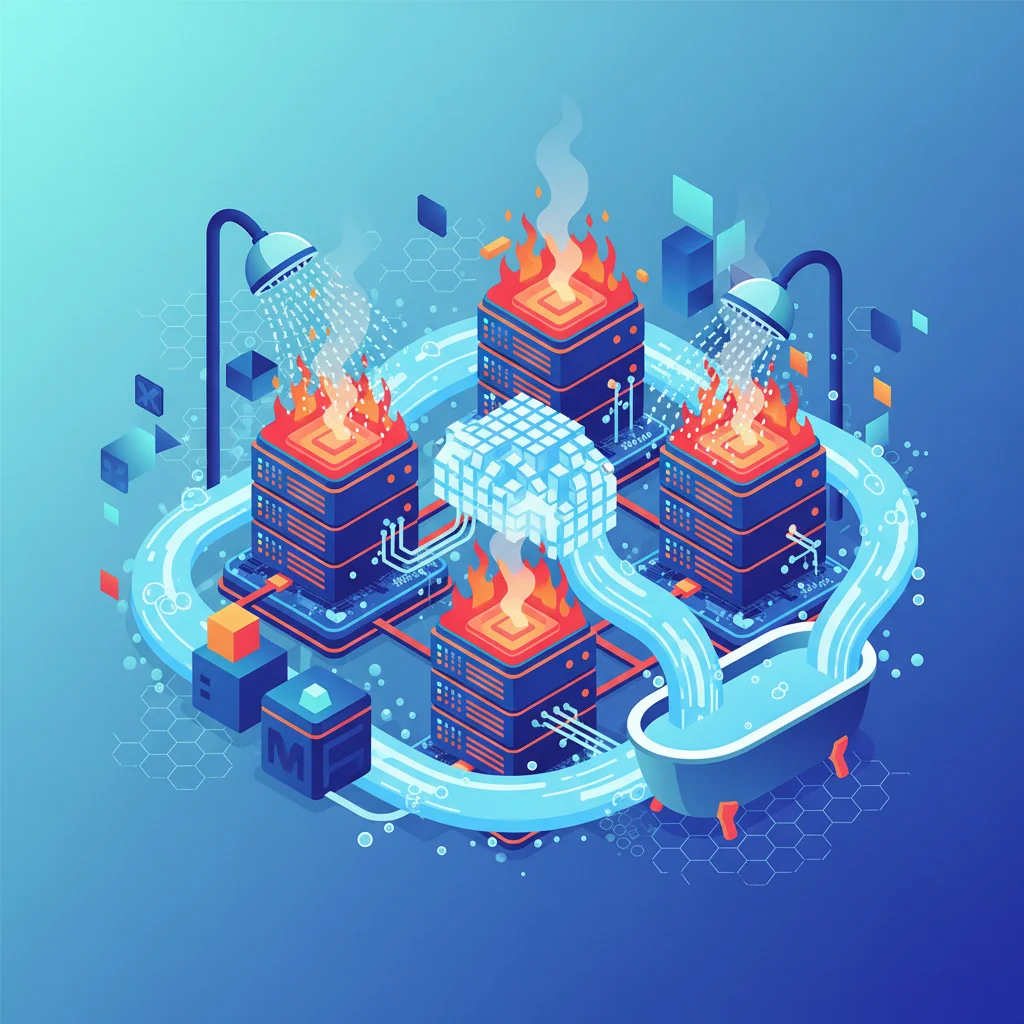
Enter the “bath.” This is the radical, futuristic solution that science fiction has promised for years: submerging entire servers in a tank of liquid. But this isn’t water, of course. It’s a specially engineered, non-conductive dielectric fluid that is a far more effective medium for heat transfer than air.
Companies like UK-based Iceotope are pioneering this technology. Servers are placed vertically in sealed chassis filled with this fluid. The fluid absorbs the heat directly from the components—the CPUs, GPUs, and memory chips. This heated fluid is then circulated out of the server to a heat exchanger, where the heat is transferred to a water loop, cooled, and then sent back. The process is a closed loop, requiring significantly less energy and zero water evaporation.
The benefits are transformative:
- Extreme Energy Efficiency: By eliminating the need for massive fans and chillers, immersion cooling can slash cooling energy costs by up to 90% and reduce a data center’s total energy consumption by a significant margin.
- Unprecedented Density: Without the need for massive air plenums and hot/cold aisles, servers can be packed much more tightly. This means more computing power per square foot, a critical factor for expensive real estate in urban centers.
- Water Conservation: Traditional air-cooled data centers often use evaporative cooling towers, which consume millions of gallons of water. Immersion cooling systems are sealed, virtually eliminating water usage.
- Heat Reuse: The captured heat, now concentrated in a water loop, is much easier to reuse. It can be used to heat adjacent office buildings, greenhouses, or even local community swimming pools, turning a waste product into a valuable resource.
To put the difference in perspective, here’s a comparison between traditional air cooling and liquid immersion cooling:
| Metric | Traditional Air Cooling | Liquid Immersion Cooling |
|---|---|---|
| Cooling Medium | Air | Dielectric Fluid |
| Typical PUE | 1.2 – 1.6 | 1.02 – 1.05 |
| Server Density | Low to Medium | Very High |
| Water Usage | High (with evaporative cooling) | Near-Zero |
| Energy Consumption | Very High (fans, chillers) | Low (pumps) |
| Noise Level | Extremely Loud | Virtually Silent |
A Targeted Approach: Direct-to-Chip Cooling (The “Shower”)
If full immersion is the “bath,” then direct-to-chip cooling is the “shower.” This method is less radical but highly effective. Instead of submerging the whole server, a small network of pipes brings liquid coolant directly to the hottest components on the motherboard.
A “cold plate” is mounted directly onto the CPU and GPU. Coolant flows through this plate, absorbing heat with surgical precision before being piped away to be cooled. It’s a targeted strike against heat, focusing cooling power exactly where it’s needed most. This approach is often seen as a practical stepping stone for existing data centers, as it can be easier to retrofit into standard server racks than full immersion tanks.
This “shower” is particularly crucial for the bleeding-edge hardware that powers today’s most advanced AI research. The latest processors can generate hundreds of watts of heat in a space the size of a postage stamp, a thermal challenge that direct-to-chip liquid cooling is uniquely equipped to handle.
However, this innovation introduces new complexities. Maintenance becomes a different beast—you can’t just hot-swap a fan anymore. Technicians will need new skills to handle dielectric fluids and sealed systems. Furthermore, the role of automation will become even more critical for monitoring fluid dynamics, temperatures, and potential leaks at scale. From a cybersecurity perspective, while it might deter casual physical intrusion, it also changes the game for hardware-level security and maintenance protocols. For startups and entrepreneurs, this is a gold rush. The ecosystem around liquid cooling—from new fluid formulations and quick-disconnect pipes to monitoring software and robotic maintenance—is ripe for disruption.
The Ripple Effect: What This Means for the Tech Ecosystem
This revolution in cooling technology isn’t just happening in a vacuum. It has profound implications for everyone in the tech industry, from individual developers to multinational SaaS providers.
For Developers and Programmers: The thermal ceiling has long been a constraint on hardware performance. With superior cooling, chip manufacturers can design even more powerful and densely packed processors. For those working on complex programming tasks, especially in AI and scientific computing, this means access to more powerful hardware on the cloud, enabling them to build and train larger, more sophisticated models faster than ever before.
For Startups and SaaS Companies: As major cloud providers like Amazon, Google, and Microsoft adopt these technologies, the efficiency gains could translate into more competitive pricing for high-performance computing instances. For a startup building a resource-intensive AI-powered SaaS product, this could significantly lower the barrier to entry and reduce operational costs. It also bolsters their ESG (Environmental, Social, and Governance) credentials, which is increasingly important to investors and customers.
For Entrepreneurs and Innovation: As noted, the transition to liquid cooling creates a massive new market. There’s a need for specialized hardware, advanced monitoring and automation software, and certified technicians. This is a classic case of a technological shift creating a cascade of new business opportunities for nimble and innovative startups to seize.
The UK's New Digital Nanny: Is AI-Powered Nudity Blocking a Solution or a Slippery Slope?
The Future is Fluid
The digital transformation, supercharged by the rise of artificial intelligence, is generating an unprecedented amount of heat. The old methods of fanning the flames are no longer enough. The move to liquid-based solutions like immersion “baths” and direct-to-chip “showers” isn’t just a niche trend; it’s a necessary evolution for the survival and sustainable growth of the digital economy.
This isn’t just about building better data centers. It’s about enabling the next generation of software, powering groundbreaking scientific discoveries, and ensuring that the cloud infrastructure we all depend on can scale to meet the challenges of tomorrow. The next time you marvel at the power of AI, remember the silent, innovative “showers and baths” working behind the scenes, keeping the engine of progress from melting down.

Related Posts

ByteDance’s $23 Billion AI Gambit: More Than Just a Spending Spree, It’s a Declaration of War

The $4.75 Billion Power Play: Why Alphabet is Buying an Energy Company to Fuel the AI Revolution