London Calling: Why Uber & Lyft’s 2026 Robotaxi Plan with China’s Baidu is a Bigger Deal Than You Think
Picture this: It’s 2026 in London. You pull out your phone, open the Uber or Lyft app, and request a ride. A few minutes later, a sleek, electric vehicle pulls up to the curb… with no one in the driver’s seat. You hop in, tap a screen to confirm your destination, and glide silently through the bustling city streets, powered by some of the most advanced artificial intelligence on the planet.
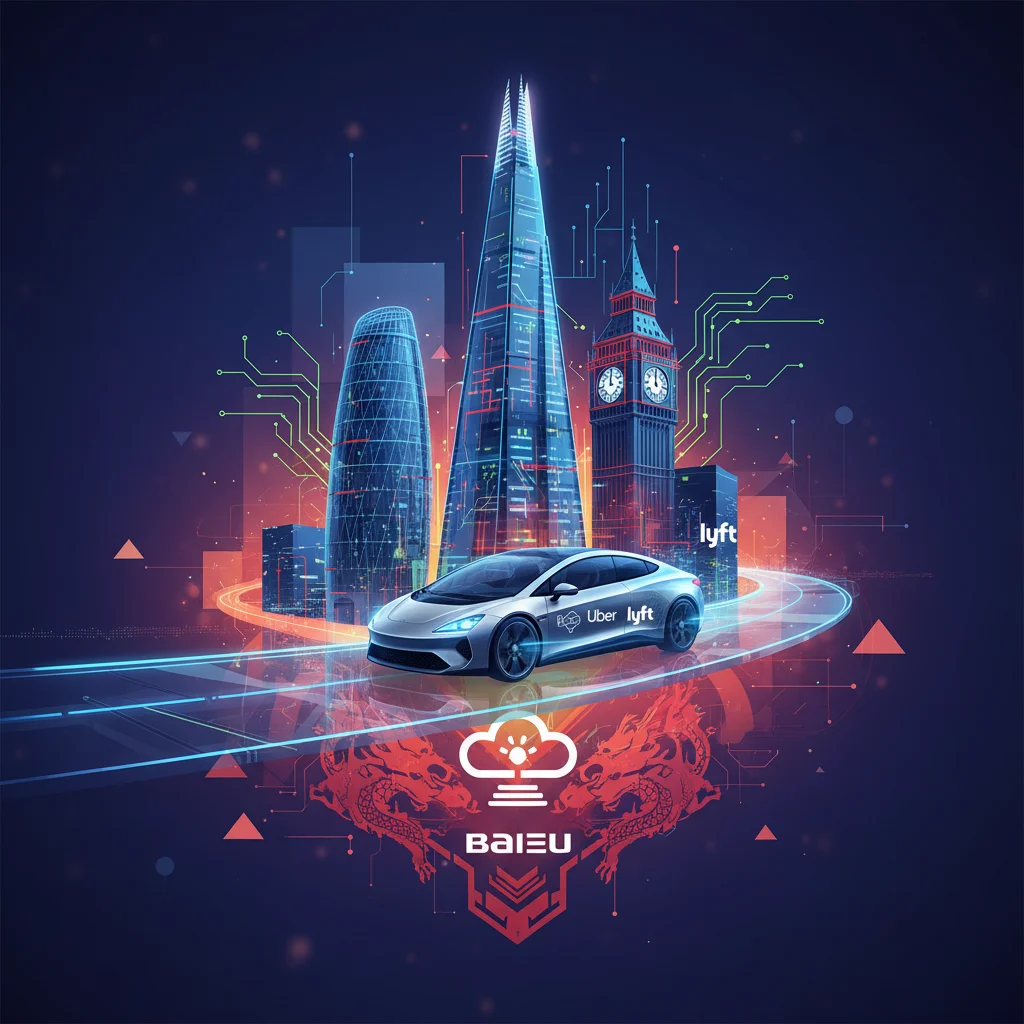
This isn’t a scene from a sci-fi blockbuster. This is the future that Uber and Lyft are actively planning to bring to the UK, with a stunning announcement that they intend to trial Chinese robotaxis on British roads by 2026. The technology partner in this ambitious venture? Baidu, the Chinese tech giant, and its highly experienced autonomous driving unit, Apollo Go.
For anyone in the tech industry—from developers and entrepreneurs to seasoned investors—this news is more than just a headline. It’s a seismic event signaling a new phase in the global race for autonomous dominance. It’s a story about geopolitics, groundbreaking software, and a fundamental reimagining of urban mobility. Let’s unpack what’s really going on.
The Key Players: A Strategic Alliance of Giants
To understand the magnitude of this move, you need to know the players involved. This isn’t a plucky startup taking a long shot; it’s a calculated partnership between established titans from different corners of the globe.
Uber & Lyft: The Platform Powerhouses
For years, both Uber and Lyft have seen autonomous vehicles as the holy grail. A future without human drivers promises lower operating costs, higher efficiency, and a solution to perennial driver shortages. Both companies poured billions into developing their own self-driving technology. Uber’s Advanced Technologies Group (ATG) was a high-profile effort, but the immense cost and complexity led them to sell the unit to Aurora Innovation in 2020. Lyft followed a similar path, selling its self-driving division to a Toyota subsidiary in 2021.
Their new strategy is clear: instead of building the cars, they will be the dominant platform that connects users to the cars. By partnering with Baidu, they get access to mature, road-tested technology without the massive R&D overhead. They’re focusing on what they do best: user experience, demand aggregation, and network management—a classic SaaS (Software as a Service) playbook applied to transportation.
Baidu’s Apollo Go: The Experienced Veteran
While less of a household name in the West, Baidu is a technology behemoth in China, often called the “Google of China.” Its Apollo Go autonomous driving platform is anything but a newcomer. This isn’t a theoretical project; it’s a proven service. Baidu’s Apollo Go robotaxis have already accrued millions of driverless rides in multiple cities across China, like Wuhan and Chongqing.
Their approach is built on a powerful combination of sophisticated sensors, deep learning algorithms, and a massive data feedback loop from their existing fleet. Every mile driven by an Apollo vehicle feeds data back to the central cloud infrastructure, making the entire system smarter. This real-world experience is their trump card and likely the primary reason Uber and Lyft are ready to bet on them for a market as complex as the UK.
The UK's New Digital Nanny: Is AI-Powered Nudity Blocking a Solution or a Slippery Slope?
Under the Hood: The Tech Stack Driving the Revolution
So, how does a car drive itself through the chaotic streets of a major city? It’s a symphony of cutting-edge hardware and intelligent software, a testament to the power of modern AI and machine learning.
- Perception: The car “sees” the world using a suite of sensors, including LiDAR (Light Detection and Ranging), high-resolution cameras, and radar. This data is fused together to create a 360-degree, real-time 3D map of the environment, identifying pedestrians, cyclists, other vehicles, and road signs with incredible precision.
- Prediction: This is where the machine learning magic happens. The AI doesn’t just see a cyclist; it predicts their likely path. Will they swerve? Will they stop? The system runs thousands of simulations per second based on models trained on petabytes of driving data.
- Planning & Control: Based on the perception and prediction data, the core software plots the safest and most efficient path forward. This involves complex algorithms for acceleration, braking, and steering—a level of automation that requires flawless execution.
- Cloud & Connectivity: Each vehicle is a node in a larger network. They are constantly communicating with a central cloud platform, receiving over-the-air software updates, real-time traffic data, and remote assistance if needed. This architecture is crucial for fleet management and continuous improvement.
The programming behind these systems is incredibly complex, often involving a mix of C++ for real-time performance and Python for machine learning model development. For developers, this convergence represents a massive field of innovation and opportunity.
The Autonomous Landscape: A Competitive Snapshot
Baidu, Uber, and Lyft aren’t operating in a vacuum. The race to deploy autonomous vehicles is a global marathon with several well-funded competitors. Here’s a simplified look at how the key players stack up:
| Company (Parent) | Primary Approach | Key Technology Focus | Current Deployment Status |
|---|---|---|---|
| Waymo (Alphabet) | Full L4/L5 Robotaxi Service | Proprietary “Waymo Driver” stack with heavy LiDAR integration | Commercial operations in Phoenix, San Francisco, and Los Angeles |
| Cruise (General Motors) | Full L4/L5 Robotaxi Service | Deep integration with GM vehicle hardware; LiDAR-centric | Operations paused for safety review; previously active in several US cities |
| Baidu Apollo Go | Robotaxi Service & Open Platform | Mature AI with millions of real-world miles; strong V2X (Vehicle-to-Everything) | Widespread commercial service in multiple major Chinese cities (source) |
| Tesla | Advanced Driver-Assist (ADAS) sold to consumers | Vision-only (no LiDAR); relies on massive fleet data from consumer cars | “Full Self-Driving” (Beta) available to customers; not a true robotaxi service yet |
This table highlights the significance of the Uber/Lyft/Baidu partnership. While Waymo and Cruise have focused on building vertically integrated services in the US, Baidu has achieved immense scale in its home market. This trial is its first major foray into a key Western market, leveraging the existing user bases of Uber and Lyft as a powerful entry strategy.
When Lifelines Fail: Can AI and Automation Prevent the Next 999 Outage?
Why This Matters: The Ripple Effect on Tech, Business, and Society
The arrival of robotaxis is not just a new feature in a ride-hailing app. It’s a catalyst for widespread change.
For Developers and Tech Professionals:
The demand for talent in AI, robotics, computer vision, and embedded systems will skyrocket. Expertise in cybersecurity for connected devices will become paramount, as securing a fleet of autonomous vehicles from malicious attacks is a non-negotiable requirement. This is a field where software truly meets the physical world, creating fascinating challenges in reliability, safety, and ethical programming.
For Entrepreneurs and Startups:
The rise of the “passenger economy” opens up a universe of new business models. If people are no longer driving, what will they be doing in their cars? This creates opportunities for startups focused on in-car entertainment, mobile commerce, and productivity tools. Ancillary services will also boom, from specialized cleaning and maintenance for AV fleets to advanced fleet management software and high-speed charging infrastructure.
For the Public and Urban Planners:
The long-term vision is transformative. Widespread automation in transport could drastically reduce traffic accidents, ease congestion, and reclaim urban space currently dedicated to parking. It could provide newfound mobility for the elderly and people with disabilities. However, it also raises critical questions about job displacement for professional drivers, data privacy, and the ethical decision-making of AI in accident scenarios.
The Dust Settles: Why Roomba's AI Dream Ended in a Bankruptcy Nightmare
The Road Ahead: Navigating the Bumps to 2026
The path to a 2026 launch is far from smooth. Uber, Lyft, and Baidu will need to navigate a complex web of challenges:
- Regulatory Hurdles: The UK government has been supportive of AV testing, but approving a large-scale public service is another matter entirely. Clear legal frameworks for liability and safety will be essential.
- Public Trust: Winning over a skeptical public is crucial. Every incident, no matter how minor, will be heavily scrutinized. Extensive public education and a flawless safety record during trials will be key.
- Technical Perfection: As noted, London is a uniquely challenging environment. The AI must be robust enough to handle every conceivable edge case, from complex roundabouts to unpredictable British weather.
Despite these challenges, the announcement marks a clear statement of intent. The era of autonomous mobility is accelerating, and the familiar apps on our phones are set to become the gateway to this revolutionary technology. The fusion of American platform dominance, Chinese AI expertise, and the historic streets of London will be a fascinating experiment to watch. Fasten your seatbelts—the future of transportation is about to get a whole lot more interesting.