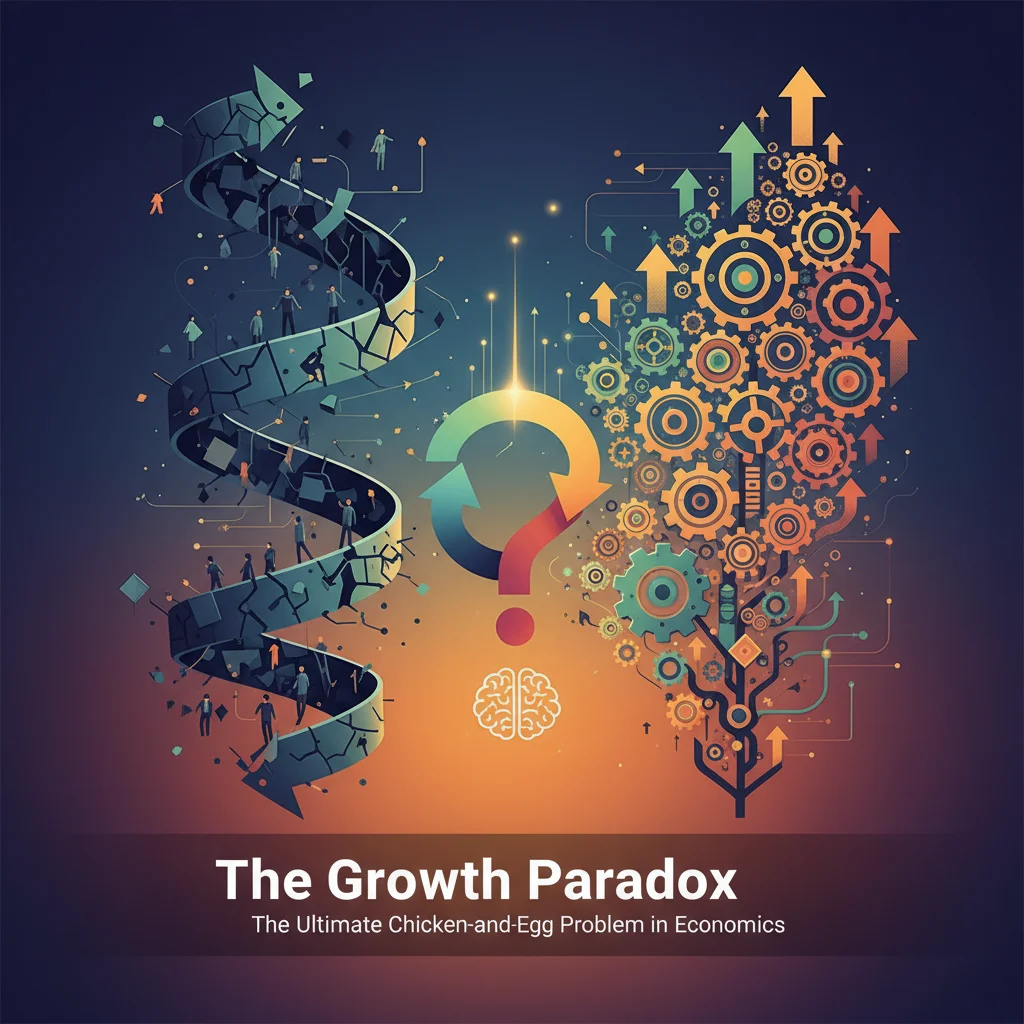
The Growth Paradox: Is Poverty a Cause or a Consequence of Economic Stagnation?
The Ultimate Chicken-and-Egg Problem in Economics
In the complex world of global economics and finance, few questions are as fundamental or as fiercely debated as the one surrounding poverty. Is a lack of economic growth the primary driver of poverty, or does widespread poverty itself stifle the very growth needed to eradicate it? This classic chicken-and-egg dilemma, eloquently highlighted in a letter to the Financial Times, sits at the heart of development economics and has profound implications for investors, business leaders, and policymakers alike. For decades, the debate has shaped international aid, government policy, and investment strategies.
On one side of the argument is the “growth-first” school of thought. Proponents argue that the most effective anti-poverty program is a robust, expanding economy. A rising tide, they contend, lifts all boats. By focusing on policies that stimulate GDP growth, attract foreign investment, and foster a dynamic stock market, nations create jobs, increase wages, and generate the tax revenue necessary to fund social safety nets. The focus here is on the macro: create a powerful economic engine, and the benefits will eventually trickle down to the most vulnerable.
On the other side is the “poverty-first” or “human capital” perspective. This view posits that a population trapped in poverty lacks the fundamental tools to participate in a modern economy. Without access to adequate healthcare, education, and basic financial services, individuals cannot become productive workers, innovative entrepreneurs, or active consumers. In this model, poverty isn’t just a result of a weak economy; it’s a primary cause. The focus here is on the micro: empower individuals directly, and they will collectively build a stronger, more resilient economy from the ground up.
Untangling this paradox is more than an academic exercise. It directly influences how capital is allocated, how businesses approach emerging markets, and how we can build a more stable and prosperous global economy. In this analysis, we will delve into both sides of this crucial debate, explore how modern financial technology is rewriting the rules, and identify where the future of smart, sustainable investing lies.
The “Rising Tide” Argument: Why Economic Growth is Seen as the Ultimate Cure
The most compelling evidence for the growth-first approach comes from the monumental economic transformations of the 20th and 21st centuries. The argument is simple and powerful: a growing economy is a job-creating machine. When businesses expand, they need more workers. When competition for labor increases, wages rise. When individuals have stable, higher-paying jobs, they can afford better food, housing, and education for their children, breaking the intergenerational cycle of poverty.
No case study illustrates this more dramatically than China. Over the past four decades, China has pursued a relentless strategy of economic expansion, becoming the world’s factory and a global economic superpower. The results for poverty reduction have been staggering. According to the World Bank, China has lifted more than 800 million people out of poverty, accounting for over 75% of the global reduction in extreme poverty during this period. This was not primarily achieved through direct aid programs, but as a byproduct of massive investment in infrastructure, manufacturing, and trade that fueled unprecedented GDP growth.
From an investor’s perspective, this model is straightforward. Investing in a country’s stock market, participating in its bond market, or providing foreign direct investment (FDI) for a new factory is not just a play for financial returns; it’s a direct injection of capital into the economic engine. This capital builds companies, creates employment, and ultimately drives the prosperity that alleviates poverty. The health of the economy, measured by indicators like GDP growth and stock market performance, becomes the primary proxy for social progress.
The 2027 Crypto Countdown: Is the UK's Ambitious Plan a Game-Changer or a Gamble?
The “Poverty Trap” Argument: Why Human Capital is the True Engine of Growth
However, the growth-first model has its critics and its limitations. What happens when a country is stuck in a “poverty trap”? This is a vicious cycle where the conditions of poverty prevent the very economic development needed to escape it. A population suffering from malnutrition and preventable diseases cannot be productive. A workforce that is largely illiterate cannot adapt to new technologies or take on skilled jobs. A society without access to basic banking and credit cannot foster entrepreneurship.
This is where the human capital approach comes in. Proponents, including Nobel laureate Amartya Sen, argue that true development is about expanding human capabilities. By investing first in health, education, and financial inclusion, a country builds the foundational assets for long-term, sustainable growth. An educated and healthy population is more innovative, more adaptable, and more capable of driving a knowledge-based economy. This isn’t about handouts; it’s about investing in the most valuable asset any economy has: its people.
Microfinance is a prime example of this philosophy in action. By providing small loans to aspiring entrepreneurs in developing nations—often women who are excluded from the traditional banking system—organizations like the Grameen Bank have shown that a small amount of capital can unlock immense human potential. This approach doesn’t wait for a large corporation to build a factory; it empowers individuals to start their own businesses, creating a distributed and resilient economic base. Research from the International Monetary Fund (IMF) has consistently shown that greater financial inclusion is correlated with stronger economic growth and reduced income inequality.
Below is a comparison of these two foundational approaches to development economics.
| Aspect | Growth-First Approach | Human Capital-First Approach |
|---|---|---|
| Primary Goal | Increase national GDP and industrial output. | Improve individual well-being and capabilities. |
| Key Levers | Foreign Direct Investment, infrastructure projects, favorable trade policies, stock market development. | Investment in education, healthcare, microfinance, and basic financial inclusion. |
| Core Belief | A rising economic tide will lift all boats. | Empowered individuals will build their own boats, creating a tide. |
| Potential Risk | Can exacerbate inequality if gains are not widely shared. | Can lead to slower initial GDP growth and reliance on aid. |
| Investor Focus | Macro-level indicators: market indices, national debt, GDP forecasts. | Micro-level impact: social return on investment (SROI), ESG metrics, community impact. |
Bridging the Divide: How Fintech and Modern Investing Are Solving the Paradox
The old debate is being rendered obsolete by a new wave of innovation in finance and technology. These advancements are creating systems that can simultaneously drive economic growth and directly tackle the root causes of poverty, creating a virtuous cycle that benefits both investors and society.
1. Financial Technology (Fintech) and Inclusion
One of the biggest barriers for people in poverty is a lack of access to the formal banking system. Without a bank account, it’s difficult to save money securely, receive payments, access credit, or get insurance. Fintech is demolishing this barrier. In Africa, Asia, and Latin America, mobile money platforms have brought hundreds of millions of people into the formal financial system for the first time. This digital infrastructure allows for more efficient trading, enables small-scale entrepreneurship, and provides a platform for delivering other services. This is a clear case where a technological innovation in finance directly empowers individuals, fueling grassroots economic activity.
2. Blockchain and Transparency
A significant challenge in development is corruption and inefficiency, where aid money or government funds fail to reach their intended recipients. Blockchain technology offers a potential solution. With its immutable and transparent ledger, blockchain can be used to track the flow of funds from a donor all the way to a beneficiary, ensuring accountability and cutting out intermediaries. It can also be used to create secure digital identities and land registries, giving people in poverty a formal claim to their assets—a crucial step for accessing credit and investing in their future.
3. The Rise of Impact Investing and ESG
Perhaps the most significant shift is happening within the investment community itself. A growing number of investors are no longer solely focused on maximizing financial returns. They are using their capital to actively seek out companies and funds that generate a positive and measurable social or environmental impact alongside a financial return. The impact investing market is now worth over a trillion dollars, according to the Global Impact Investing Network. This trend is forcing a change in corporate behavior. Companies operating in emerging markets are now being judged not just on their profits, but on their labor practices, their community engagement, and their environmental footprint. This aligns the machinery of the stock market and private equity with the goals of sustainable development.
Conclusion: A New Paradigm for a Stronger Global Economy
The “chicken and egg” problem of poverty and growth is not a problem with a single answer, because it’s no longer the right question. We’ve moved beyond the binary choice between top-down growth and bottom-up empowerment. The future of a prosperous and stable global economy lies in creating systems that do both simultaneously.
For finance professionals, business leaders, and investors, this represents a monumental shift and an incredible opportunity. The strategies that will generate the most sustainable long-term returns will be those that are inherently inclusive. By leveraging financial technology to reach the unbanked, by using blockchain for greater transparency, and by adopting an ESG and impact-focused investing lens, we can build economic models that are more resilient, more equitable, and ultimately, more profitable. Tackling poverty is not just a moral imperative; in the 21st century, it is the most intelligent strategy for building a robust and dynamic global economy.
UK Housing Correction: Decoding the £2,000 Price Drop and What It Means for Your Investments