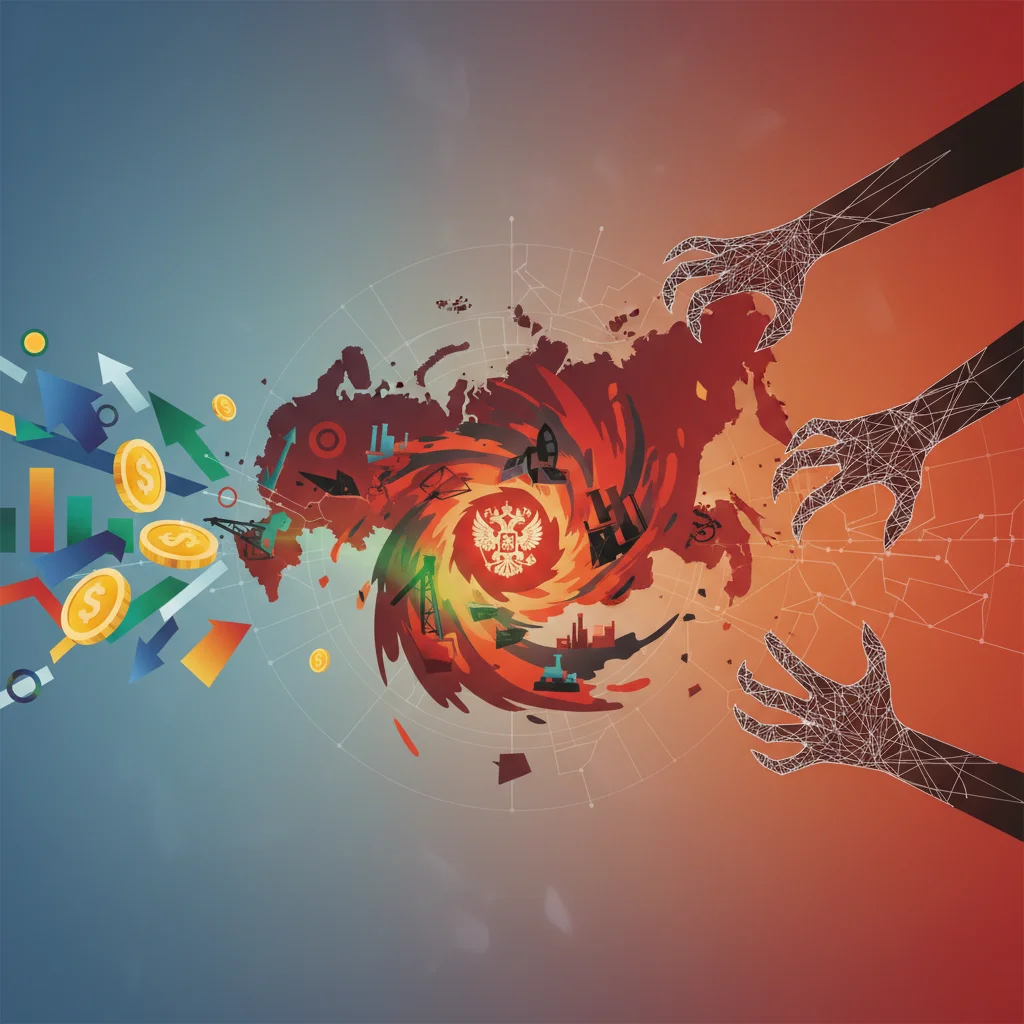
Investing in Russia: The Ultimate Moral Hazard in Modern Finance
In the intricate world of global finance, every investment is a calculated risk. Professionals spend their careers building complex models to price this risk, weighing economic indicators, market sentiment, and corporate health. But what happens when the risk isn’t just financial, but fundamentally moral? What happens when a nation repeatedly demonstrates a willingness to tear up the rulebook, default on its obligations, and engage in actions that make it a pariah on the world stage? This is the stark reality facing anyone considering investing in Russia today, a situation that Timothy Ash of Chatham House aptly labels a profound “moral hazard.”
The term “moral hazard” is a cornerstone of economics and finance. It describes a situation where one party gets involved in a risky event knowing that it is protected against the risk and some other party will incur the cost. It’s the reason you have a deductible on your insurance—to ensure you still have an incentive to be careful. In the context of international investing, the moral hazard arises when investors pour capital into a regime with a history of expropriation and default, implicitly assuming that if things go wrong, some international body or future government will make them whole. This assumption is not just financially naive; it’s ethically perilous and sets a dangerous precedent for the entire global financial system.
This post delves into the complex layers of risk associated with the Russian economy, moving beyond simple stock market charts and P/E ratios. We will explore Russia’s historical disregard for financial obligations, analyze the unprecedented modern sanctions regime, and ultimately argue why treating Russian assets as a typical high-risk, high-reward play is a fallacy that ignores the deep-seated moral and structural dangers involved.
A Century of Broken Promises: Russia’s Historical Default DNA
To understand the risk of investing in Russia today, one must look beyond the immediate crisis and examine its historical DNA. The concept of investor protection has had a fraught and often violent history in the country. The most glaring example, as highlighted by Ash, dates back to 1918. Following the Bolshevik Revolution, Vladimir Lenin’s government outright repudiated all the sovereign debt of the Tsarist regime, wiping out the holdings of countless foreign investors, particularly in France. This was not a restructuring or a delayed payment; it was a complete and total erasure of obligation, an ideological statement that the new state was not bound by the promises of the old.
While a century has passed, that event etched a permanent scar on Russia’s reputation in international finance. It established a precedent that, under sufficient political pressure, the state’s commitments could simply vanish. Fast forward eighty years to 1998. In the chaotic aftermath of the Soviet Union’s collapse, Russia once again defaulted on its domestic debt, devalued the ruble, and declared a moratorium on payments to foreign creditors. The 1998 financial crisis sent shockwaves through the global economy, contributing to the collapse of the highly-leveraged US hedge fund Long-Term Capital Management (LTCM) and requiring a massive bailout to prevent systemic contagion. For a generation of traders and investors, it was a brutal lesson in the political and economic volatility inherent in the Russian market.
These are not isolated incidents; they are foundational data points. They reveal a pattern where political expediency and state power can override the legal and financial contracts that underpin the global economy. Ignoring this history is not just an analytical failure; it’s a willful blindness to the fundamental character of the investment landscape.
Beyond the Bottom Line: How Europe's New Reporting Rules Are Redefining Global Finance
The Modern Minefield: Sanctions, Seizures, and a Bifurcated Financial World
If history provides the context, the current situation presents an entirely new dimension of risk. The international response to the 2022 invasion of Ukraine has been financially unprecedented. The sanctions levied against Russia by the G7 and its allies are the most comprehensive and coordinated ever imposed on a major economy. These are not merely symbolic gestures; they are structural attacks on Russia’s integration into the global financial system.
Consider the key measures enacted:
- Central Bank Asset Freeze: Approximately $300 billion of the Russian Central Bank’s foreign reserves were frozen, effectively removing the state’s primary tool for defending its currency and managing its economy.
- SWIFT Cutoff: Major Russian banks were disconnected from the SWIFT messaging system, the backbone of international banking transactions, isolating them from routine global commerce.
– Technology and Capital Bans: Severe restrictions were placed on exporting critical technology to Russia and on new investments in key sectors like energy.
These actions have created a “fortress Russia” that is also a financial prison. For foreign investors, the implications are stark. Even if a Russian company is profitable, how do you repatriate dividends? If you hold a Russian bond, how can you receive payment when the banking channels are severed? The Moscow stock market may post gains in ruble terms, but what is the real-world value of those assets if they cannot be sold and converted into hard currency? The traditional tools of financial analysis become moot when the basic plumbing of trading and settlement is deliberately dismantled.
To illustrate the economic impact, let’s compare some key metrics before and after the full-scale invasion.
The table below provides a snapshot of the structural shock to the Russian economy, highlighting the shift from a globally integrated market to a sanctioned and isolated one.
| Economic Indicator | Pre-Invasion (2021) | Post-Invasion Reality (2022-2023) |
|---|---|---|
| Foreign Direct Investment (FDI) | $38.9 billion inflow (source) | Massive divestment and net outflow; new FDI from non-sanctioning countries is minimal. |
| Access to Global Capital Markets | Fully integrated; Russian firms and government could issue bonds and equity globally. | Largely cut off from Western capital; reliant on domestic market and limited non-Western sources. |
| Major Western Companies Operating | Over 1,000 major international firms had a significant presence. | Vast majority have exited, suspended operations, or sold assets at steep discounts. |
| Currency Convertibility | Ruble was freely convertible. | Severe capital controls imposed; convertibility is heavily managed and restricted. |
The Siren Call of Distressed Assets
Despite the overwhelming risks, a certain type of investor is invariably drawn to chaos. The allure of buying distressed assets for pennies on the dollar is a powerful one in the world of high finance. The logic is simple: if and when the situation normalizes, these assets could skyrocket in value, delivering astronomical returns. Some may be betting on a regime change or a swift end to the conflict, hoping to get in on the ground floor of a recovery.
However, this line of thinking is dangerously simplistic in the Russian context. It equates a war-torn, sanctioned state with a typical corporate bankruptcy. In a corporate restructuring, there is a legal framework (like Chapter 11 in the U.S.) that governs the process and protects creditors’ rights. In Russia, there is no such predictable framework. Any future “normalization” would be subject to the whims of the prevailing political power, with no guarantee that foreign investors would be treated fairly.
Furthermore, participating in this market actively props up a war economy. Buying Russian assets, even on the secondary market, creates liquidity and signals to the regime that some corners of the international financial community are willing to look the other way. This is where the financial argument bleeds directly into the ethical one, creating the moral hazard Timothy Ash warns of. Making a profit from a state engaged in a brutal war of aggression carries a reputational and ethical cost that cannot be quantified on a balance sheet.
The Bank of England's £800 Billion Tightrope: Why a Policy Misstep Could Shake the UK Economy
The Precedent for Global Finance and Economics
The ultimate danger of this moral hazard extends far beyond individual portfolios. If the global community were to orchestrate a bailout or create mechanisms that make investors in Russian debt whole, it would send a catastrophic signal to other rogue or authoritarian regimes. The message would be clear: you can default on your debts, invade your neighbors, and violate international law, and the global financial system will eventually find a way to cushion the blow for those who funded you.
This would fundamentally undermine the risk-pricing mechanism that underpins the entire system of international lending and investing. The cost of capital for all emerging markets could rise, as lenders would have to price in the possibility that even the most egregious behavior might not lead to permanent financial consequences. It would cripple the effectiveness of financial sanctions as a tool of foreign policy, one of the few powerful levers available short of military conflict.
For investors and corporations that profess to follow ESG (Environmental, Social, and Governance) principles, the contradiction is even more acute. The “S” and “G” in ESG are rendered meaningless if a firm willingly holds assets in a country that is actively violating the core tenets of social responsibility and good governance on a global scale. This is the ultimate test of whether ESG is a genuine framework for ethical investing or merely a marketing tool.
The Price of a Vote: Why Political Data Mining is a Ticking Time Bomb for the Economy
Conclusion: An Unacceptable Risk
The case against investing in Russia is not a political argument disguised as financial advice. It is a cold, hard assessment of risk in its purest form—a synthesis of historical precedent, geopolitical reality, and ethical consideration. The Russian Federation has, through its actions past and present, demonstrated a fundamental untrustworthiness that dissolves the very foundation of a sound investment: a predictable legal and political framework.
To invest in Russia today is to make a bet not on economic fundamentals, but on the hope that decades of history and the current global order will be overturned. It is to accept a level of political and legal risk that is unquantifiable. Most importantly, it is to participate in a moral hazard that rewards destructive behavior and sets a dangerous precedent for the future of global finance. For any prudent investor, business leader, or policymaker, the conclusion is unavoidable: the risk is not just high; it’s unacceptable.

Related Posts
The TikTok Deal: A High-Stakes Game for Global Finance, Technology, and Your “For You” Page

The Kingmaker’s Gambit: How One Man’s Political Strategy Could Reshape Israel’s Investment Landscape