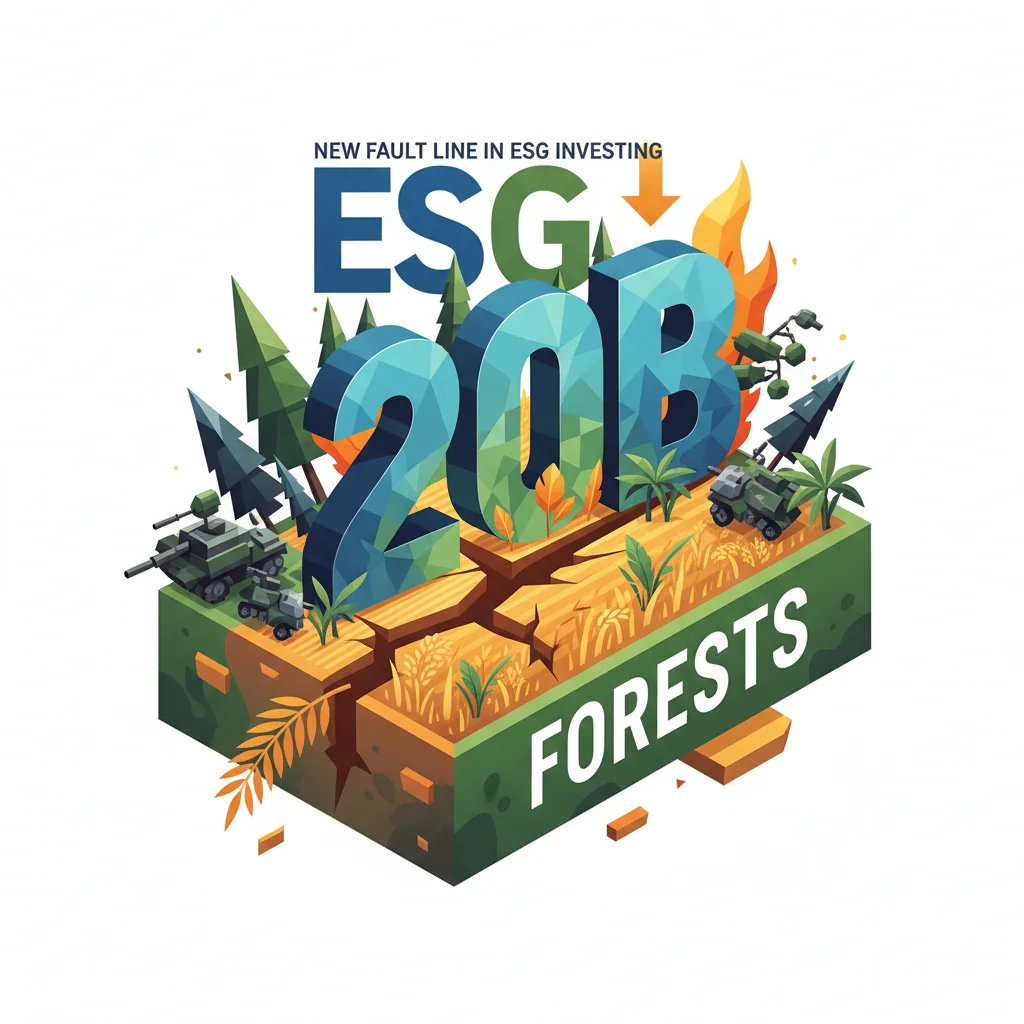
Indonesia’s $20 Billion Gamble: Forests for Food and the New Fault Line in ESG Investing
In a move that has sent shockwaves through environmental and financial circles alike, the Indonesian government is deploying its military to accelerate the clearing of vast swathes of rainforest. The objective: a colossal state-backed “food estate” project aimed at bolstering national food security. The scale is staggering—an area of up to 3 million hectares, roughly the size of Belgium, is slated for conversion into farmland. This isn’t just an environmental story; it’s a profound development with deep implications for the global economy, international investing, and the very principles of sustainable finance.
For investors, business leaders, and financial professionals, Indonesia’s ambitious plan presents a complex and challenging case study. It pits a nation’s sovereign right to feed its people against its international climate commitments. This decision creates a new and volatile fault line in the world of ESG (Environmental, Social, and Governance) investing, forcing a difficult conversation about priorities in an increasingly unstable world. As we’ll explore, the ripple effects could touch everything from commodity trading and the stock market to the future of financial technology in supply chain management.
The “Food Estate”: A Nation’s Response to Global Volatility
At its core, the food estate project is President Joko Widodo’s answer to a growing global crisis. The COVID-19 pandemic and the war in Ukraine have exposed the fragility of global supply chains, sending food prices soaring and raising the specter of shortages. For a nation of over 270 million people, dependency on food imports is a significant economic and political vulnerability. The government’s stated goal is to transform these forest and peatland areas into productive farms for crops like rice, corn, and cassava, thereby reducing its import bill and achieving self-sufficiency.
The involvement of the military is a clear signal of the project’s national priority. While officially tasked with providing logistical support and manpower, their presence underscores the government’s determination to push the project forward at a rapid pace, side-stepping potential bureaucratic or local opposition. This top-down, state-driven approach is a hallmark of major infrastructure projects in the region, but its application to land conversion on this scale is unprecedented and raises critical questions about governance and transparency.
The Swiss Paradox: How a Record M&A Boom is Defying Economic Gravity
Balancing the Economic Ledger: A High-Stakes Calculation
From a purely domestic economics perspective, the government’s rationale is understandable. However, the project’s success is far from guaranteed, and the potential downsides are immense, creating a high-stakes economic gamble. Below is a breakdown of the perceived benefits versus the significant, and potentially catastrophic, risks involved.
| Stated Economic Goals (The “Pros”) | Potential Environmental & Economic Risks (The “Cons”) |
|---|---|
| Enhanced Food Security: Reduced reliance on volatile international markets for staple foods, insulating the domestic economy from global price shocks. | Massive Carbon Emissions: Clearing forests and draining carbon-rich peatlands releases enormous amounts of CO2, undermining Indonesia’s climate goals and potentially incurring future carbon taxes or trade barriers. |
| Reduced Import Bill: Lowering food imports can improve the nation’s trade balance and strengthen its currency. | Biodiversity Loss: The targeted areas are home to critically endangered species, including orangutans. This loss of “natural capital” has long-term economic consequences for tourism and ecosystem services. |
| Job Creation: The project promises to create agricultural jobs in rural areas, potentially alleviating poverty. | Soil Degradation & Low Yields: Experts have warned that many of the targeted peatlands are unsuitable for the proposed crops, risking project failure, soil degradation, and wasted investment (source). |
| Rural Development: Aims to stimulate economic activity in less-developed regions of Borneo and Papua. | Sovereign & Reputational Risk: The project could damage Indonesia’s international standing, impacting its credit rating, foreign investment, and access to international banking and climate finance. |
The Investor’s Dilemma: Navigating the New ESG Minefield
For the global investment community, Indonesia’s food estate project is a red flag that cannot be ignored. It introduces several layers of risk and complexity that will directly impact portfolios and investment strategies.
1. The ESG Conflict
This project is a classic ESG conundrum. It scores points on the “S” (Social) by addressing food security but fails catastrophically on the “E” (Environmental). ESG rating agencies and fund managers will struggle to score Indonesian sovereign bonds and equities. Funds with strict deforestation-free mandates may be forced to divest, potentially causing capital flight and impacting the Indonesian stock market. This forces a re-evaluation of how ESG frameworks weigh competing objectives.
2. Commodity Markets and Supply Chain Contamination
The project will inevitably increase the supply of certain agricultural commodities from Indonesia. However, this new supply will be tainted by its association with deforestation. This could lead to a two-tiered market, where “deforestation-free” products command a premium. For international corporations in the food and beverage sector, this creates a massive supply chain headache. Proving the origin of their raw materials will become more critical—and more difficult—than ever. The reputational damage of being linked to this project could be severe.
Beyond the Ticker: Why Hedge Funds Are Getting Their Hands Dirty in Physical Commodities
3. The Role of Financial Technology
This challenge, however, also presents an opportunity for innovation. The need for verified, transparent supply chains is a perfect use case for emerging financial technology. Imagine a system where blockchain is used to create an immutable, farm-to-shelf ledger for every bag of rice or ton of cassava. Satellite imagery and IoT sensors could verify that a product originated from a pre-existing, non-deforested plot of land. This data could be integrated into fintech platforms used for trade finance and supply chain management, allowing banking institutions and corporations to selectively finance and procure sustainable goods. This isn’t science fiction; it’s a necessary evolution in response to complex market risks like the one unfolding in Indonesia.
International Pressure and the Future of Green Finance
The final piece of the puzzle is the reaction of the international community. Major financial institutions like the World Bank and the Asian Development Bank, as well as nations that have provided Indonesia with billions in climate finance, are now in an awkward position. They have championed Indonesia’s climate goals, which now seem to be taking a backseat to domestic policy. According to the Financial Times, this project could jeopardize a $20 billion Just Energy Transition Partnership aimed at weaning the country off coal.
The pressure from these institutions could be a powerful lever. If access to international capital markets and development loans is threatened, the economic calculation behind the food estate could change. This situation highlights the critical role that global banking and finance play in enforcing international norms and steering the global economy toward a more sustainable path.
Conclusion: A Bellwether for a World in Transition
Indonesia’s military-backed push to clear forests for food is more than a regional environmental issue. It is a bellwether for the global political economy. It encapsulates the tension between national priorities and global responsibilities, between immediate needs and long-term sustainability. For investors and business leaders, it serves as a stark reminder that the path to a green economy is not linear. Geopolitical instability, resource nationalism, and food security are powerful forces that can derail even the most well-intentioned climate plans.
The key takeaway is the need for a more sophisticated and nuanced approach to risk analysis. ESG can no longer be a simple checklist; it must be a dynamic framework that accounts for complex trade-offs. The financial world must watch Indonesia closely. The outcome of this $20 billion gamble—whether it leads to food security or ecological and economic disaster—will provide crucial lessons for the future of sustainable investing in an increasingly uncertain world.

Related Posts
The Unquantifiable Asset: How a Fast-Food Owner’s Goodwill Translates into Hard Financial Returns
The Ripple Effect: Why a Local Water Shortage is a Warning Sign for the Global Economy