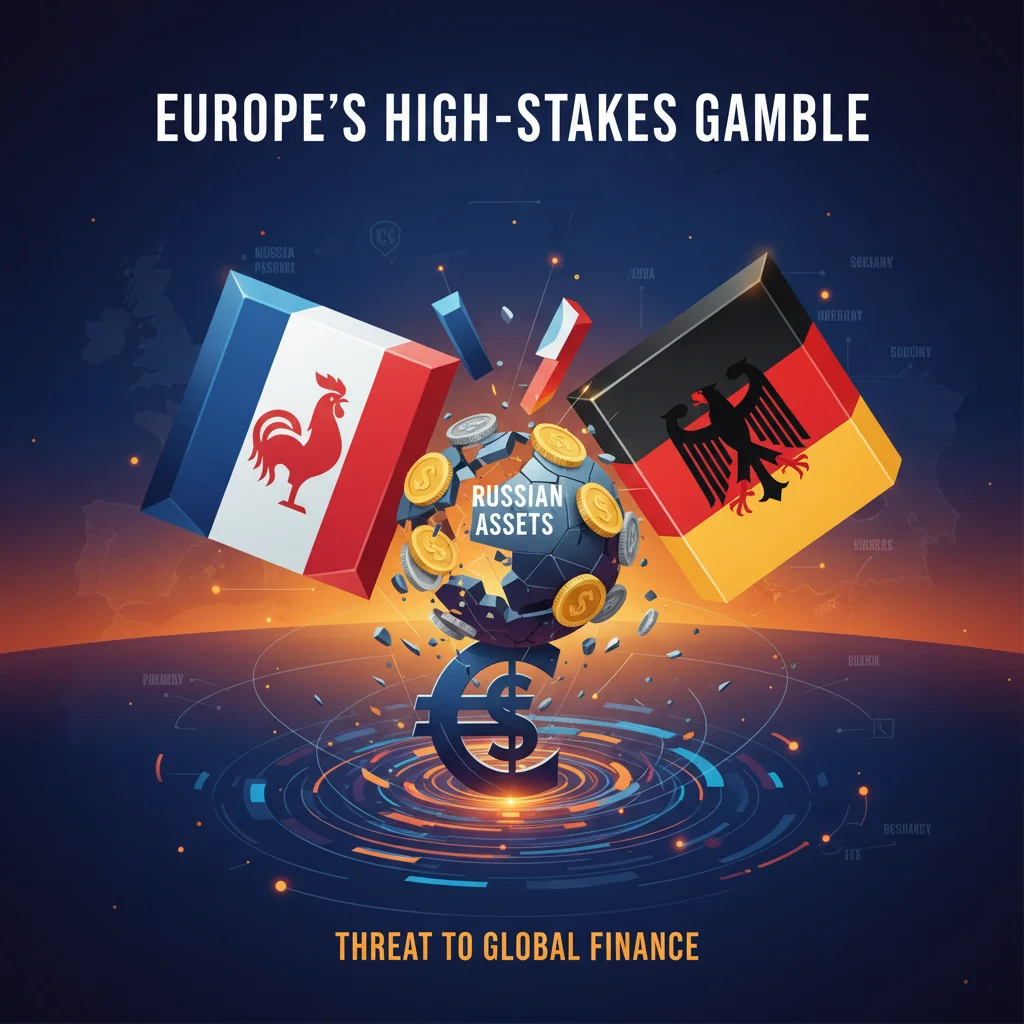
Europe’s High-Stakes Gamble: The Franco-German Clash Over Russian Assets Threatens Global Finance
In the intricate dance of European geopolitics, the partnership between France and Germany has long been the central rhythm. For decades, this duo has acted as the continent’s engine, with Germany’s economic pragmatism often tempering France’s bold political ambitions. But in the shadow of the ongoing war in Ukraine, a stunning role reversal is underway, one that has blindsided observers and threatens to create deep fissures not just within the European Union, but across the global financial landscape. At the heart of this dispute lies a monumental question with no easy answer: What should be done with over €200 billion in frozen Russian central bank assets?
Germany, once the paragon of caution and a proponent of “Wandel durch Handel” (change through trade), is now championing a surprisingly aggressive stance. Spearheaded by figures like opposition leader Friedrich Merz and supported by Chancellor Olaf Scholz’s government, Berlin is increasingly open to the radical step of seizing these assets outright to fund Ukraine’s reconstruction. This marks a dramatic departure from Germany’s post-war identity, a “Zeitenwende” or “turning point” that extends from military spending to the very foundations of international finance.
Conversely, France, traditionally more assertive on the international stage, is now pumping the brakes. President Emmanuel Macron’s government is urging caution, expressing grave concerns over the legal and financial repercussions of such an unprecedented move. This unexpected hesitation from Paris has created a diplomatic impasse at a critical moment, leaving allies in the G7 puzzled and highlighting a fundamental disagreement on risk, responsibility, and the future of the global economy.
The Great Reversal: A New Power Dynamic in Europe
To understand the gravity of this shift, one must appreciate the historical context. Germany’s economic policy has long been rooted in stability, predictability, and a strict adherence to international law. The idea of seizing another sovereign nation’s assets was, until recently, anathema to Berlin’s political and banking establishment. However, the sheer brutality of the war in Ukraine and the mounting costs of supporting Kyiv have forced a profound recalculation.
The German position has evolved from initial reluctance to a powerful advocacy for leveraging Russia’s own funds against it. The argument from Berlin is increasingly one of moral and financial necessity. With Ukraine in desperate need of aid and Western taxpayers feeling the strain, the vast sums of money sitting dormant in European financial institutions present a tempting, and to some, a just, solution. This new assertiveness reflects a Germany that is shedding its post-Cold War reticence and embracing its role as a decisive geopolitical actor.
France’s newfound caution is just as remarkable. The Elysée Palace, typically a source of ambitious EU-level proposals, is now the voice of restraint. French officials argue that a full-scale seizure of assets would be a leap into the legal dark, violating the principle of sovereign immunity—a cornerstone of international law. They warn of a cascade of negative consequences, from endless legal challenges to severe retaliatory measures from Russia against French companies. According to a recent Financial Times report, this foot-dragging from Paris has become a major point of friction, particularly as Germany sought to build a consensus ahead of key G7 meetings (source).
The Unseen ROI: Why Your Travel Attire is a Strategic Financial Decision
At the Core of the Conflict: Profits vs. Principal
The debate centers on two distinct approaches for utilizing the frozen assets, the vast majority of which—nearly €190 billion—are held at the Belgium-based securities depository Euroclear. Both options carry vastly different implications for international law, economics, and the stability of the Eurozone.
Below is a breakdown of the two main proposals being debated within the G7, highlighting the stark contrast in risk and reward.
| Proposal | Mechanism | Estimated Yield for Ukraine | Key Proponents | Primary Risks |
|---|---|---|---|---|
| Windfall Profits Tax | Tax the unexpected profits (interest) generated by the immobilized assets. The principal remains untouched. | €3-5 billion annually | France, European Commission (initially) | – Legally safer but provides limited funds. – Seen by some as insufficient to meet Ukraine’s needs. – Potential for complex tax litigation. |
| Full Asset Seizure | Confiscate the entire principal of the frozen assets and transfer them to Ukraine. | ~€200 billion (one-time) | United States, United Kingdom, and increasingly, Germany | – Unprecedented legal challenge to sovereign immunity. – High risk of Russian retaliation. – Could destabilize the Euro and deter foreign investing in the EU. – Sets a dangerous international precedent. |
The French position favors the far less controversial option of taxing the windfall profits. This approach is seen as legally defensible, as it doesn’t touch the sovereign property itself. However, its critics, including many in Washington and Berlin, argue that the few billion it would generate annually are a drop in the bucket compared to Ukraine’s reconstruction needs, estimated to be in the hundreds of billions.
The German and American preference for full seizure is a high-stakes gambit. It promises a war-changing financial package for Ukraine but risks tearing up the rulebook of global finance. The core fear, articulated forcefully by Paris, is that such a move would shatter the trust that underpins the international financial system. If a country’s central bank reserves can be confiscated, why would nations like China, Saudi Arabia, or Brazil continue to hold their vast reserves in Euros or Dollars? The long-term damage to the Euro’s status as a reserve currency, they argue, could far outweigh the short-term benefit to Ukraine.
Germany’s newfound boldness, on the other hand, is a direct response to the existential threat Russia poses. Berlin appears to have concluded that the risk of inaction—a defeated Ukraine and an emboldened Russia on the EU’s border—is far greater than the potential financial blowback. For business leaders and finance professionals, this signals a major shift: geopolitical risk is no longer a secondary consideration but a primary driver of economic policy in Europe’s largest economy. The outcome of this debate will send a powerful signal to the stock market about the EU’s appetite for risk and its commitment to upholding the international order, or its willingness to rewrite the rules in the face of aggression.
The Global Ripple Effect: Beyond Europe’s Borders
The implications of this decision extend far beyond Paris and Berlin. The United States has been a vocal proponent of seizing the assets, viewing it as a way to make Russia pay directly for its aggression. The G7 remains divided, and the EU’s inability to form a consensus, largely due to French resistance, has stalled progress. A failure to act decisively could be interpreted as a sign of weakness and disunity in the West, a narrative that would be eagerly exploited by Moscow and Beijing.
Furthermore, this debate is forcing a global conversation about the architecture of international finance. For decades, the system has been built on the U.S. dollar and the Euro as the world’s primary reserve currencies, with Western financial institutions acting as the central clearing houses. A move to confiscate sovereign assets, no matter how justified, could accelerate efforts by non-Western powers to build parallel financial systems. This could involve promoting other currencies, creating alternative payment networks, or even exploring decentralized financial technology (fintech) and blockchain-based solutions to reduce dependence on the West. The long-term consequences for Western economic dominance could be profound.
Beyond the Ticker: Why Hedge Funds Are Getting Their Hands Dirty in Physical Commodities
The legal precedent is another major concern. While proponents argue that Russia’s violation of international law justifies a proportional response, opponents warn of a slippery slope. If Russian assets can be seized today, whose could be seized tomorrow? This uncertainty could introduce a new layer of political risk into sovereign debt markets and international banking, potentially raising borrowing costs for nations perceived as politically unstable. The very predictability that underpins the global economy is at stake.
Conclusion: A Crossroads for Europe and the World
The surprising role reversal between a newly assertive Germany and a suddenly cautious France over frozen Russian assets is a defining moment for the European Union. It lays bare the deep-seated tensions between moral imperatives and legal-financial realities. The final decision, which remains elusive, will have consequences that reverberate for decades.
For investors, business leaders, and financial professionals, this is a crucial development to watch. It is a real-time stress test of the EU’s political cohesion and the resilience of the global financial order. The outcome will not only impact the funding of Ukraine’s defense and reconstruction but will also set a powerful precedent for the future of economic sanctions, sovereign immunity, and the balance of power in the 21st-century global economy. As Paris and Berlin navigate this high-stakes diplomatic fallout, the world watches, knowing that the very rules of international finance hang in the balance.

Related Posts
Europe’s Trillion-Dollar Battery Dilemma: Why Local Content is the New Gold Standard

The Kingmaker’s Gambit: How One Man’s Political Strategy Could Reshape Israel’s Investment Landscape