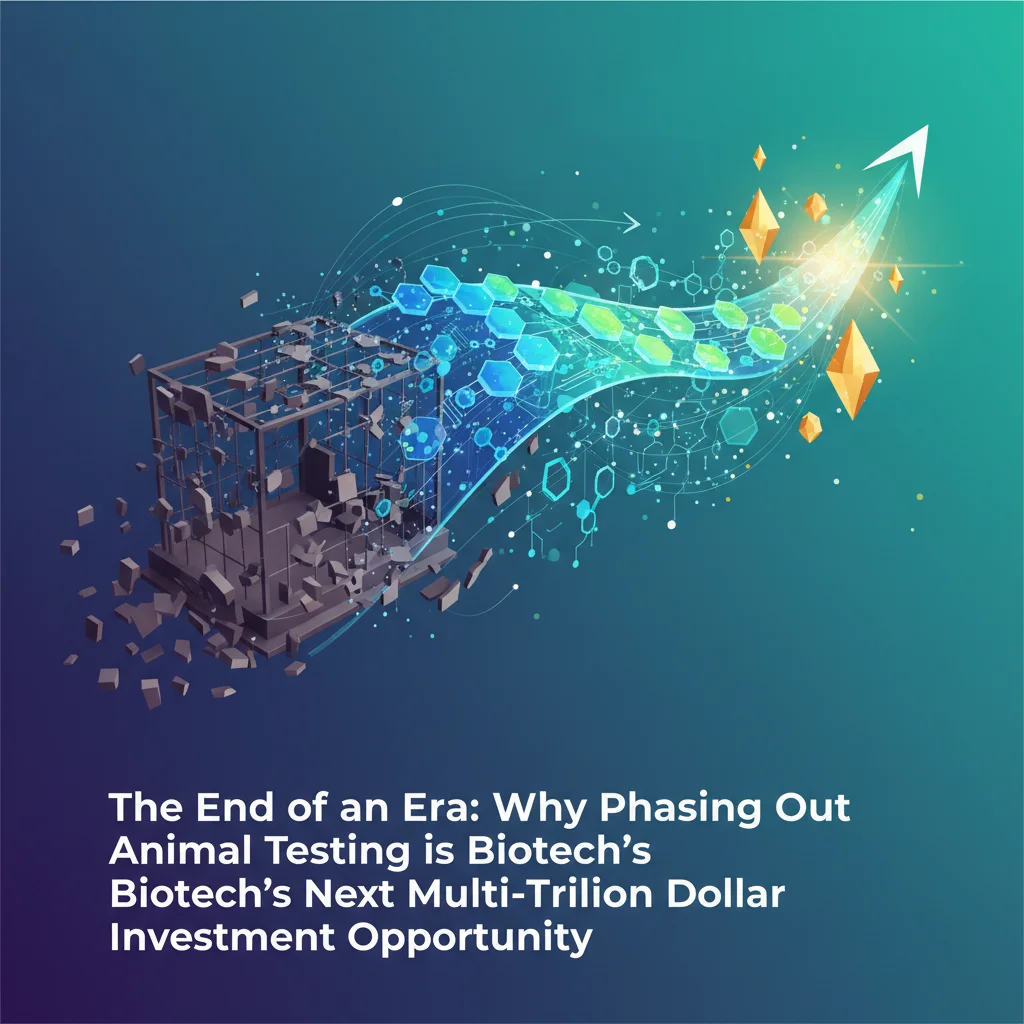
The End of an Era: Why Phasing Out Animal Testing is Biotech’s Next Multi-Trillion Dollar Investment Opportunity
For nearly a century, the path to bringing a new drug to market has been a long, arduous, and expensive journey, marked by a critical, yet deeply flawed, gatekeeper: animal testing. It has been a non-negotiable step mandated by regulators, a process that consumes billions of dollars and years of research. Yet, its predictive power for human outcomes has been shockingly poor. Now, a seismic shift is underway, one that promises not only to revolutionize drug development but also to create a powerful competitive advantage and a landmark opportunity for savvy investors.
This transformation was recently highlighted in a letter to the Financial Times by Simon Burns, CEO of the clinical research technology company Vial. He argues that the move away from mandated animal testing can give Western biotech firms a decisive edge. This isn’t just an ethical or scientific debate; it’s a fundamental change in the economics of one of the world’s most vital industries. For those in finance, investing, and business leadership, understanding this paradigm shift is crucial, as it will redefine risk, accelerate timelines, and ultimately determine the next generation of winners in the pharmaceutical stock market.
The Broken Model: The Staggering Cost and Failure of Animal-Based Drug Development
To appreciate the magnitude of the coming change, one must first grasp the inefficiency of the current system. The drug development pipeline is notoriously a “leaky” one, where the vast majority of promising compounds fail before ever reaching a patient. A significant part of this problem lies in the preclinical phase, where animal testing is the primary method for assessing safety and efficacy.
The statistics are grim. An estimated 95% of all drugs that are shown to be safe and effective in animal tests go on to fail in human trials. They either don’t work, have dangerous side effects, or both. This chasm between animal models and human biology represents one of the most significant bottlenecks in modern medicine. The physiological and genetic differences are often too vast for a mouse, rat, or even a primate to be a reliable proxy for a human patient.
This failure rate has profound financial consequences. The cost to develop a new prescription medicine that gets to market is now estimated to be as high as $2.8 billion. A large portion of this cost is sunk into compounds that ultimately fail, often after successfully clearing animal trials. For investors, this translates into immense risk. A biotech company’s valuation can be decimated overnight by a failed Phase II or Phase III clinical trial, wiping out billions in market capitalization and setting research back by years. This high-stakes reality has long been a defining feature of biotech investing, making the entire sector a high-risk, high-reward proposition.
The Trillion-Dollar Ripple Effect: Why a Farmer's Poverty is Wall Street's Problem
A Legislative Game-Changer: The FDA Modernization Act 2.0
The catalyst for this industry-wide disruption is a landmark piece of bipartisan legislation: the FDA Modernization Act 2.0, signed into law in the United States at the end of 2022. For the first time since 1938, this act removes the federal mandate requiring animal testing for new drugs. It doesn’t ban the practice, but it officially empowers the FDA to accept data from a new generation of alternative testing methods.
This is more than a subtle regulatory tweak; it is a declaration that the future of drug development lies in human-relevant science. By unshackling innovators from an archaic requirement, the act unleashes the potential for faster, more accurate, and more cost-effective drug discovery. It allows biotech firms to pivot to technologies that better predict human response, fundamentally altering the risk equation that has long governed the industry’s economics.
The New Arsenal: Comparing Traditional vs. Modern Testing Methods
The alternatives sanctioned by the new act, often called New Alternative Methods (NAMs), are not science fiction. They are sophisticated technologies that provide a far more accurate window into human biology. These include:
- Organs-on-a-Chip (OOCs): These are microfluidic devices, often the size of a USB stick, lined with living human cells that mimic the structure and function of human organs like the lung, liver, or heart. They allow researchers to test a drug’s effect on human tissue in a dynamic, real-time environment.
- In-Silico Modeling: This involves using powerful computer simulations and artificial intelligence to model a drug’s interaction with human proteins and biological pathways. As computational power grows, these models are becoming exponentially more predictive.
- 3D Bioprinting and Organoids: These techniques involve creating miniature, self-organizing three-dimensional tissue cultures derived from human stem cells. These “mini-organs” replicate the complexity of human tissue far better than a 2D petri dish culture.
The advantages of these methods over traditional animal testing are stark. The table below offers a comparative overview:
| Metric | Traditional Animal Testing | New Alternative Methods (NAMs) |
|---|---|---|
| Predictive Accuracy | Low (<10% success rate in humans) | High (Directly uses human cells/data) |
| Time to Result | Months to Years | Days to Weeks |
| Cost per Compound | High (Hundreds of thousands to millions) | Significantly Lower (Thousands to tens of thousands) |
| Throughput | Low (Tests one compound at a time) | High (Can screen thousands of compounds in parallel) |
| Ethical Concerns | High | Minimal to None |
Political Risk on Trial: What the Arrest of a Bolivian Ex-President Means for Global Investors
The Investment Thesis: How This Shift Creates a Competitive Edge
As Simon Burns noted, this technological and regulatory pivot gives Western biotechs a formidable advantage. Companies that embrace NAMs can build a more robust and de-risked pipeline, creating compelling opportunities across the finance and investing landscape.
1. De-risking the Development Pipeline
The primary benefit is a drastic reduction in the failure rate. By “failing faster and cheaper” in the preclinical stage using more accurate human-based models, companies can avoid sinking hundreds of millions into drugs destined to fail in human trials. This improved probability of success fundamentally enhances a company’s intrinsic value, making it a more attractive investment. This shift could stabilize the notorious volatility associated with biotech trading on the stock market.
2. Accelerating Speed-to-Market
NAMs can deliver results in a fraction of the time required for animal studies. This acceleration shortens the entire drug development timeline, allowing companies to bring successful therapies to patients—and revenue—sooner. In the world of pharmaceutical economics, where patent clocks are always ticking, getting to market even a year earlier can be worth billions of dollars, dramatically improving the return on investment.
3. A New Investment Frontier: Specialized CROs
The transition will fuel explosive growth for a new breed of Contract Research Organizations (CROs) that specialize in these advanced testing models. These companies will provide the essential infrastructure for the entire industry, offering a lucrative “picks and shovels” play for investors looking to capitalize on the trend without betting on a single drug’s success.
4. The Global Competitive Advantage
The U.S. and Europe are leading this regulatory change. Biotechs operating in these regions can now innovate faster and more efficiently than competitors in countries with more rigid, outdated animal testing mandates. This creates a durable competitive moat, potentially shifting the center of gravity for pharmaceutical innovation and impacting the global economy of drug development for decades to come.
Challenges on the Horizon
Despite the immense promise, the transition will not be instantaneous. The industry faces several hurdles:
- Standardization and Validation: Regulators and scientists must work to establish standardized protocols for these new methods to ensure data is reliable and comparable across different labs and companies.
- Upfront Investment: While cheaper on a per-compound basis, the initial capital expenditure for some of these technologies, like advanced AI modeling infrastructure or bioprinting labs, can be high.
- Talent Gap: The industry needs a new generation of toxicologists, biologists, and data scientists trained to use and interpret data from these complex systems.
Furthermore, the financial world, from venture capital to banking, will need to adapt. Investment due diligence will shift from reviewing traditional animal study data to evaluating the predictive power of complex computational models and organ-on-a-chip assays. This requires a new level of technical expertise within investment teams. The potential for using technologies like blockchain to ensure the integrity and provenance of this new, highly digital data stream is also an emerging area of interest.
The UK's Post-Brexit Gamble: Is Another 'Big Bang' on the Horizon for Finance?
Conclusion: Investing in a More Human Future
The phasing out of mandated animal testing is not merely an incremental improvement; it is a paradigm shift that re-writes the rules of drug development. It aligns the scientific process more closely with its ultimate goal: healing humans. By embracing human-relevant models, the biotech industry can become more efficient, more ethical, and vastly more successful.
For investors, business leaders, and anyone involved in the finance of innovation, this is a pivotal moment. The companies that lead this charge—whether they are developing new drugs or building the tools that enable that development—are not just on the right side of history; they are positioned to capture immense value. The real edge is no longer in conforming to the old ways, but in pioneering the new ones. The era of human-first drug discovery has begun, and it represents one of the most compelling investment theses of the 21st century.

Related Posts
The Great Cool-Down: What November’s Inflation Report Means for the Economy, Your Investments, and the Future of Finance
The Rate Cut Ripple Effect: A Deep Dive into the Winners and Losers