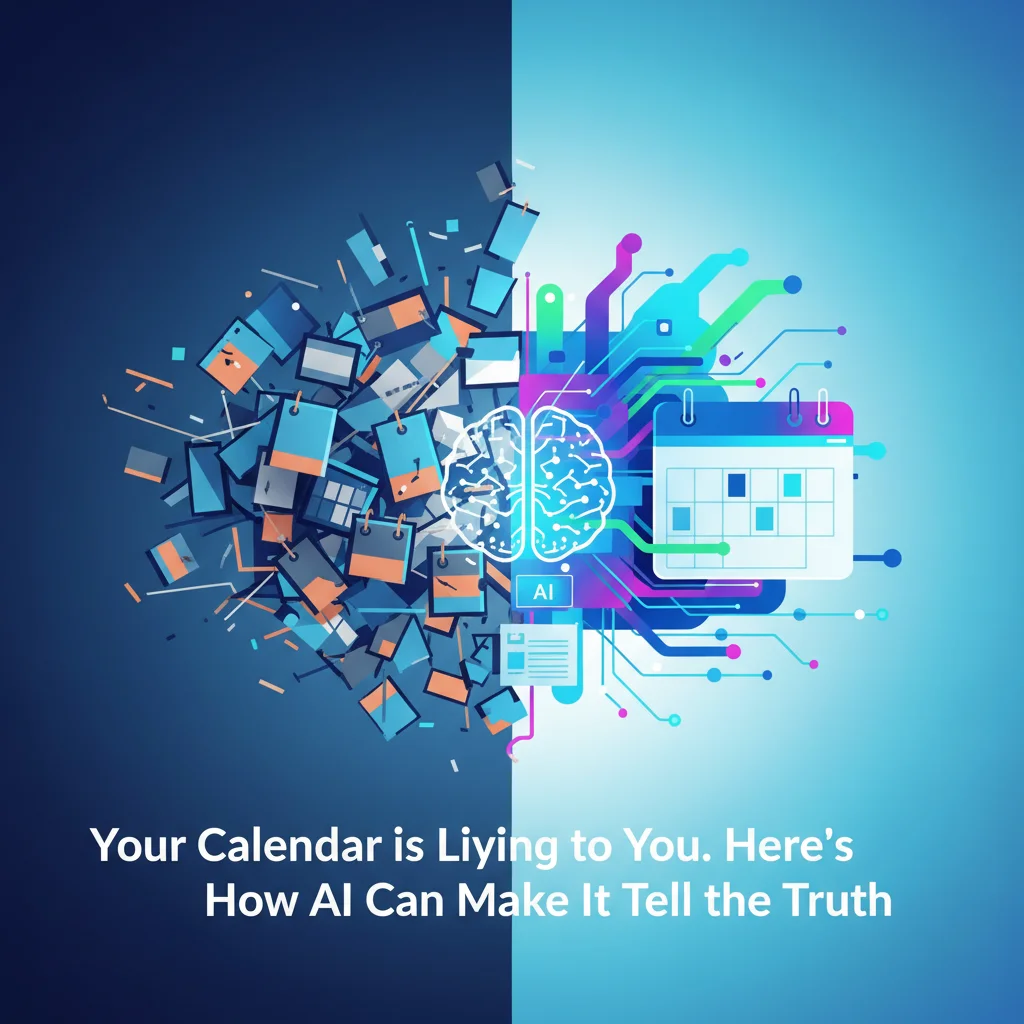
Your Calendar is Lying to You. Here’s How AI Can Make It Tell the Truth.
Take a quick glance at your digital calendar. What do you see? A neat, color-coded grid promising a day of organized productivity? Or a battlefield, scarred with back-to-back meetings, conflicting appointments, and the ghosts of tasks you never had time to start? For most of us in the modern workforce, it’s the latter. The very tool designed to bring order to our lives has become a primary source of chaos and anxiety—a phenomenon the Financial Times aptly calls “the tyranny of the digital calendar.”
We spend countless hours playing “calendar Tetris,” trying to slot in a crucial 30-minute chat between a one-hour sync and a 90-minute all-hands. We send emails with subject lines like “Finding a time to connect,” sparking a chain of replies that could have been a meeting in itself. Our calendars are packed, but our actual productive output feels stagnant. We’re busy, but are we effective?
This digital overload isn’t just a personal failing; it’s a systemic problem born from a decade of digital transformation, accelerated by the shift to remote and hybrid work. Our calendars have become public real estate where anyone with a link can stake a claim on our most valuable resource: time. But a new wave of technological innovation is rising to challenge this chaotic status quo. Led by ambitious startups and powered by artificial intelligence, the fight to reclaim our schedules has begun.
The Anatomy of Calendar Chaos
How did we get here? The digital calendar, in its current form, is a relatively simple piece of software. It’s a shared ledger of time slots, marked as “busy” or “free.” This binary approach fails to capture the nuance of a modern workday. It doesn’t know the difference between a high-stakes client negotiation and a low-priority optional check-in. It can’t distinguish between an hour of deep, focused programming and an hour spent passively listening in a company-wide town hall.
The result is a system that optimizes for being “in a meeting” rather than “getting work done.” This leads to several critical pain points:
- Meeting Overload: With easy access to everyone’s availability, scheduling a meeting has become the default action for any query or update. This leads to calendars so saturated with calls that there’s no time left for the actual work discussed in them.
- Cognitive Drain: The constant context-switching between meetings, emails, and tasks is mentally exhausting. It shatters our focus and prevents us from entering a state of “deep work,” where true problem-solving and creativity happen.
- The Scheduling Tax: The administrative overhead of finding a suitable time for multiple stakeholders across different time zones is a significant drain on productivity. One study suggested that executives spend nearly two full days each week in meetings, with a significant portion of that time being unproductive.
This isn’t just an inconvenience; it’s a direct threat to business outcomes, employee well-being, and genuine innovation. When your most talented developers, marketers, and strategists spend their days locked in a digital cage of their own making, everyone loses.
The Cavalry Arrives: AI-Powered Scheduling Automation
Enter the next generation of productivity tools. A growing number of SaaS companies are building intelligent layers on top of our existing calendars (like Google Calendar and Outlook), transforming them from passive ledgers into proactive, intelligent assistants. These platforms leverage machine learning and sophisticated algorithms to fundamentally change our relationship with time.
Companies like Clockwise, Reclaim.ai, and Motion aren’t just finding empty slots. They are pioneering a new field of “time orchestration.” Their AI models analyze your tasks, priorities, meeting patterns, and even your stated personal preferences to build a dynamic, optimized schedule that works for you, not against you.
Here’s a look at how this new approach, powered by cloud-based computing and intelligent automation, is tackling the problem:
| Challenge | The Old Way (Manual Calendar Management) | The New Way (AI-Powered Time Orchestration) |
|---|---|---|
| Finding Focus Time | Manually blocking “Do Not Disturb” chunks and hoping colleagues respect them. | The AI automatically identifies, reserves, and defends flexible blocks of “deep work” time based on your priorities and deadlines. |
| Scheduling a Group Meeting | Endless email chains, Doodle polls, or manually cross-referencing 10 different calendars. | Define attendees and goals. The AI finds the optimal time that minimizes disruption, respects focus time, and aligns with everyone’s working hours. |
| Handling a Schedule Conflict | A frantic flurry of messages to reschedule, often causing a domino effect of other changes. | The AI can automatically and intelligently reschedule lower-priority meetings to accommodate a more urgent request, often without any human intervention. |
| Managing Tasks & Calendar | Two separate, disconnected systems. You manually decide when to work on which task. | Tasks from your project management tool are automatically scheduled into available slots on your calendar, ensuring your to-do list actually gets done. |
This isn’t just about convenience. It’s a paradigm shift. The AI acts as a personal chief of staff, negotiating your time on your behalf and protecting it as the valuable asset it is. It can de-fragment your day, clustering meetings together to create longer, uninterrupted stretches for concentration. It can even learn your habits, like scheduling demanding tasks in the morning when you’re most alert.
Under the Hood: The Technology Making It Possible
For the developers, entrepreneurs, and tech professionals in the audience, it’s worth exploring the engine driving this revolution. This isn’t simple “if-then” programming. The intelligence behind these tools is a sophisticated blend of several key technologies:
- Machine Learning Models: These systems ingest vast amounts of data—your past meeting acceptances, your stated work hours, your task completion rates, the seniority of other attendees—to build a predictive model of your priorities and preferences.
- Constraint Satisfaction Algorithms: At its core, scheduling is a complex optimization problem. These algorithms work to find the “best” solution that satisfies a long list of constraints (e.g., “must happen this week,” “Jane can’t meet after 4 PM,” “protect a 2-hour coding block for Mark”).
- Natural Language Processing (NLP): Some advanced tools can interpret the intent behind a meeting request or a task description, helping to automatically categorize and prioritize it without manual input.
- Cloud-Native Architecture: Running on the cloud allows these SaaS platforms to process data and run complex calculations in real-time, integrating seamlessly with the APIs of Google Workspace, Microsoft 365, and other productivity suites.
This fusion of technologies represents a significant leap forward. We’re moving from a system of record (a dumb calendar) to a system of intelligence—one that actively helps us allocate our time and attention more effectively.
Nvidia's Tightrope Walk: Navigating the High-Stakes US-China AI Chip War
Beyond Meetings: The Future of the AI-Powered Workday
The innovation we’re seeing in calendar management is just the tip of the iceberg. The ultimate vision is a fully integrated, intelligent work hub where your calendar is the central nervous system. Imagine a future where:
- Your project management tool tells your calendar a critical deadline is approaching, and the calendar automatically clears your schedule for a few hours of focused work.
- Your communication app detects a conversation that needs a follow-up meeting and prompts your AI assistant to schedule it with the right people.
- Your well-being app notes you’ve had too many back-to-back meetings and works with your calendar to automatically schedule a 15-minute break. According to some experts, this focus on preventing burnout is a key feature of the new scheduling tools.
This level of seamless automation and integration is the holy grail for productivity software. It promises to eliminate the thousands of tiny, manual administrative tasks that chip away at our day, freeing up our cognitive resources for the complex, creative, and strategic work that truly drives value.
Australia's Social Media Ban for Kids: A Tech Minefield or a Necessary Revolution?
It’s Time to Reclaim Your Time
The tyranny of the digital calendar is a real and pervasive problem, turning a tool of organization into a source of stress. For years, we’ve adapted our work styles to the limitations of our software. We’ve accepted back-to-back meetings as normal and sacrificed deep work at the altar of constant availability.
Now, technology is finally catching up to our needs. Powered by artificial intelligence, a new generation of smart scheduling tools is giving us the power to fight back. They offer a future where our calendars are no longer our masters, but our trusted partners—proactively guarding our focus, streamlining our collaboration, and helping us orchestrate a more productive, balanced, and sustainable workday.
The revolution won’t happen overnight, but it has begun. It’s time to stop letting your calendar lie to you about what a productive day looks like. It’s time to let AI help it tell the truth.

Related Posts
The AI Gold Rush or a Ticking Debt Bomb? Why Wall Street is Hedging its Bets on Tech
The New OS for Networking: Why London’s Private Clubs Are a Blueprint for Tech’s Elite