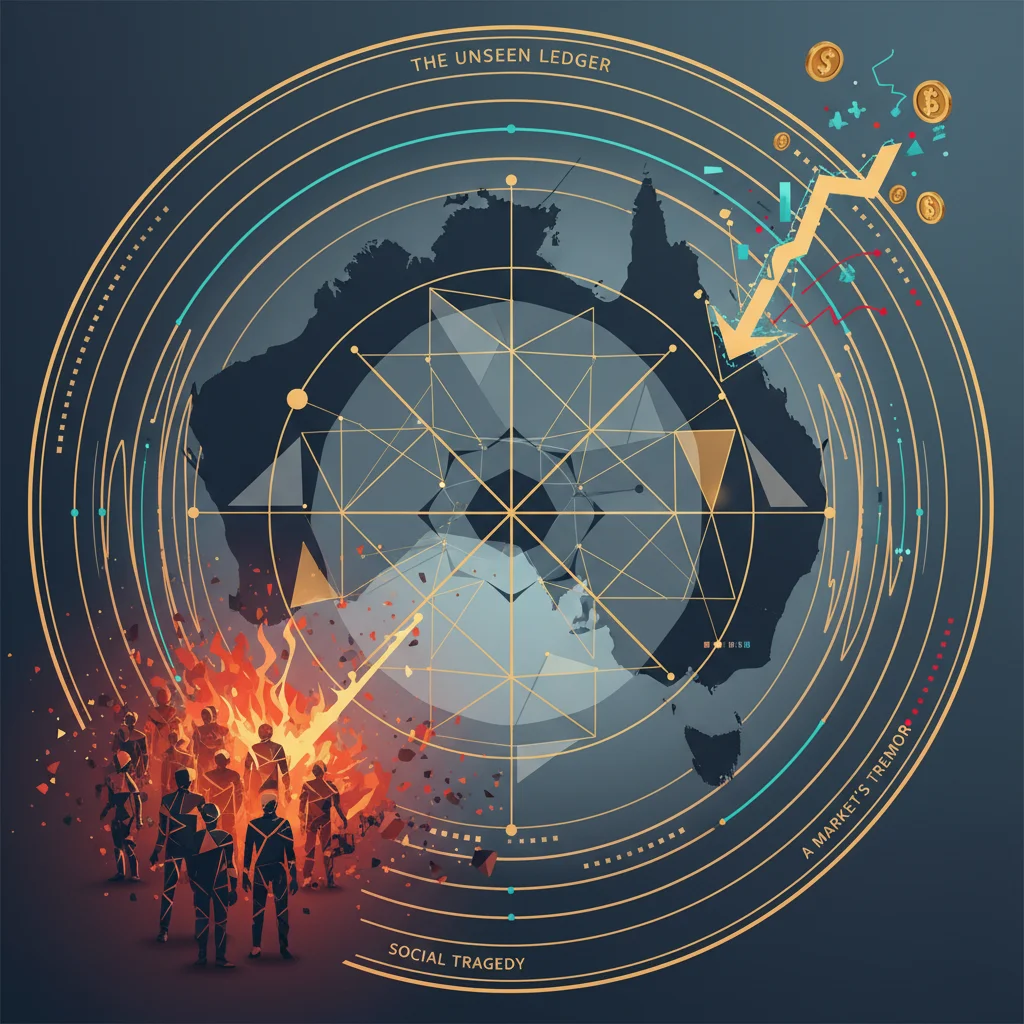
The Unseen Ledger: Gauging the Economic Shockwaves of Social Tragedy in Australia
A Nation’s Grief, A Market’s Tremor
In the wake of a horrific attack on a Jewish festival that claimed 15 lives, Australia finds itself at a somber crossroads. Prime Minister Anthony Albanese’s pledge to review the nation’s gun laws and combat a rising tide of antisemitism is more than a political response to a national tragedy; it is a critical inflection point for the country’s social cohesion and, by extension, its economic stability. For investors, business leaders, and financial professionals, events like these are stark reminders that the bedrock of any thriving economy is societal safety and predictability. When that foundation is shaken, the tremors are felt far beyond the immediate community, reaching into the heart of the stock market, corporate boardrooms, and international investment portfolios.
While the human cost is immeasurable and must always remain our primary focus, a secondary, analytical lens is required to understand the far-reaching consequences. Such events introduce a potent element of uncertainty into the market. They challenge the core assumptions of stability that underpin financial models and investment theses. This post will delve into the complex interplay between social policy, public safety, and economic resilience, using Australia’s past and present to illustrate why social capital is one of the most valuable, yet often overlooked, assets on a nation’s balance sheet.
The Economic Anatomy of a Crisis: More Than Just Headlines
The immediate aftermath of a tragedy is characterized by grief and a demand for justice. However, the economic reverberations begin almost instantly and unfold over months and years. These costs are both direct and indirect, creating a complex financial ledger of loss and response.
- Direct Economic Costs: These are the most tangible expenses. They include the immense strain on healthcare systems, the significant cost of law enforcement investigations and heightened security measures, and the physical damage to property. While often covered by insurance or government funds, they represent a significant and unplanned diversion of capital from productive economic activities.
- Indirect Economic Costs: This is where the impact broadens and deepens, affecting investor sentiment and consumer behavior. Tourism, a vital sector for Australia, can suffer as the country’s image as a safe destination is tarnished. Consumer confidence may dip, leading to reduced spending in retail and hospitality sectors, particularly in the affected region. Furthermore, businesses face rising insurance premiums as underwriters reassess risk profiles. For those engaged in international trading and commerce, such instability can complicate supply chains and increase the perceived risk of doing business.
Ultimately, social fragility introduces volatility, and markets abhor volatility that isn’t tied to predictable business cycles. It forces a fundamental repricing of risk, which can deter foreign direct investment and make capital more expensive for domestic enterprises.
A Look Back: The Economic Lessons of the 1996 National Firearms Agreement
To understand the potential path forward, it is essential to look at Australia’s own history. The 1996 Port Arthur massacre, in which 35 people were killed, was a similar moment of national trauma that catalyzed sweeping change. The subsequent National Firearms Agreement (NFA) involved a massive government-funded buyback of over 650,000 firearms and imposed stringent restrictions on gun ownership. This decisive action provides a powerful case study not only in public health policy but also in socio-economic stabilization.
Research following the NFA has shown a dramatic and sustained reduction in firearm-related deaths. A 2018 study published in the Annals of Internal Medicine found that the reforms were associated with a significant drop in firearm suicides and homicides, with no evidence of substitution to other lethal means. While correlation is not causation, the data strongly suggests the policy was effective in its primary goal of saving lives.
But what about the economic impact? A safer society is a more productive and prosperous one. Below is a simplified look at key indicators that reflect the environment for investing and economic growth in the years following the NFA’s implementation.
| Indicator | Observation & Economic Implication |
|---|---|
| Firearm Deaths | Significant and sustained drop. This reduces direct costs on the healthcare system and justice system, freeing up public funds for infrastructure, education, and innovation. |
| Consumer Confidence | While influenced by many factors, a greater sense of public safety contributes to long-term stability in consumer spending, a cornerstone of the domestic economy. |
| Foreign Direct Investment (FDI) | Australia’s reputation as a stable, safe, and well-governed country is a key selling point for attracting FDI. The NFA reinforced this image, making it a more predictable market for long-term capital allocation. |
| Sovereign Risk Rating | Ratings agencies like S&P and Moody’s factor social cohesion and political stability into their assessments. Proactive and effective governance, as demonstrated by the NFA, supports a strong sovereign credit rating, lowering the government’s cost of borrowing. |
The Modern Risk Landscape: Fintech, Global Scrutiny, and Corporate Responsibility
Twenty-five years after the NFA, the world of finance is vastly different. The rise of financial technology (fintech) and the instantaneous flow of information mean that the market’s reaction to events is faster and more global than ever before. A crisis in Sydney can affect trading desks in New York and London within minutes. This new reality places even greater emphasis on proactive risk management.
Today, institutional investors increasingly use sophisticated ESG (Environmental, Social, and Governance) metrics to guide their decisions. A country’s approach to gun control, hate speech, and social equity are no longer “soft” issues but hard data points in a comprehensive risk assessment. A perceived backslide in public safety or a failure to address social fractures can lead to capital flight or, at the very least, a “risk premium” being applied to Australian assets.
The banking and finance sectors also have a critical role to play. There is growing pressure on financial institutions to consider their role in the firearms industry, with some major funds divesting from manufacturers and retailers. Furthermore, advanced fintech and AI tools are being deployed to detect and disrupt the financial networks of hate groups, a crucial step in preventing the organization and funding of extremist violence. The conversation is evolving from purely governmental action to a whole-of-economy approach where corporate and financial stewardship are paramount.
Some technologists even point to the potential of emerging technologies like blockchain to create immutable and transparent registries for controlled items, though the political and practical hurdles for such an application remain immense. The core point is that technology is providing new tools for both managing and measuring risk related to social stability.
Solving the Market's Puzzle: An Investor's Guide to the Modern Financial Crossword
Conclusion: Investing in Stability is the Ultimate Growth Strategy
The tragedy in Australia is a painful reminder that social health and economic prosperity are inextricably linked. The government’s proposed review of its gun laws is a pivotal moment that investors and business leaders should watch closely, not as a political spectacle, but as a fundamental test of the nation’s commitment to the stability that has long made it an attractive market.
For a modern economy, the true measure of strength is not just its GDP growth or the performance of its stock market, but its resilience in the face of shocks. This resilience is built on a foundation of public safety, social trust, and effective governance. As Australia navigates this difficult period, the decisions made will send a powerful signal to the global financial community about its long-term viability as a safe and predictable place to invest. The most profound lesson is a simple one: the most valuable investments a nation can make are in its own people and their security.
Robinhood's New Frontier: Why the Fintech Giant is Betting Big on Indonesia
As Prime Minister Albanese stated, the country will do more to combat antisemitism (source). This commitment, coupled with a re-evaluation of public safety measures, is the first step in reinforcing the social and economic foundations that will support Australia’s future growth.