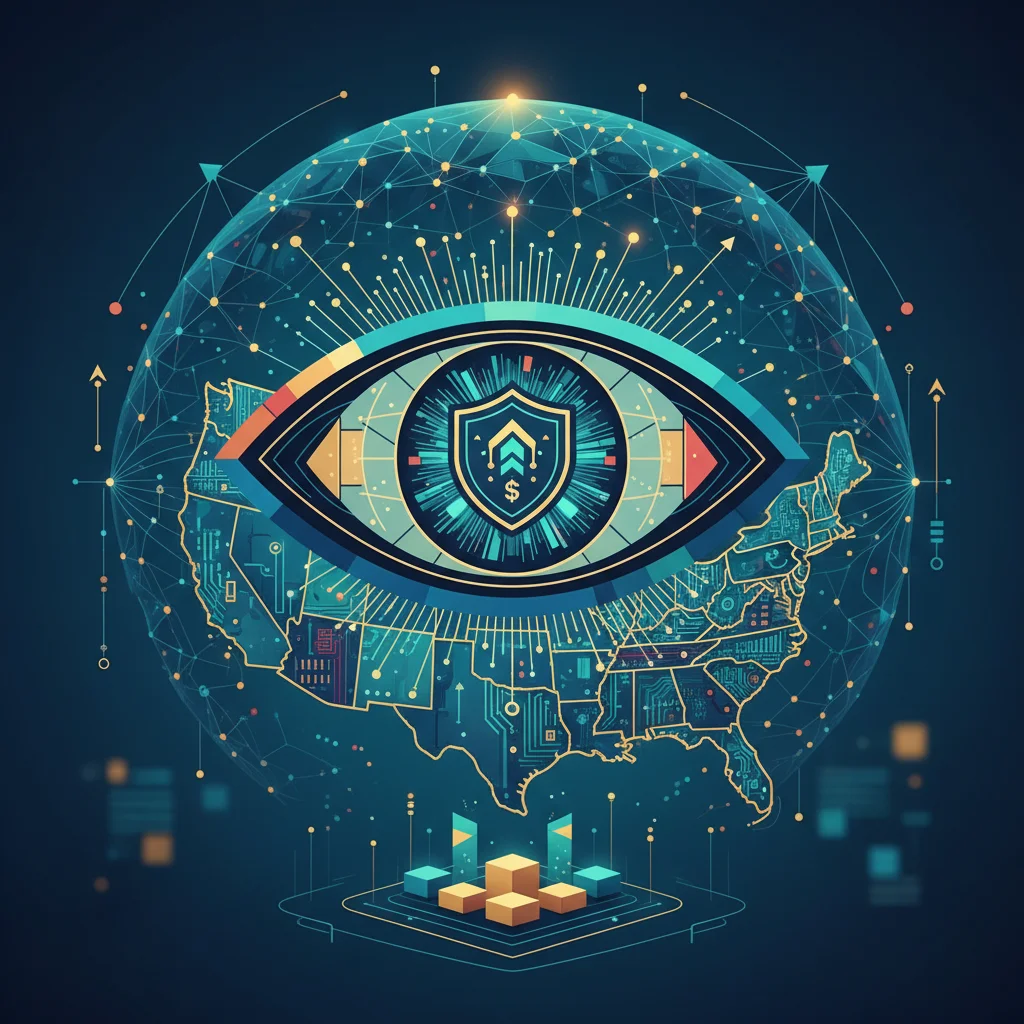
The Surveillance Premium: How America’s Watchful Eye Creates a Haven for Investors
The Unspoken Pillar of the US Economy
In the modern discourse of economics and civil liberties, the term “surveillance state” is almost exclusively pejorative. It conjures images of Orwellian overreach, infringements on privacy, and a chilling erosion of personal freedom. For most, the debate ends there. But what if this pervasive network of information gathering, often criticized, is also a powerful, albeit controversial, engine of economic stability? What if it constitutes a hidden competitive advantage that makes the United States the world’s preeminent safe harbor for capital?
This provocative idea, recently floated in a letter to the Financial Times, suggests that America’s surveillance capabilities are not just a tool for national security, but a fundamental pillar supporting the strength of its stock market and the resilience of its economy. It argues that by preemptively identifying and neutralizing threats—from corporate fraud to terrorist financing—the system prevents the kind of catastrophic shocks that can obliterate investor confidence overnight. This article delves into this unorthodox thesis, exploring the concept of a “surveillance premium” and its profound implications for investing, global finance, and the future of financial technology.
A Tale of Two Systems: Predictability vs. Caprice
To understand the value of this stability, one only needs to look at the world’s other economic superpower: China. In recent years, global investors have watched with growing unease as the Chinese government has launched sudden, sweeping crackdowns on its most successful private enterprises. The abrupt suspension of Ant Group’s record-breaking IPO, the regulatory assault on ride-hailing giant Didi just days after its US listing, and the overnight dismantling of the private tutoring industry are stark reminders of where ultimate power lies.
These actions, often executed with little warning or transparent due process, inject a level of political and regulatory risk that is difficult to price. As a result, investor confidence has been shaken. According to a report from the Institute of International Finance, foreign investors have been pulling money out of Chinese markets, spooked by the unpredictable nature of state intervention. This unpredictability is the antithesis of what long-term capital seeks. Investors, from sovereign wealth funds to retail traders, prize stability and the rule of law above almost all else.
The following table provides a comparative overview of the two approaches, highlighting the core differences that impact the investing landscape:
| Factor | United States Approach | China Approach |
|---|---|---|
| Corporate Oversight | Regulated by established bodies (SEC, DOJ) with clear rules, extensive disclosure requirements, and a formal legal process. Surveillance is used to enforce these rules. | Subject to the unpredictable will of the Chinese Communist Party (CCP). State intervention can be sudden, opaque, and politically motivated, overriding market logic. |
| Rule of Law | Based on a long-standing, adversarial legal system. While imperfect, it provides a framework for recourse and predictability. | The legal system is subordinate to the CCP. The concept of “rule by law” rather than “rule of law” prevails, meaning the law is a tool of the state. |
| Capital Controls | Generally free and open capital flows, allowing investors to move money in and out with relative ease. | Strict capital controls that can be tightened or loosened at the state’s discretion, creating potential liquidity traps for foreign investors. |
| Data & Information | Information, while monitored, is largely accessible. Corporate and economic data are subject to standardized reporting. | Information is tightly controlled and often censored. Key economic data can be opaque or manipulated, hindering due diligence. |
This contrast illustrates the core of the argument: the US system, for all its flaws, operates with a degree of predictability that China’s currently lacks. The “surveillance” in the US is largely aimed at enforcing a known set of rules, whereas in China, it is often a tool to enforce the shifting priorities of the state.
Beyond the Handshake: The Economic Stakes of Germany's Diplomatic Dance with Israel
De-Risking the Economy from Within
The American surveillance apparatus is a complex web of agencies, including the NSA, FBI, CIA, and, crucially for the financial world, the Treasury Department’s Financial Crimes Enforcement Network (FinCEN) and the Securities and Exchange Commission (SEC). While their mandates differ, they collectively create an environment where large-scale systemic threats are often identified and mitigated before they can metastasize.
Consider the prevention of corporate fraud. The specter of Enron or WorldCom—scandals that wiped out billions in shareholder value and shook faith in the stock market—looms large. Today, the combination of whistleblower protections, advanced data analytics used by regulators, and intelligence gathering makes it significantly harder for such massive frauds to go undetected for long. The SEC’s enforcement actions, which in 2023 resulted in orders totaling $4.949 billion in financial remedies, serve as a powerful deterrent. This proactive policing, while intrusive, functions as a form of systemic risk management that ultimately protects investors.
The same principle applies to the integrity of the banking system. Post-9/11 legislation, like the Patriot Act, dramatically expanded the government’s ability to monitor financial transactions to combat money laundering and terrorist financing. This has transformed the financial technology and compliance sectors, forcing institutions to “Know Your Customer” (KYC) and report suspicious activities. While costly and burdensome for banks, this framework makes the US financial system a hostile environment for illicit actors, reinforcing its status as a secure place for legitimate capital.
The Global Magnet for Capital
The result of this perceived stability is a powerful, self-reinforcing cycle. Global investors, seeking to preserve and grow their wealth, view the United States as the ultimate safe haven. When geopolitical tensions flare in Eastern Europe, a property crisis brews in China, or uncertainty grips emerging markets, the “flight to safety” overwhelmingly directs capital toward US assets: Treasury bonds, the US dollar, and American equities.
This constant influx of foreign capital has profound benefits for the US economy. It keeps borrowing costs low for the government and corporations, fuels a vibrant venture capital ecosystem that powers innovation in fields like fintech and AI, and provides deep liquidity for the stock market. This structural advantage, underpinned by a foundation of perceived security, is a key reason why the US markets have consistently outperformed many global peers over the long term. The “surveillance premium” is not just a theoretical concept; it is reflected in the valuation of nearly every US-based financial asset.
The Future of Finance, Trading, and Transparency
The dynamic between surveillance, technology, and finance is constantly evolving. The rise of decentralized finance (DeFi) and privacy-centric blockchain technologies presents a direct challenge to the state’s monitoring capabilities. Regulators are now grappling with how to apply century-old financial rules to a new, borderless, and often anonymous digital world. The ongoing debate around Central Bank Digital Currencies (CBDCs) is another key battleground, pitting the potential for transactional efficiency against fears of complete governmental oversight of all economic activity.
For those in finance and trading, understanding this landscape is critical. The regulatory response to these new technologies will shape the future of investing. Will the US find a way to integrate these innovations while maintaining its information dominance, or will they create new avenues for risk that the current system cannot contain? The answer will determine whether the surveillance premium endures or erodes in the decades to come.
An Uncomfortable Conclusion for a Pragmatic Investor
The notion that America’s surveillance state is a net positive for its economy is, without question, a difficult and uncomfortable one. It challenges us to weigh the tangible benefits of market stability and investor protection against the intangible, yet fundamental, costs to individual privacy. However, for investors, finance professionals, and business leaders, ignoring this dynamic is a luxury they cannot afford.
The stability premium derived from this system is a powerful, if unspoken, force in global economics. It is a key differentiator that separates the US from its geopolitical rivals and a primary driver of its enduring appeal as a destination for capital. While the ethical debate will and should continue, the pragmatic reality is that in a world of increasing uncertainty, the perception of a watchful, stabilizing hand—however intrusive—is an asset that the market continues to price at a premium.

Related Posts
Navigating the Void: Rishi Sunak, the COVID Economy, and the Playbook That Never Was

The Price of a Parcel: Why Evri’s Delivery Woes Are a Warning Sign for Investors and the Economy
