The AI Gold Rush or a Ticking Debt Bomb? Why Wall Street is Hedging its Bets on Tech
We are living through a technological revolution of staggering proportions. The rise of generative artificial intelligence has ignited a firestorm of innovation, investment, and unbridled optimism. Companies like NVIDIA are reaching trillion-dollar valuations, venture capital is pouring into fledgling AI startups, and it seems like every sector, from healthcare to finance, is being reshaped by the power of machine learning. The headlines scream of progress, of a new gold rush that promises to mint a generation of tech billionaires.
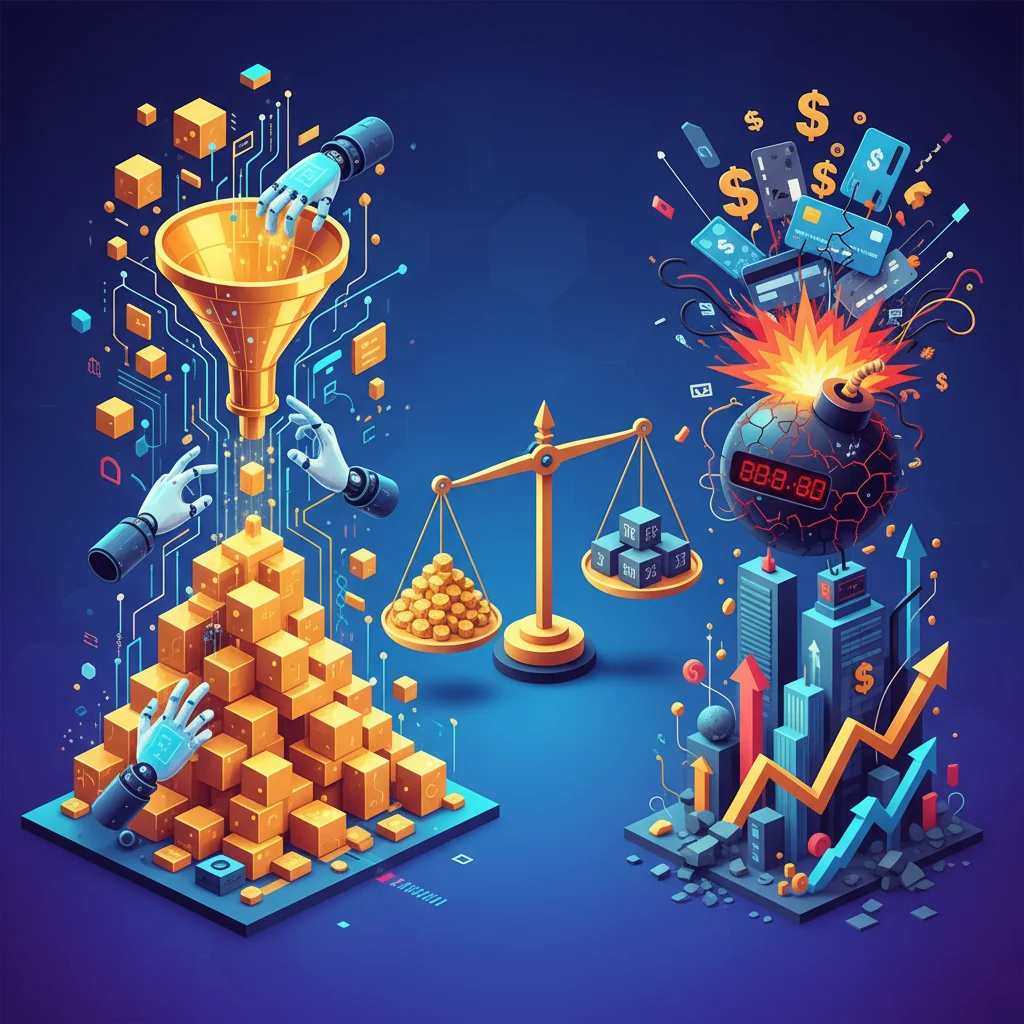
But behind the curtain of this dazzling spectacle, in the quieter, more cynical corners of Wall Street, a different story is unfolding. A shadow market, one that thrives not on optimism but on risk, is buzzing with activity. Traders are making massive bets, not on who will be the next AI giant, but on who will be the first to fall. They’re buying up insurance policies on tech company debt at a record pace, a clear signal that for all the public hype, there’s a deep undercurrent of anxiety about a potential “AI debt bust.”
This isn’t just abstract financial maneuvering. It’s a critical signal about the health and stability of the tech ecosystem that employs developers, powers our favorite SaaS products, and fuels the dreams of entrepreneurs. So, what exactly is happening, and why should you—whether you’re writing code, leading a startup, or just fascinated by tech—pay close attention?
Decoding the Tea Leaves: What’s a Credit Default Swap?
To understand what’s spooking investors, we first need to pull back the curtain on a financial instrument with a rather notorious reputation: the Credit Default Swap, or CDS. If that term gives you flashbacks to the 2008 financial crisis and “The Big Short,” you’re on the right track.
In the simplest terms, a CDS is like an insurance policy on a company’s debt. Let’s break it down with an analogy:
- Imagine a large tech company, “InnovateCorp,” takes out a massive loan to build a new fleet of AI data centers.
- A hedge fund, “Prudent Capital,” is worried that InnovateCorp might have over-leveraged itself and could struggle to pay back that loan (i.e., default on its debt).
- Prudent Capital goes to a large investment bank and buys a CDS. They pay a regular premium, just like an insurance premium.
- If InnovateCorp does indeed default on its loan, the investment bank pays Prudent Capital the full value of the loan. If InnovateCorp stays healthy and pays its debts, Prudent Capital is just out the premiums they paid.
The crucial part is the price of that “premium.” It’s not fixed. It fluctuates based on the market’s perceived risk. If the market suddenly gets very nervous about InnovateCorp’s future, more funds will want to buy this “insurance,” and the price will go up. Therefore, the CDS market acts as a real-time sentiment meter for corporate financial health, often revealing a more sober truth than the soaring stock market.
The Data Is In: A “Boom” in Betting Against Tech
This isn’t just a theoretical concern. Trading activity in these insurance-like products has surged dramatically. According to a recent report from the Financial Times, trading volumes for CDS linked to a basket of North American investment-grade tech companies have skyrocketed. Investors, particularly hedge funds, are actively seeking protection against a downturn, signaling a growing unease beneath the surface of the market’s enthusiasm.
What’s driving this fear? It’s a cocktail of factors. Many established tech giants have taken on enormous amounts of debt to fund acquisitions or massive R&D projects in the AI arms race. For example, companies like Oracle and Dell have used debt to finance major deals, and investors are now scrutinizing their ability to manage these huge financial obligations in a world of higher interest rates (source).
Below is a simplified look at the factors that can influence the perceived risk of a tech company, and consequently, the cost of insuring its debt.
| Factor Increasing Perceived Risk | Example Scenario |
|---|---|
| High Debt-to-Equity Ratio | A company funds a $50 billion acquisition almost entirely with new loans. |
| Negative Cash Flow | A promising AI startup is burning through hundreds of millions in venture capital without a clear path to profitability. |
| Intense Market Competition | A SaaS company’s flagship product is suddenly challenged by a new, free open-source model. |
| Regulatory Scrutiny | Governments in the US and EU announce sweeping new regulations on AI data privacy and model training. |
| Dependence on Hype Cycle | A company’s valuation is tied more to its visionary CEO’s promises than its current revenue or products. |
This surge in hedging isn’t just about a few nervous investors; it’s a market-wide trend. The volume of traded CDS contracts tied to a key index of tech, media, and telecom company debt was nearly 50% higher in the first quarter of 2024 than the average for the previous year (source). The smart money is quietly preparing for turbulence.
The Ultimate Startup: Are Tech Billionaires Building Utopian Cities or Digital Feudalism?
Echoes of the Past: Are We in Another Bubble?
For anyone who has been in the tech industry for more than a decade, this scenario feels eerily familiar. The relentless hype, the sky-high valuations for pre-revenue companies, and the “this time it’s different” mantra all carry echoes of bubbles past.
The Dot-Com Bubble (1999-2001): In the late ’90s, the promise of the internet created a frenzy. Companies with “.com” in their name were valued in the billions based on “eyeballs” rather than profits. The crash was brutal, wiping out countless companies and investors. The parallel today is the “AI-washing” phenomenon, where every company, regardless of its core business, is rebranding itself as an “AI company” to attract investment.
The 2008 Financial Crisis: While triggered by the housing market, this crisis was supercharged by complex financial derivatives, with CDS playing a starring role. Investors used them to bet against the housing market, while banks used them to package and sell risky debt. The lesson here is how quickly financial instruments designed to *manage* risk can, in fact, *amplify* it and spread contagion throughout the entire economy.
The key question is: Is this time truly different? On one hand, yes. Unlike the dot-com era’s vaporware, the underlying technology of artificial intelligence, cloud computing, and large-scale data processing is undeniably real and transformative. The innovation is tangible. On the other hand, human psychology and market dynamics are timeless. The fear of missing out (FOMO) can easily inflate asset prices beyond their fundamental value, and debt is still debt, regardless of how exciting the technology it funds may be.
Think of it as the great AI sort-out. The next 24 months will likely bring a wave of consolidation, acquisitions, and, yes, failures. The companies that will struggle are those that have confused access to cheap capital with a viable business model. The winners will be those who can demonstrate not just brilliant programming and cutting-edge machine learning models, but a clear, defensible path to profitability. This market tremor is a healthy, albeit painful, dose of reality. It’s forcing the industry to move from “What can AI do?” to “How can AI make money sustainably?”
What This Means for You: Navigating the AI Hype Cycle
This Wall Street drama has real-world implications for everyone in the tech ecosystem. It’s a signal to look past the marketing and focus on the fundamentals.
For Developers, Engineers, and Tech Professionals:
Your job security and the value of your stock options are tied to your employer’s financial health. When considering a job offer, especially at a startup, dig deeper than the tech stack. Ask tough questions: What is the company’s burn rate? What is the runway? Is there a clear path to profitability, or is the strategy simply to raise the next round of funding? A company with a strong balance sheet and a focus on fiscal discipline is more likely to weather a storm than one built on hype and debt. Fields like cybersecurity and efficiency-driving automation often remain resilient even in a downturn, as they become cost-saving necessities rather than luxuries.
Your AI Isn't Your Therapist: Why Using General Chatbots for Mental Health is a High-Stakes Gamble
For Entrepreneurs and Startup Founders:
The era of “growth at all costs” is over. While innovation remains paramount, the goalposts have moved. Your pitch deck needs more than a brilliant idea; it needs a bulletproof business model. VCs and lenders are becoming more risk-averse, and the due diligence process will be more rigorous. Focus on unit economics, customer acquisition costs, and lifetime value. Demonstrate how your software or service solves a real problem and can generate sustainable revenue. The ability to build lean, operate efficiently, and show a clear path to breaking even is now a startup superpower.
For Investors and the General Public:
Be wary of the hype. The stock market is often a popularity contest, but the bond and credit markets are where the cold, hard analysis happens. When you see headlines about a company’s soaring stock, it’s worth checking to see what the CDS market is saying about its debt. It can provide a valuable, and often more grounded, second opinion on the company’s long-term viability.
The Dawn of a More Sober AI Era
The AI revolution is not a mirage. It is a fundamental technological shift that will create immense value and change the world. However, the path of any revolution is never a straight line up and to the right. It’s marked by periods of explosive growth, irrational exuberance, and painful corrections.
The booming market for tech credit default swaps is not a sign that the AI dream is dead. It’s a sign that the dream is growing up. It’s a rational response to the very real risks that accompany such rapid, capital-intensive change. This newfound caution will ultimately be healthy for the industry, washing out the weaker players and forcing a greater focus on building enduring, profitable businesses.
The future of artificial intelligence will be built not just on brilliant code and powerful algorithms, but on sound financial foundations. The companies that understand this—the ones that pair groundbreaking innovation with fiscal prudence—are the ones that will survive the shakeout and define the next chapter of technology.

Related Posts
The £1.9 Billion Void: Deconstructing the UK’s COVID Fraud and its Economic Aftermath

The $40 Billion Collapse: Do Kwon, the Terra/Luna Crash, and a Cautionary Tale for Tech Innovators