Chile at a Crossroads: How a Polarizing Election Will Shape Its Economy and Your Investments
For decades, Chile has been the poster child for economic stability and free-market success in Latin America. A powerhouse of copper production and a magnet for foreign investment, its economy was long the envy of its neighbors. But the ground beneath this stable facade has been shaking. Following years of simmering social discontent that erupted in widespread protests in 2019, the nation stands at a pivotal crossroads, forced to choose between two diametrically opposed futures in a high-stakes presidential election.
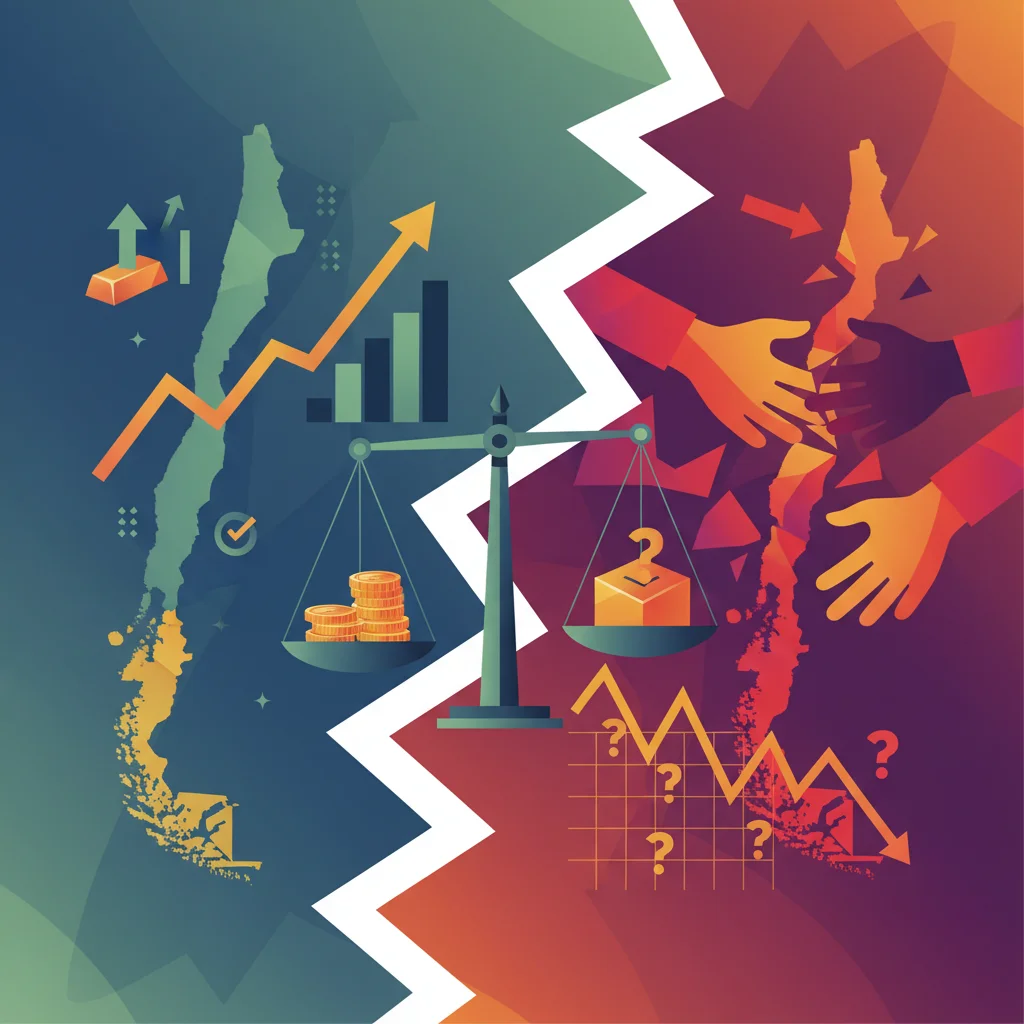
The contest pits the far-right, law-and-order conservative José Antonio Kast against the young, progressive leader of a broad-left coalition, Gabriel Boric (a movement in which prominent figures like Communist party member Jeannette Jara are key players). The original Financial Times reporting highlighted the stark contrast, framing it as a choice between an arch-conservative and a leftwinger, a description that captures the deep ideological chasm dividing the nation. This isn’t just another election; it’s a referendum on the soul of Chile’s economic model. For investors, business leaders, and anyone involved in global finance, the outcome will have profound and lasting implications for the stock market, banking, and the future of financial technology in the region.
The Backdrop: From Economic Miracle to Social Uprising
To understand the gravity of this election, one must look back to the “estallido social” (social outburst) of 2019. What began as a protest over a subway fare hike quickly spiraled into a nationwide movement against deep-seated inequality in pensions, healthcare, and education. Millions of Chileans felt left behind by the very neoliberal model that generated so much wealth. The protests ultimately led to a historic referendum where an overwhelming majority voted to scrap the country’s Pinochet-era constitution, a document that underpins its market-led economy.
This political earthquake shattered the traditional center-left and center-right coalitions that had governed Chile for 30 years, paving the way for more radical alternatives. The result is a polarized landscape where voters are faced with two candidates who offer not just different policies, but entirely different visions of society. According to a Reuters analysis of the political climate, this polarization reflects a region-wide trend where electorates are increasingly rejecting the political establishment in favor of outsider candidates promising radical change.
A Dangerous Silence: How US-Japan-China Tensions Over Taiwan Are Shaking Global Finance
A Tale of Two Economies: Comparing the Candidates’ Platforms
The economic philosophies of José Antonio Kast and Gabriel Boric could not be more different. Their platforms represent a fundamental disagreement on the role of the state, the private sector, and the distribution of wealth. Investors are watching closely, as the implementation of either agenda would drastically alter Chile’s business environment.
Below is a comparative breakdown of their core economic proposals:
| Economic Policy Area | José Antonio Kast (Right-Wing) | Gabriel Boric (Left-Wing Coalition) |
|---|---|---|
| Taxation | Slash corporate tax from 27% to 17%. Cut taxes on individuals and businesses to spur private investment. | Raise taxes on corporations and high-income earners. Introduce new “super-rich” and environmental taxes to fund social programs. |
| Pension System | Maintain and strengthen the privatized pension fund (AFP) system, with potential reforms to increase competition. | Dismantle the AFP system and replace it with a state-run social security model, with contributions from employers. |
| Mining & Natural Resources | Promote private investment in mining with stable regulations and lower tax burdens to maximize production. | Increase mining royalties significantly to capture more of the industry’s profits for the state. Potential for state-owned lithium company. |
| Government Spending | Reduce the size of the state, cut public spending, and focus on fiscal discipline and balanced budgets. | Massively increase social spending on healthcare, education, and social safety nets, funded by higher taxes and debt. |
The Ripple Effect on Finance, Trading, and Investment
The outcome of this election will reverberate through every corner of the financial world, from institutional trading desks in New York to retail investors considering emerging market ETFs.
Stock Market and Currency Volatility
The Chilean peso and the IPSA stock index have already experienced significant volatility in the run-up to the vote. A Boric victory, particularly with a mandate to overhaul the pension system, could trigger a capital flight from the AFP funds. These funds are the largest institutional investors in the local stock market, and their dissolution or significant alteration would create a massive structural shock. Currency traders will be watching the central bank’s response, as it may need to intervene to prevent a catastrophic collapse of the peso. The country’s strong macroeconomic fundamentals, including a high GDP per capita for the region (source: World Bank), provide some buffer, but political risk is currently the dominant driver.
Foreign Direct Investment and the Copper Question
As the world’s largest copper producer, Chile’s mining policy is a matter of global economic importance. Copper is essential for everything from construction to electric vehicles. Boric’s plan to hike royalties could deter the billions in foreign investment needed to maintain and expand production. This could, in turn, constrain global supply and push copper prices higher, feeding into worldwide inflationary pressures. Kast’s platform, by contrast, is designed to attract this investment, but it risks ignoring the local demands for a greater share of the nation’s mineral wealth, potentially fueling future conflict.
Decoding the Buffett Indicator: Is the Global Stock Market Flashing a Major Warning Sign?
The Future of Financial Technology: A Fork in the Road
The election also presents two very different paths for Chile’s burgeoning **fintech** ecosystem. The nation has been a leader in Latin American **financial technology**, but the new government’s approach to regulation and the economy will be critical.
- The Kast Scenario: A Kast presidency would likely champion deregulation and open banking initiatives, creating a fertile ground for fintech innovation. Lower corporate taxes and a pro-business stance could attract more venture capital to the sector. We might see an acceleration in fintechs focused on wealth management, digital **trading** platforms, and even **blockchain** applications for securing financial assets and streamlining supply chains.
- The Boric Scenario: A Boric government’s focus would be on financial inclusion and state-led solutions. This could create opportunities for fintechs that help deliver social benefits, manage the new public pension system, or provide low-cost banking services to underserved populations. However, the risk of heavy-handed regulation, state control over the **banking** sector, and a less favorable tax environment could stifle private sector innovation and investment. The dismantling of the AFP system, for example, would be a seismic event for the entire financial services industry.
The Monroe Doctrine 2.0: What a US 'Peace Through Strength' Policy Means for the Global Economy
Conclusion: A Nation on the Brink
Chile’s presidential election is far more than a domestic political event. It is a case study in the global tensions between free-market capitalism and demands for social equality. The choice between José Antonio Kast and Gabriel Boric is a choice between two fundamentally different economic and social contracts. For the international community, the result will signal the future direction of one of Latin America’s most important economies. Investors, economists, and business leaders must prepare for a new chapter in Chile’s history, one that will be defined by the path chosen and will undoubtedly bring both significant risks and unexpected opportunities in its wake. The only certainty is that the stable, predictable Chile of the past is gone, and a new, more uncertain era is about to begin.