The Drunkard’s Walk: Are Central Banks Leading the Economy to a Minsky Moment?
There’s an old parable, often attributed to the brilliant and tragically prescient economist Hyman Minsky, that goes something like this: A drunkard is stumbling down the street, barely able to stand. A well-meaning sober person comes along, offers an arm, and helps the drunkard walk steadily. After a few blocks, the drunkard’s confidence swells. “I’m fine now,” he slurs, shrugging off the helping hand. “I can walk on my own.” He takes two confident steps, then promptly trips and falls flat on his face.
In a recent letter to the Financial Times, Mimoza Shabani and her colleagues posed a provocative question: Are our central banks acting like that drunkard? It’s a powerful analogy that cuts to the heart of the economic turbulence we’ve experienced over the past two decades. The letter argues that central banks, having propped up the economy with unprecedented support, grew overconfident in their ability to manage the system, only to stumble when faced with the consequences of their own actions. This isn’t just a clever metaphor; it’s a direct invocation of Minsky’s most famous and unsettling theory: that stability, in itself, is destabilizing.
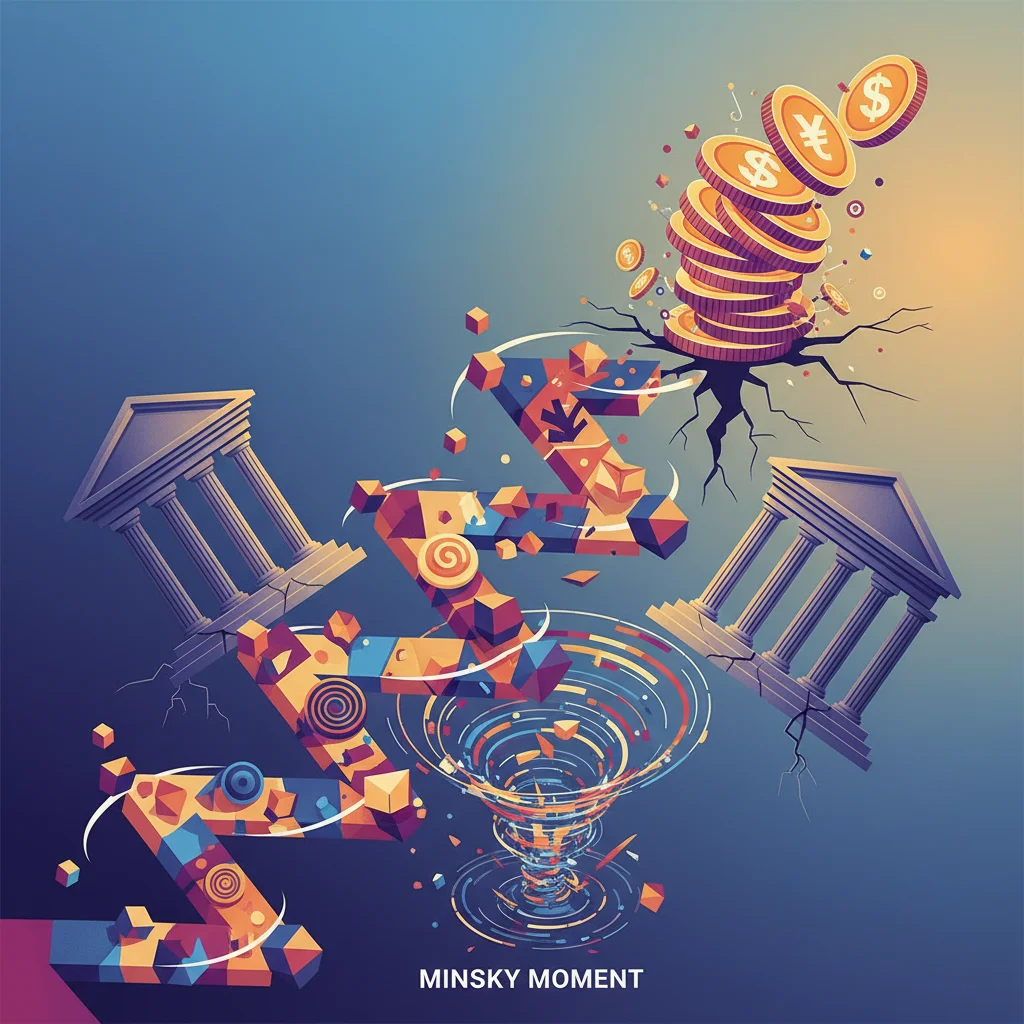
This post will delve into that powerful idea. We’ll explore who Hyman Minsky was, unpack his Financial Instability Hypothesis, and analyze how the “drunkard’s walk” of modern central banking may have led us to the precipice of a “Minsky Moment”—a sudden, cascading collapse of asset values that marks the end of a speculative boom. For anyone involved in finance, investing, or the broader economy, understanding this dynamic is no longer an academic exercise; it’s a crucial tool for navigating the uncertain road ahead.
Who Was Hyman Minsky and Why Does He Matter Now?
For much of his career, Hyman Minsky was an outsider in the world of economics. While mainstream thought was dominated by theories of market equilibrium and rational actors, Minsky focused on the messy, irrational, and inherently unstable nature of capitalist financial systems. He argued that economies don’t naturally tend toward a stable balance; instead, they move through cycles of boom and bust driven by human psychology and the dynamics of debt.
His central thesis, the Financial Instability Hypothesis (FIH), can be summarized in a single, paradoxical phrase: “stability is destabilizing.” Minsky theorized that during long periods of economic prosperity and stability, investors, bankers, and businesses become complacent. They forget the pain of the last downturn, take on more risk, and leverage themselves with ever-increasing amounts of debt. This growing fragility goes unnoticed until a shock occurs, at which point the over-leveraged system collapses under its own weight. Ignored for decades, Minsky’s work was thrust into the spotlight after the 2008 Global Financial Crisis, which played out almost exactly as his theories predicted.
Unlocking a Financial Fortress: The High-Stakes Plan to Fund Ukraine with Frozen Russian Assets
From Financial Crisis to Inflationary Fire: The Drunkard’s Walk of Monetary Policy
Let’s map Minsky’s parable onto the actions of central banks, particularly the U.S. Federal Reserve, over the last 15 years. The 2008 crisis was the initial fall. In response, central banks offered a powerful helping hand.
This support came in two main forms:
- Zero Interest Rate Policy (ZIRP): By cutting interest rates to near zero, central banks made borrowing incredibly cheap, encouraging spending and investment to stimulate the economy.
- Quantitative Easing (QE): Central banks created new money to buy massive quantities of government bonds and other financial assets. This injected trillions of dollars of liquidity into the banking system, pushing down long-term interest rates and encouraging risk-taking in the stock market and other assets.
For over a decade, this support worked—or so it seemed. The economy recovered, unemployment fell, and the stock market embarked on one of the longest bull runs in history. This was the period where the drunkard, propped up by the sober helper, felt steady on his feet. The prevailing wisdom in banking and economic circles was that central banks had mastered the art of crisis management. They had the tools, and they knew how to use them. Stability reigned.
The table below outlines this progression, aligning recent economic history with Minsky’s framework.
| Era | Central Bank Policy | Economic Environment | The “Drunkard’s Walk” Analogy |
|---|---|---|---|
| 2008-2009 | Emergency rate cuts, initial QE | Global Financial Crisis, deep recession | The drunkard has fallen and needs help. |
| 2010-2019 | Sustained ZIRP, multiple rounds of QE | Slow but steady growth, low inflation, massive asset price boom (stock market, real estate) | The sober helper (central bank) is providing a steadying arm. |
| 2020-2021 | Massive new QE and fiscal stimulus (COVID response) | Short, sharp recession followed by a rapid, stimulus-fueled recovery | The drunkard feels invincible, taking an extra drink for good measure. |
| 2022-Present | Rapid, aggressive interest rate hikes, Quantitative Tightening (QT) | Highest inflation in 40 years, fears of recession, market volatility | The drunkard shoves the helper away and promptly stumbles. |
The final stage—the stumble—began in 2021. The massive stimulus, combined with supply chain disruptions, unleashed a wave of inflation that central banks initially dismissed as “transitory.” They had become so confident in their models that they failed to see the danger. When inflation proved persistent, they were forced into a dramatic reversal, hiking interest rates at the fastest pace in decades. The helping hand was violently withdrawn, and the global economy, built on a foundation of cheap debt, began to wobble.
Hedge, Speculative, and Ponzi: The Three Faces of Debt
To truly grasp Minsky’s theory, we must understand his classification of debt. He argued that as the economic cycle progresses and optimism grows, the quality of debt deteriorates across three stages:
- Hedge Financing: This is the most stable form of debt. A borrower (be it a company or individual) has sufficient cash flow to repay both the principal and interest on their loan. Think of a profitable blue-chip company or a homeowner with a stable job and a conventional mortgage.
- Speculative Financing: This is a riskier stage. The borrower has enough cash flow to cover the interest payments but cannot pay down the principal. They must constantly roll over their debt, borrowing new money to pay back the old. This works as long as lenders are willing and interest rates remain stable. Many growth-focused tech companies or commercial real estate developers operate in this zone.
- Ponzi Financing: This is the most fragile and dangerous stage. The borrower’s cash flow covers neither principal nor interest. Their only hope for survival is that the value of the underlying asset (a property, a stock, a business) continues to rise, allowing them to borrow even more against its appreciating value. This is pure, unadulterated speculation, and it is the fuel for a Minsky Moment. When asset prices stop rising, the entire structure collapses.
The post-2008 era of easy money unquestionably pushed a significant portion of the global economy down this spectrum. According to S&P Global, corporate defaults have been rising as financial conditions tighten. Many of these are firms that likely shifted from speculative to Ponzi-like financial structures, sustained only by the promise of perpetually cheap credit. The rapid increase in interest rates is now exposing these vulnerabilities.
Netflix's Endgame: Decoding the Billion-Dollar Warner Bros. Deal and Its Impact on the Stock Market
What This Means for Investing and Trading in the Modern Economy
For investors, business leaders, and anyone involved in the stock market, Minsky’s framework is not just a historical lesson; it’s a practical guide to risk management. The key takeaway is to be deeply skeptical of long periods of calm and to recognize the signs of growing financial fragility.
- Question the Narrative: When the consensus view is that “this time is different” and that risks have been permanently contained, it’s time to be cautious. The belief that central banks had solved the business cycle was a classic sign of Minsky-esque hubris.
- Watch the Debt, Not Just the Profits: Look beyond headline earnings and analyze balance sheets. How is a company financing its growth? Is it hedge, speculative, or verging on Ponzi? High levels of leverage are a red flag in a rising-rate environment.
- Beware of Asset-Liability Mismatches: The collapse of Silicon Valley Bank in 2023 was a textbook Minsky case study. The bank used short-term liabilities (customer deposits) to buy long-term assets (government bonds). When rates rose, the value of those bonds plummeted, creating a fatal mismatch. This principle applies across the financial technology (fintech) and banking sectors. As one Federal Reserve paper noted, hundreds of U.S. banks were potentially exposed to similar risks.
- Diversify Beyond Traditional Assets: In a world where central bank policy has inflated all traditional asset classes in unison, true diversification is essential. This includes considering assets with different risk profiles and understanding how macroeconomic shifts impact various sectors of the economy.
Conclusion: Can We Avoid the Next Fall?
The parable of the drunkard, as applied to central banking by the letter in the Financial Times, is a stark warning. For more than a decade, the global economy was propped up by an unprecedented wave of monetary stimulus. This support bred complacency and encouraged the very risk-taking and leverage that Hyman Minsky identified as the seeds of financial crises. Now, as the support is withdrawn to fight inflation, the system is being tested.
We are currently living through a great economic experiment. The challenge for policymakers is to tame inflation without triggering the very Minsky Moment they have inadvertently set the stage for. For those of us in the world of finance, trading, and investing, the challenge is to navigate this treacherous environment with our eyes wide open, recognizing that the greatest risks often accumulate when everything looks the most stable.