From Ivory Towers to Digital Embassies: Navigating the New Geopolitics of Finance
The End of the “Cosy” Era in Global Finance
In the pages of the Financial Times, a reader’s letter carried a deceptively simple title: “A novel that swaps cosy Oxford for Paris embassy (source)“. While the letter itself was brief, its title perfectly encapsulates the profound transformation reshaping the world of finance, investing, and the global economy. For decades, the financial world resembled the hallowed, ivy-clad halls of Oxford—a place of established tradition, theoretical models, and a relatively small, cloistered group of decision-makers dictating the flow of capital. It was a world governed by predictable econometric forecasts and the stately pronouncements of central bankers. But that world is fading.
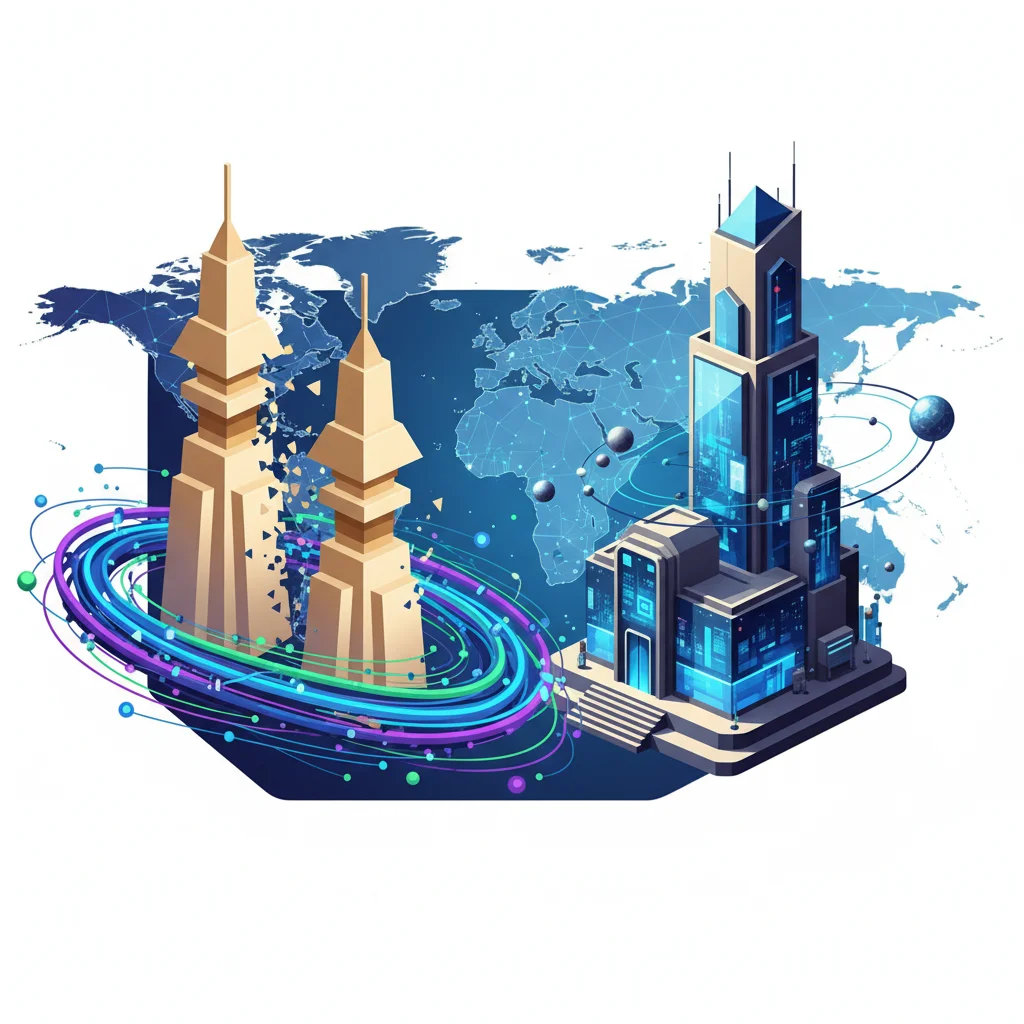
We are now entering the era of the “Paris Embassy”—a dynamic, hyper-connected, and politically charged arena. Here, the rules are not set by tenured professors but are negotiated in real-time by a diverse cast of new actors: fintech innovators, decentralized protocols, retail trading collectives, and national governments wielding technology as a tool of economic statecraft. In this new world, market-moving intelligence is as likely to come from a satellite image of an oil tanker or a shift in blockchain transaction volume as it is from a quarterly earnings report. This isn’t merely a technological upgrade; it’s a fundamental shift in power, risk, and opportunity. For investors, finance professionals, and business leaders, understanding this transition from the old, cosy establishment to the high-stakes world of digital diplomacy is no longer optional—it is essential for survival and success.
The Old Guard: Life in the Financial “Oxford”
To appreciate the magnitude of the current shift, we must first understand the world we’re leaving behind. The “Oxford” model of finance, which dominated the 20th century, was characterized by centralization, opacity, and a deliberate, academic pace. The global financial system was an oligopoly of large institutions—investment banks, commercial banks, and asset managers—all operating under the watchful eye of government regulators and central banks like the Federal Reserve.
Key characteristics of this era included:
- Centralized Authority: Monetary policy, interest rates, and the very supply of money were dictated by a handful of central banking officials. The stock market looked to these institutions for guidance, and their word was financial law.
- Information Asymmetry: Access to high-quality information was the primary advantage. Investment banks had armies of analysts, and privileged access to management gave them an edge. The average investor received information much later, if at all.
- Human-Driven Trading: While technology existed, major decisions were made by human portfolio managers and traders on bustling trading floors. It was a world of relationships, intuition, and “gut feelings” backed by research.
- Slow-Moving Regulation: The regulatory framework was robust but slow to adapt, designed for a world of physical ledgers and cross-border transfers that took days, not seconds.
This system provided a sense of stability and order. Economic models, while imperfect, offered a comforting illusion of predictability. However, the 2008 financial crisis shattered this illusion, revealing deep structural flaws and a dangerous lack of transparency. According to a report from the Financial Crisis Inquiry Commission, the crisis was an “avoidable” event caused by “widespread failures in financial regulation and supervision” (source). This catastrophic failure of the old guard cracked the foundations of the ivory tower, creating an opening for a new, technology-first approach to finance.
Unlocking a Financial Fortress: The High-Stakes Plan to Fund Ukraine with Frozen Russian Assets
Welcome to the Embassy: The New Arenas of Financial Power
The “Paris Embassy” is not a single location but a decentralized network of power centers where technology, geopolitics, and finance intersect. It’s a world defined by speed, transparency (of a new kind), and a complex web of interdependencies. Let’s explore the key chambers of this new diplomatic complex.
The Diplomatic Corps of Code: Fintech and Blockchain
In the new financial embassy, the most influential ambassadors are not people, but protocols. Financial technology, or fintech, has fundamentally rewired the plumbing of the economy. Peer-to-peer lending, digital payment apps, and robo-advisors have democratized access to financial services that were once the exclusive domain of traditional banks.
At the heart of this revolution is blockchain technology. If traditional banking is a private, centralized ledger kept in a vault, blockchain is a public, decentralized ledger cryptographically secured and distributed among thousands of computers. This creates a system for transferring value that is transparent, immutable, and operates without a central intermediary. It is, in essence, a new diplomatic protocol for establishing trust in a trustless digital world.
This has given rise to Decentralized Finance (DeFi), a parallel financial system built on blockchain that offers services like lending, borrowing, and trading without any banks. The total value locked in DeFi protocols has grown exponentially, reaching tens of billions of dollars and demonstrating a clear appetite for alternatives to the traditional banking system. The global fintech market itself is projected to reach over $324 billion by 2026, a testament to its disruptive power (source).
High-Stakes Negotiations: Geopolitics and the Economy
The “cosy Oxford” model assumed that finance and politics were related but distinct fields. The “Paris Embassy” model understands they are two sides of the same coin. Today, the stock market is as sensitive to geopolitical tremors as it is to economic data. Consider the following:
- The Weaponization of Finance: The use of sanctions and the exclusion of nations from the SWIFT international payment system have turned financial networks into instruments of foreign policy. This has spurred countries like China to accelerate the development of their own digital currency (the digital yuan) to create alternative systems, a clear example of financial technology being used in a geopolitical chess match.
- The Tech Cold War: US-China tensions over semiconductor technology directly impact the stock market performance of tech giants like NVIDIA, Apple, and TSMC. A government policy decision in one capital can wipe billions off market caps in another.
- Resource Nationalism: As the world transitions to a green economy, the control of resources like lithium, cobalt, and rare earth minerals becomes a critical factor in both economic and national security, directly influencing trading and investing in related sectors.
In this environment, an investor who only reads economic reports is flying blind. Understanding the geopolitical landscape is now a prerequisite for sound financial strategy.
The Canary in the Coal Mine: Why a Turkey Farm Scandal Signals a Seismic Shift in Financial Risk
The Intelligence Wing: Algorithmic Trading and AI
Every embassy has an intelligence-gathering operation, and in the world of modern finance, this is the domain of artificial intelligence and high-frequency trading (HFT). Algorithms can execute millions of trades in a fraction of a second, acting on data far beyond the processing power of the human brain. They analyze satellite imagery to count cars in a retailer’s parking lot, parse the sentiment of millions of social media posts, and monitor global news feeds in every language to trade on events before human analysts have even finished reading the headlines.
This represents a fundamental shift from the old world of investing. The table below illustrates the stark contrast between the traditional and modern approaches.
Comparison: Traditional vs. Modern Financial Operations
| Attribute | “Cosy Oxford” (Traditional Finance) | “Paris Embassy” (Modern Finance) |
|---|---|---|
| Primary Decision-Maker | Human Portfolio Manager | AI/Algorithmic Trading Models |
| Key Asset | Privileged Information & Relationships | Vast Datasets & Processing Speed |
| Execution Speed | Minutes to Days | Microseconds to Milliseconds |
| Primary Risk | Human Error, Misjudgment | Algorithmic Flashes, Cybersecurity Breaches |
| Regulatory Focus | Ensuring Fair Disclosure | Market Stability, Data Privacy, Code Audits |
This new paradigm of trading offers incredible efficiency but also introduces new, systemic risks. “Flash crashes,” where markets plummet and recover in minutes due to rogue algorithms, are a feature of this world. The intelligence game is faster and more ruthless than ever, and the line between a strategic advantage and a systemic vulnerability is razor-thin.
Thriving in the New Era: A Playbook for the Future
The transition from Oxford to the Embassy is not something to be feared, but something to be understood and navigated. For investors and business leaders, a new playbook is required.
- Embrace Technological Literacy: You don’t need to be a coder, but you must understand the basic principles of blockchain, AI, and cybersecurity. These are no longer niche “tech” topics; they are core components of the modern economy.
- Integrate Geopolitical Analysis: Investment research must now include geopolitical risk analysis as a standard component. Understand how supply chains, international relations, and national policies can impact your portfolio or business.
- Diversify Beyond Asset Classes: True diversification now means diversifying across platforms, protocols, and political jurisdictions. Over-reliance on a single financial system or technology is a significant, often overlooked, risk.
- Prioritize Agility and Adaptability: In a world that moves at the speed of algorithms, the five-year plan is dead. Businesses and investment strategies must be built for agility, with the ability to pivot quickly in response to new information and changing market dynamics.
The cosy, predictable world of 20th-century finance is now a chapter in the history books. We are all diplomats in this new, complex global embassy. The stakes are higher, the pace is faster, and the rules are constantly being rewritten. But for those who can master the new languages of technology and geopolitics, the opportunities to build wealth and create value are greater than ever before.
Netflix's Endgame: Decoding the Billion-Dollar Warner Bros. Deal and Its Impact on the Stock Market