Decoding the Global Economy: Fed’s Rate Cut, Ukraine’s Future, and Europe’s Industrial Gambit
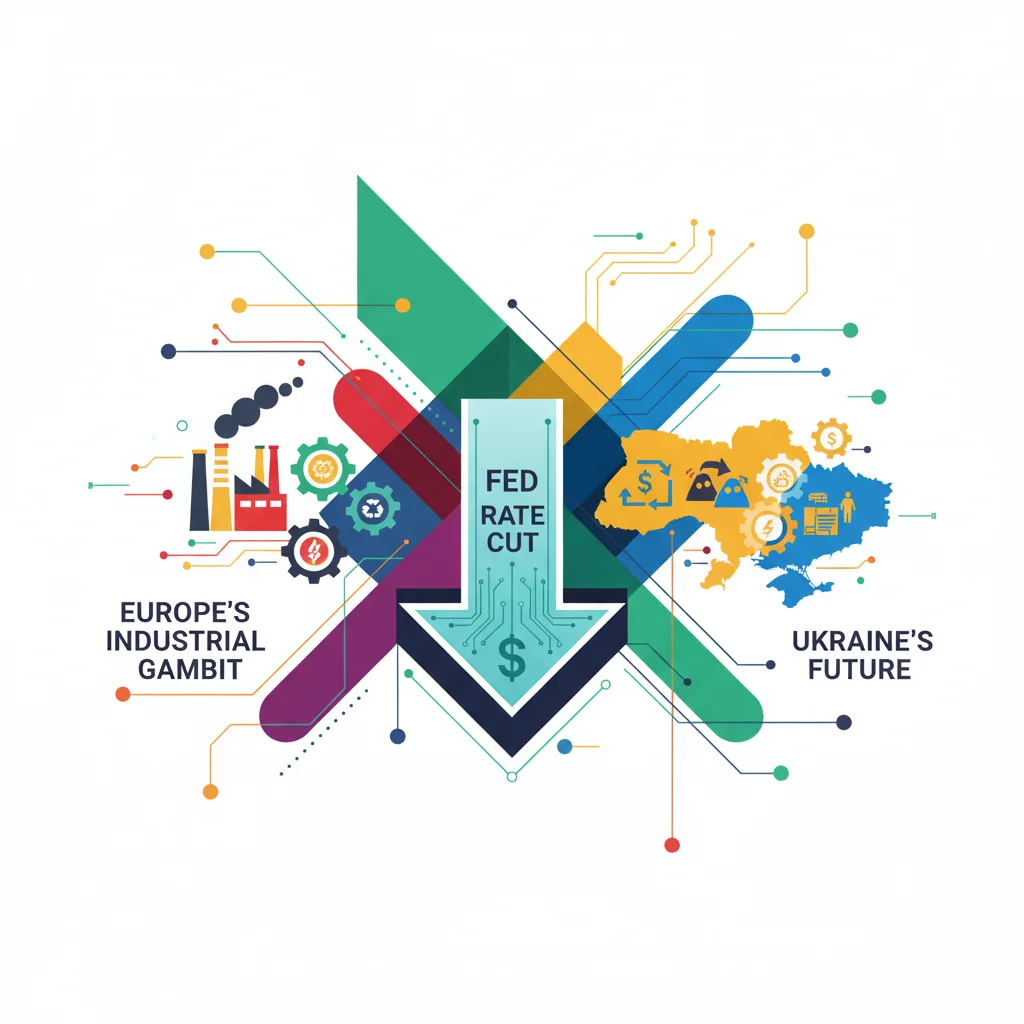
In a world of interconnected markets and complex geopolitical currents, a single headline can send ripples across the entire global financial system. This week, three such headlines emerged, each a significant event in its own right, but together painting a vivid picture of the challenges and opportunities defining our era. The U.S. Federal Reserve executed a pivotal interest rate cut, signaling a major shift in monetary policy. Simultaneously, high-level discussions began to blueprint the colossal task of postwar reconstruction in Ukraine. And across the Atlantic, Europe solidified its “Made in Europe” proposals, a bold strategy aimed at reclaiming industrial sovereignty.
These are not isolated events. They are the gears of a complex global machine, turning in response to one another. The Fed’s decision impacts the cost of capital that will be needed to rebuild Ukraine. Europe’s industrial strategy will determine where that capital is deployed and which supply chains are prioritized. For investors, business leaders, and anyone engaged in the global economy, understanding the interplay between these forces is no longer optional—it is essential for navigating the path ahead.
In this deep dive, we will unpack each of these developments, exploring their immediate consequences and long-term implications for finance, investing, and international relations.
The Federal Reserve’s Pivot: Unpacking the Cut to a Three-Year Low
The world’s most influential central bank has made its move. The U.S. Federal Reserve announced a rate cut, bringing its benchmark federal funds rate to a three-year low. This decision, while anticipated by some market watchers, marks a significant departure from the hawkish, inflation-fighting stance that has dominated monetary policy in recent years. But what does this pivot truly signify, and what are its cascading effects on the stock market, banking, and the broader economic landscape?
At its core, a rate cut is a tool to stimulate economic activity. By making it cheaper for businesses to borrow for expansion and for consumers to finance large purchases, the Fed aims to inject liquidity and confidence into the system. The timing suggests a pre-emptive strike against a potential slowdown, a move to soften the landing of an economy that has weathered significant inflationary pressures and global uncertainty.
Implications for Investors and the Stock Market
For investors, a rate cut is a double-edged sword. On one hand, lower interest rates reduce the appeal of safer assets like bonds and savings accounts, pushing capital towards riskier assets like equities. This often provides a tailwind for the stock market, particularly for growth-oriented sectors like technology and consumer discretionary, whose future earnings are valued more highly in a low-rate environment. The cost of capital for corporations also decreases, potentially boosting profits and shareholder returns.
On the other hand, the very reason for the cut—a potentially weakening economy—is a cause for concern. It can be interpreted as a signal from the Fed that it sees trouble on the horizon. This duality creates a complex environment where market sentiment can swing dramatically. Prudent investors will be closely watching accompanying economic data on employment, inflation, and consumer spending to gauge whether the Fed’s stimulus is a vitamin shot for a healthy economy or a defibrillator for a struggling one.
To illustrate the potential effects, consider the following comparison of monetary policy actions:
| Asset Class | Impact of a Rate Cut (Dovish Policy) | Impact of a Rate Hike (Hawkish Policy) |
|---|---|---|
| Equities (Stock Market) | Generally positive, especially for growth stocks. Lower borrowing costs can boost corporate profits. | Generally negative, as higher borrowing costs can squeeze profits and safer bonds become more attractive. |
| Bonds | Positive for existing bond prices, as their fixed yields become more attractive relative to new, lower-yield bonds. | Negative for existing bond prices, as new bonds are issued with higher, more attractive yields. |
| Real Estate | Positive, as lower mortgage rates stimulate demand for housing and commercial property. | Negative, as higher mortgage rates increase the cost of financing and can cool the market. |
| Commodities | Can be positive, as a weaker dollar (often a result of rate cuts) makes dollar-denominated commodities cheaper for foreign buyers. | Can be negative, as a stronger dollar makes commodities more expensive for foreign buyers. |
The Hidden Dangers of Private Equity: A Billion-Dollar Lawsuit Exposes Wall Street's Hottest Trend
Beyond the Battlefield: The High-Stakes Economics of Postwar Ukraine
While the world’s financial markets react to the Fed’s every move, another, more foundational economic discussion is taking place: the plan for rebuilding Ukraine. The talks surrounding the nation’s postwar reconstruction represent one of the most ambitious and complex economic undertakings of the 21st century. The scale is staggering, with early estimates from institutions like the World Bank suggesting the cost could run into hundreds of billions of dollars (source).
These discussions involve a coalition of global players, including the G7 nations, international financial institutions, and the private sector. The goal is not merely to rebuild what was lost but to forge a new, modern, and resilient Ukrainian economy integrated with the West. This involves massive investments in infrastructure, energy, digital services, and agriculture. For international investors, this presents a generational opportunity, but one that is fraught with significant risk.
The Role of Fintech and Blockchain in a Transparent Reconstruction
A key challenge in any large-scale reconstruction effort is ensuring that funds are deployed effectively and transparently. This is where modern financial technology can play a transformative role. The use of blockchain technology, for instance, could create an immutable ledger for tracking aid disbursements and construction contracts, drastically reducing the potential for corruption and ensuring accountability.
Fintech platforms can facilitate micropayments, streamline cross-border investments, and provide financial services to displaced populations, helping to rebuild the economic fabric from the ground up. The reconstruction of Ukraine could become a landmark case study in leveraging technology to build a more efficient and transparent state, a concept that will be critical for attracting the necessary private-sector capital.
The Investor's Mosaic: Decoding Market Signals from China's Debt to Fed Whispers
Fortress Europe? Analyzing the ‘Made in Europe’ Strategy
The third major development is the crystallization of the “Made in Europe” proposals. This is far more than a branding exercise; it is a fundamental strategic shift in European economics. Spurred by the vulnerabilities exposed by the pandemic’s supply chain disruptions and the geopolitical shock of the war in Ukraine, the EU is moving aggressively to reduce its dependence on external powers, particularly China and Russia, for critical goods.
The strategy focuses on bolstering domestic production in key strategic sectors. These include:
- Semiconductors: Reducing reliance on Asian manufacturers for the chips that power the modern digital economy.
– Green Technology: Leading the world in the production of batteries, solar panels, and wind turbines to drive the energy transition.
– Pharmaceuticals: Ensuring a stable supply of essential medicines and active pharmaceutical ingredients.
– Raw Materials: Developing domestic mining and recycling capabilities to secure the resources needed for high-tech manufacturing.
The Economic Trade-Offs of Strategic Autonomy
This push for self-sufficiency, or “strategic autonomy,” comes with significant economic trade-offs. The primary benefit is increased resilience. By onshoring production, Europe can better insulate itself from external shocks and geopolitical blackmail. It also has the potential to create high-skilled jobs and spur a new wave of innovation within the bloc. The European Commission’s backing of these initiatives with subsidies and favorable regulations is designed to catalyze private investment in these target areas (source).
However, the drawbacks are equally significant. Reshoring production can be less efficient and more expensive than relying on specialized global supply chains, potentially leading to higher prices for consumers and businesses. It also risks being viewed as protectionism, inviting retaliatory measures from trading partners and potentially fragmenting the global trading system that has delivered decades of growth. The key challenge for European policymakers will be to strike a balance between building resilience and maintaining the benefits of open trade.
The Price of a Truce: Why a Chinese Spy Agency Was Spared U.S. Sanctions
Conclusion: A New Chapter in the Global Economic Narrative
The Federal Reserve’s rate cut, the blueprint for Ukraine’s future, and Europe’s industrial renaissance are not separate stories. They are interwoven threads in a single, evolving narrative about the future of the global economy. We are moving from an era defined by hyper-globalization and just-in-time supply chains to one characterized by strategic competition, regionalization, and a renewed focus on national and economic security.
For those in the world of finance, investing, and business, this new landscape demands a more sophisticated and nuanced approach. It requires looking beyond simple market indicators and understanding the deep geopolitical and strategic currents shaping economic policy. The decisions made in Washington, Brussels, and Kyiv today will set the stage for the market dynamics, investment opportunities, and economic realities of tomorrow. Navigating this complex terrain successfully will be the defining challenge for a generation of leaders and investors.

Related Posts

Funding the Frontline: Could “War Bonds” Reshape UK Finance and Defence?
Collision Course: Trump, The Fed, and the High-Stakes Battle for America’s Economic Future