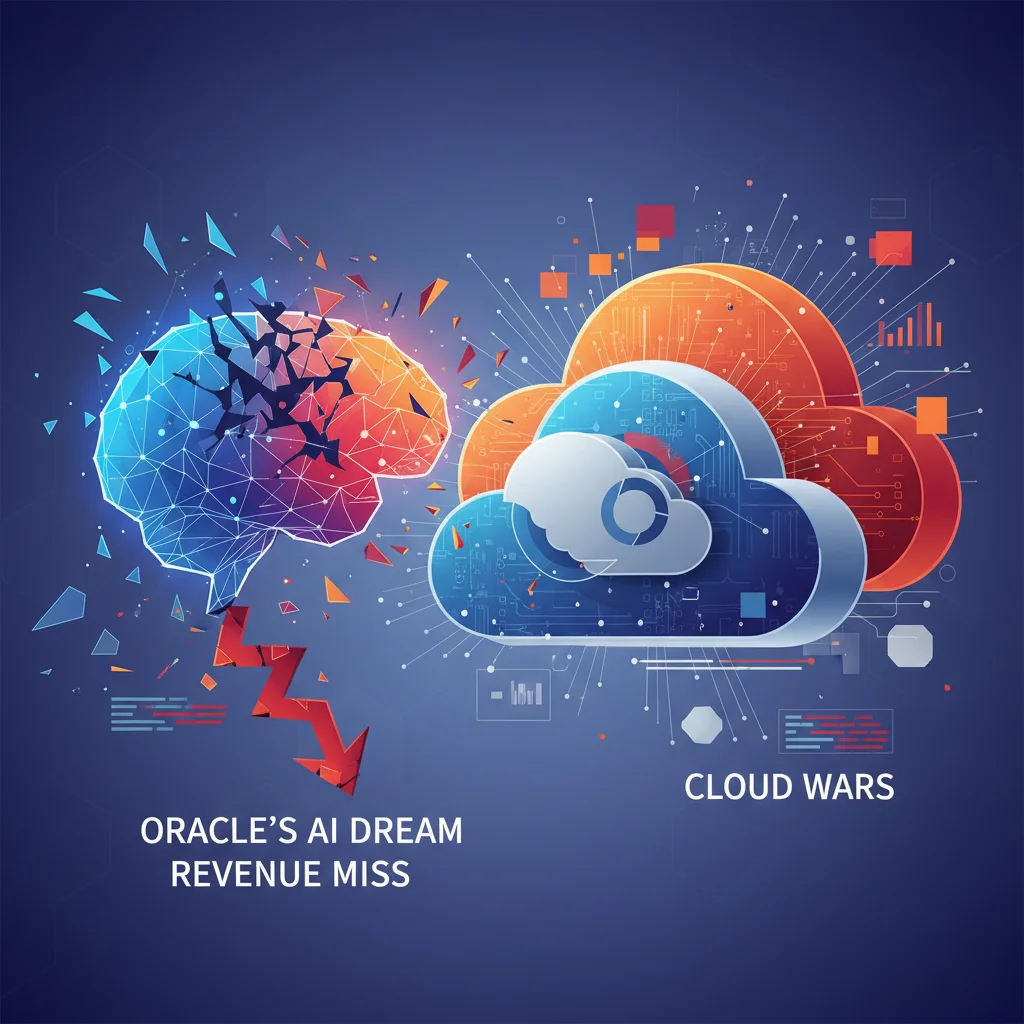
Oracle’s AI Dream Hits a Reality Check: Unpacking the Revenue Miss and the Future of the Cloud Wars
In the tech world, the narrative is everything. For the past year, the story has been one of explosive growth fueled by the insatiable demand for artificial intelligence. Companies with a credible AI play have seen their valuations soar, creating an aura of invincibility. But as the dust settles, the market is beginning to ask tougher questions. This week, we saw a prime example of this when tech behemoth Oracle, despite its aggressive push into AI, reported revenues that missed Wall Street’s expectations, sending its shares tumbling.
The news, first highlighted by the BBC, immediately raised concerns about the company’s financial trajectory and its ability to compete in the cutthroat world of cloud computing. On the surface, it’s a simple story: a company missed its numbers. But beneath the headline lies a complex and fascinating drama about corporate strategy, technological shifts, and the high-stakes battle for the future of the internet’s infrastructure. Is this a minor stumble for Oracle, or is it a symptom of a deeper challenge in its quest to dethrone the reigning cloud kings?
In this deep dive, we’ll go beyond the numbers to explore what Oracle’s situation *really* means. We’ll analyze its position in the great cloud battlefield, dissect its ambitious AI strategy, and provide actionable insights for developers, tech leaders, and startups trying to navigate this rapidly evolving landscape.
The Anatomy of a Miss: What the Numbers Reveal
When a company the size of Oracle misses its revenue forecast, it’s not just a line item on a spreadsheet; it’s a signal that reverberates through the entire industry. While the company still posted impressive figures, the deviation from analyst expectations was enough to spook investors. This “miss” is critical because it challenges the prevailing narrative that the AI boom is a rising tide that lifts all boats equally. It suggests that converting AI hype into consistent, predictable revenue is far more difficult than it looks.
Oracle’s business is a sprawling empire, but for this discussion, we can break it down into two key areas: its legacy software and its modern cloud infrastructure business. Its traditional database and enterprise applications (like NetSuite and Fusion) are mature, cash-cow businesses. The real growth story, and the focus of investors, is Oracle Cloud Infrastructure (OCI). This is Oracle’s answer to Amazon Web Services (AWS), Microsoft Azure, and Google Cloud Platform (GCP). OCI is where the company has placed its massive bet on the future of AI and machine learning, investing billions in data centers packed with the high-performance NVIDIA GPUs required for training large language models.
The recent financial report indicates that while OCI is growing, its pace may not be fast enough to offset sluggishness in other areas or meet the market’s sky-high expectations for AI-driven growth. This performance has led to renewed questions about whether Oracle can truly carve out a significant share of the market from the entrenched hyperscalers who had a decade-long head start.
India's New Smartphone Mandate: A Cybersecurity Shield or a Surveillance Trojan Horse?
A Titan’s Uphill Battle in the Cloud Wars
To understand Oracle’s current predicament, we need a bit of historical context. Oracle was famously late to the cloud party. For years, founder Larry Ellison was publicly skeptical of the cloud model, a stance that allowed AWS, Azure, and GCP to build formidable leads in infrastructure, platform services, and, most importantly, developer mindshare. Realizing its mistake, Oracle has spent the last several years engaged in an aggressive and expensive game of catch-up.
Instead of competing head-on across every possible service, Oracle has adopted a more focused strategy, targeting its massive existing customer base of enterprises that already rely on Oracle databases. Its pitch is compelling: run your most critical Oracle workloads on the cloud built by Oracle for better performance and lower cost. The emergence of generative AI provided a golden opportunity to double down on this by offering specialized, high-performance computing for AI/ML workloads at what it claims are more competitive prices.
But how does OCI really stack up against the competition? Here’s a high-level comparison for tech professionals and decision-makers:
| Feature / Aspect | Oracle Cloud (OCI) | AWS / Azure / GCP (The “Hyperscalers”) |
|---|---|---|
| Primary Target | Large enterprises, existing Oracle customers, high-performance computing (HPC), and AI training. | Broad market from individual developers and startups to global enterprises. |
| Key Differentiator | Price-performance for specific workloads (e.g., bare metal, GPUs), deep integration with Oracle database & SaaS products. | Vast portfolio of services, mature developer ecosystems, extensive global reach, and first-mover advantage. |
| AI/ML Services | Strong focus on providing raw infrastructure (GPU clusters) for model training. Growing portfolio of managed AI services. | Comprehensive suite of services from infrastructure (e.g., TPUs, Inferentia) to high-level APIs (e.g., Vision, NLP, GenAI platforms). |
| Perceived Weakness | Smaller service portfolio, less developer mindshare, and a reputation for being less “startup-friendly.” | Complex pricing models, potential for vendor lock-in, and can be more expensive for certain high-performance workloads. |
This table illustrates Oracle’s challenge. While it has a strong technical offering for a specific niche, it is fighting a broader war for adoption against competitors who are deeply embedded in the workflows of millions of developers and companies. The recent revenue report suggests this is a tougher fight than anticipated, even with the tailwind of AI demand (source).
The AI Paradox: Drowning in Demand, Thirsty for Revenue?
The central paradox for Oracle is this: the demand for AI computing is undeniably historic, and Oracle has secured significant capacity of the much-coveted NVIDIA GPUs. It has signed high-profile deals with major AI players like Cohere. So, why isn’t this translating into blowout revenue numbers that crush expectations? There are a few potential reasons:
- Long Sales and Implementation Cycles: Oracle’s primary customers are large enterprises. These deals involve long negotiation periods, complex migrations, and significant engineering work. The revenue from a deal signed today might not show up in financial reports for several quarters.
- Competitive Pressure and Pricing: To win market share, Oracle has been competing aggressively on price. While this can attract customers, it might also mean lower margins and a smaller immediate impact on the top line. The cloud business is a game of scale, and Oracle is still in the investment phase of building that scale.
- The “Whole Product” Challenge: Building a successful AI platform isn’t just about offering GPUs. It’s about providing the entire stack of tools that make developers’ lives easier: efficient data pipelines, robust container orchestration, serverless functions, and seamless programming frameworks. While Oracle is improving rapidly, competitors have a more mature and comprehensive offering here, which can be a deciding factor for many AI startups.
This situation highlights a crucial lesson in innovation: having a powerful engine is useless without a well-built car and a network of roads to drive on. Oracle has the engine (GPUs), but it’s still paving the roads and building the car to compete with the Teslas and Fords of the cloud world.
The AI Tutor Has Arrived: How Software is Rewriting the Rules of the Classroom
Implications for the Tech Ecosystem
So, what does Oracle’s speed bump mean for you? It depends on who you are.
- For Developers & Tech Professionals: This could be a net positive. A hungrier Oracle means more competition, which often translates to better pricing, more free credits, and increased investment in developer relations. It’s a strong reminder to pursue multi-cloud skills. Being proficient in OCI in addition to the big three could become a valuable differentiator, especially in enterprise environments.
- For Entrepreneurs & Startups: Don’t ignore OCI, especially if your startup is focused on intensive AI model training. Oracle is highly motivated to win over the next generation of AI companies and may be willing to offer favorable terms and engineering support that would be harder to get from the market leaders. This event underscores the importance of negotiating your cloud contracts carefully and avoiding vendor lock-in.
- For Cybersecurity Professionals: Oracle continues to make cybersecurity a core tenet of its cloud offering, often bundling security features that are add-on costs elsewhere. As enterprises weigh their cloud options, Oracle’s security-first approach remains a significant advantage. The financial pressure to grow may even lead to further innovation in security automation to attract risk-averse corporate clients.
The broader industry should see this as a sign of a maturing market. The initial, frenzied phase of “buy all things AI” is giving way to a more discerning evaluation of real-world value and sustainable business models. A recent analysis of market trends supports the idea that customers are becoming more selective about their cloud vendors (source).
The AI Revolution's Human-Sized Hole: Why Your Best Bot is Still a Person
Conclusion: A Marathon, Not a Sprint
Oracle’s revenue miss isn’t a sign of impending doom. It’s a reflection of the monumental task the company has undertaken: to challenge a deeply entrenched oligopoly in the most important technology market of our time. The company is a resilient and formidable competitor with deep pockets, a loyal enterprise customer base, and world-class engineering talent.
However, this event serves as a crucial reminder that in the tech industry, past glory doesn’t guarantee future success. The path to becoming a top-tier AI and cloud player is a marathon that requires more than just powerful hardware and aggressive sales tactics. It demands a relentless focus on the developer experience, a vibrant ecosystem, and the patience to build trust, one workload at a time. Oracle has joined the race, but the finish line is still a long way off, and its competitors aren’t slowing down.

Related Posts

The Uber Pay Correction: Why a Single Sentence Reveals Everything About the Future of the Gig Economy and Investing

The $40 Billion Wager: Why Microsoft and Amazon are Going All-In on India’s Digital Future