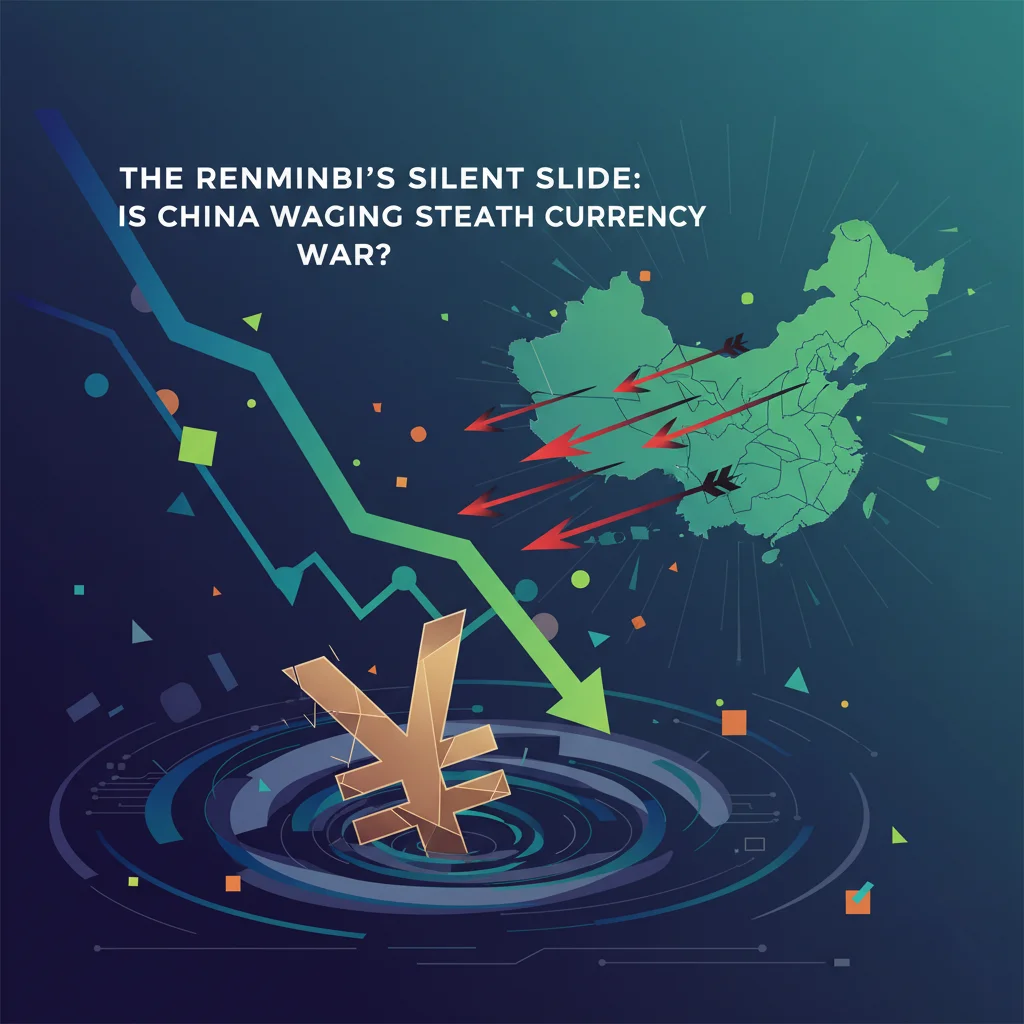
The Renminbi’s Silent Slide: Is China Waging a Stealth Currency War?
In the intricate dance of global economics, currency valuations are the subtle, often unseen, choreographers. A slight dip here, a gentle rise there, can redefine trade balances, reshape corporate profits, and rewrite the rules of international competition. Recently, a significant move on this global stage has captured the attention of business leaders in Europe, who are now sounding an alarm. The European Union Chamber of Commerce in China has issued a stark warning: the steady decline of China’s currency, the renminbi (RMB), is giving Chinese exporters an “unfair advantage” and risks igniting a new wave of trade retaliation.
This isn’t just arcane financial news; it’s a development with profound implications for the global economy, international relations, and anyone involved in investing or global business. As China grapples with significant domestic economic headwinds, the question arises: Is the renminbi’s slide a natural market reaction, or is it a calculated policy move to prop up its export machine at the expense of its trading partners? Let’s delve into the complexities of this currency conundrum and what it signals for the future of global trade.
The Core Complaint: An Uneven Playing Field
The central argument from the EU Chamber of Commerce is that the renminbi is “undervalued.” According to their position paper, the currency’s depreciation, particularly against the US dollar and the euro, makes Chinese goods significantly cheaper on the international market. This, they argue, creates an imbalanced competitive landscape where European companies struggle to compete with a flood of lower-priced Chinese products, not because of inefficiency, but because of exchange rate dynamics.
Jens Eskelund, president of the chamber, noted that while the currency’s fall might be helping China navigate its economic challenges, it comes at a cost to its trade partners. The chamber warns that if this trend continues, it could provoke a protectionist backlash. “If China were to continue to allow the renminbi to slide, it would be ‘very likely’ to prompt trade retaliation from other countries,” the chamber stated, highlighting the growing risk of a tit-for-tat tariff war that could destabilize the global trading system.
Currency Economics 101: Why a “Weak” RMB Matters
To understand the gravity of the situation, it’s essential to grasp the basics of currency valuation. When a country’s currency weakens relative to others:
- Exports Become Cheaper: A European buyer needs fewer euros to purchase the same amount of Chinese goods, making them more attractive.
- Imports Become More Expensive: Chinese consumers and businesses need to pay more yuan to buy European products, dampening demand for foreign goods.
This dual effect can supercharge a nation’s export sector and protect domestic industries from foreign competition—a powerful tool, especially when domestic demand is weak. China’s economy is currently facing a perfect storm of a prolonged property crisis, sluggish consumer spending, and deflationary pressures. In this context, boosting net exports becomes a critical lifeline for economic growth.
The Investor's Fog of War: Navigating Market Uncertainty in an Age of Geopolitical Turmoil
The concern is that China’s currency is not freely traded like the dollar or the euro. It operates under a “managed float” system, where the People’s Bank of China (PBoC) sets a daily “fixing” rate and allows the currency to trade within a narrow band around it. This gives authorities significant influence over its value, leading to accusations that they can deliberately keep it artificially low to gain a competitive edge—a practice often labeled as currency manipulation.
A Deliberate Devaluation or a Managed Decline?
The debate hinges on intent. Is the PBoC actively pushing the renminbi down, or is it simply managing an inevitable decline caused by powerful market forces? The evidence suggests a more nuanced reality. China’s economic woes have led to significant capital outflows and weakened investor confidence, all of which naturally push the currency’s value down. In fact, many analysts argue the PBoC has been intervening to *slow* the renminbi’s fall, not accelerate it, to prevent a disorderly crash that could trigger financial instability.
This highlights the tightrope Beijing is walking. A currency that is too weak risks capital flight and accusations of protectionism. A currency that is too strong could cripple its export-led recovery. The current strategy appears to be a carefully controlled depreciation—allowing the RMB to weaken enough to support the economy without causing panic.
Here’s a breakdown of the competing perspectives on the renminbi’s recent performance:
| Perspective | Argument | Implication |
|---|---|---|
| The EU Chamber’s View (Calculated Move) | China is intentionally allowing or guiding the RMB lower to subsidize its exporters and gain an unfair trade advantage. The “managed” nature of the currency is the key tool. | This is a form of protectionism that warrants a response, possibly through tariffs or other trade barriers, to level the playing field. |
| The Market Forces View (Inevitable Result) | The RMB is weakening due to fundamental economic problems: a weak property market, low interest rates compared to the US, and tepid investor sentiment. | The PBoC is actually acting as a stabilizing force, preventing a much steeper, more chaotic decline. The weakness is a symptom, not the strategy itself. |
| The “Controlled Descent” Hybrid View | Both are true. Beijing recognizes the market pressures but is strategically guiding the currency downward in a controlled manner to reap the export benefits while avoiding a panic. | This is a sophisticated policy that is difficult for trade partners to counter directly, as it’s not overt manipulation but rather a strategic “lean against the wind.” |
The Global Ripple Effect: From Boardrooms to Your Portfolio
The implications of a persistently weak renminbi extend far beyond China’s borders, impacting everything from corporate strategy to the global stock market.
For International Businesses
European and American companies that compete directly with Chinese manufacturers are on the front lines. A 10-15% currency advantage, as the renminbi has experienced against the dollar over the past couple of years (source), is a massive hurdle to overcome. This pressure could lead to shrinking profit margins, loss of market share, and difficult decisions about production and pricing.
For Investors
For those investing in the markets, this situation introduces several layers of risk and opportunity. Currency fluctuations can significantly impact the returns of international portfolios. A weakening RMB erodes the value of investments held in Chinese assets when converted back to dollars or euros. Moreover, the threat of trade retaliation introduces significant geopolitical risk, which can create volatility across global markets. Traders will be closely watching central bank announcements and trade rhetoric for signals.
Solving the Financial Puzzle: A Guide to Navigating Today's Complex Economy
The Role of Financial Technology
In this volatile environment, advances in financial technology are more critical than ever. Fintech platforms offer sophisticated tools for businesses to hedge against currency risk, using derivatives and other financial instruments to lock in exchange rates and protect their profits. For international payments and supply chain finance, new technologies, including distributed ledgers inspired by blockchain, promise to make cross-border transactions faster and more transparent, though they cannot eliminate the underlying exchange rate risk.
Conclusion: A Precarious Path Forward
The European Chamber of Commerce has fired a clear warning shot. The sustained weakness of the renminbi is no longer a peripheral issue for economics wonks; it is a central point of friction in the world’s most important trading relationships. China is navigating a perilous path, attempting to stimulate its domestic economy without triggering a full-blown trade war.
The world is watching for the response. Will Brussels and Washington accept the “market forces” argument, or will they conclude that this is a deliberate policy of competitive devaluation requiring a firm response? The answer will have lasting consequences for global supply chains, corporate profits, and the fragile stability of the international economic order. For now, the renminbi’s silent slide continues to echo loudly in the halls of power and corporate boardrooms across the globe.
The Verdict on the UK Economy: Why Scrapping Jury Trials Could Rattle Global Investors