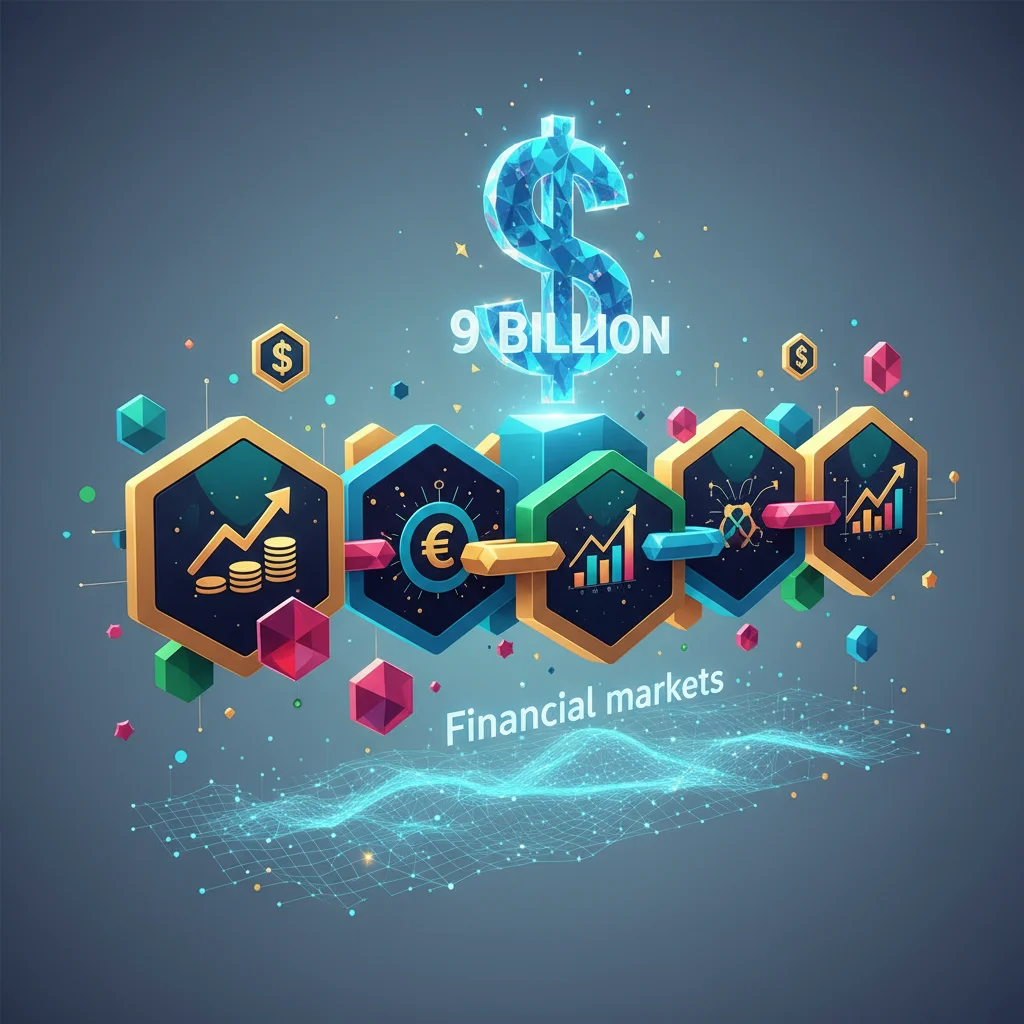
The $9 Billion Bet: How Blockchain is Forging the Future of Financial Markets
In the dynamic world of finance and investing, new platforms occasionally emerge that challenge our fundamental understanding of markets. Polymarket, a decentralized prediction market, is one such phenomenon. With trading volumes soaring past $400 million in a single month and a secondary market valuation approaching a staggering $9 billion, it’s commanding the attention of investors, technologists, and economists alike. But how can a platform, still navigating regulatory landscapes, achieve a valuation that rivals established fintech giants?
The answer lies not in speculative hype, but in the revolutionary power of its underlying architecture: blockchain technology. Polymarket isn’t just a better prediction market; it’s a case study in how decentralized infrastructure can solve age-old problems of trust, efficiency, and access that have plagued traditional financial systems for decades. This deep dive explores the technological foundations that make Polymarket’s valuation plausible and what it signals for the future of financial technology and the broader economy.
The Old Guard: Why Traditional Prediction Markets Stalled
To appreciate the innovation, we must first understand the limitations of the past. Prediction markets, in theory, are powerful tools. They harness the “wisdom of the crowds” to forecast future events, from election outcomes to economic trends. By allowing participants to buy and sell shares in the outcome of an event, the market price reflects the collective, real-time probability of that event occurring.
For years, the most cited example was the Iowa Electronic Markets (IEM), an academic project that demonstrated the potential of this concept. However, IEM and other centralized models were hamstrung by inherent structural flaws:
- Centralized Control: A single entity controlled the platform, acting as a bottleneck for creating new markets, settling outcomes, and handling funds. This introduced counterparty risk and limited scalability.
- Slow and Costly Settlements: Payouts were often manual, slow, and subject to the operational inefficiencies of traditional banking systems, involving high transaction fees.
- Geographical and Regulatory Barriers: Participation was often restricted to specific jurisdictions, limiting the pool of participants and thus the “wisdom” of the crowd.
- Lack of Transparency: The internal workings, order books, and settlement processes were often opaque, requiring participants to trust the central operator completely.
These limitations kept prediction markets as a niche academic or gambling interest rather than a mainstream financial tool. They were a brilliant idea trapped in outdated infrastructure.
The Yen's Shadow: Why the Bank of Japan's Next Move is Shaking the Crypto Market
The Blockchain Revolution: Rebuilding Finance from the Ground Up
Polymarket, built on the Polygon blockchain, fundamentally rewrites the rules. It leverages the core tenets of decentralized technology to eliminate the weaknesses of its predecessors. This isn’t merely an upgrade; it’s a complete paradigm shift in how markets can be constructed and operated.
The table below illustrates the stark contrast between the old model and the new, blockchain-powered approach.
| Feature | Traditional Prediction Markets (e.g., IEM) | Blockchain-Based Markets (e.g., Polymarket) |
|---|---|---|
| Settlement Mechanism | Centralized, manual, and often slow (days/weeks). | Automated, instant settlement via self-executing smart contracts. |
| Trust Model | Trust in a central operator (the company/institution). | Trust in immutable code and a decentralized network. |
| Accessibility | Geographically restricted, requires traditional bank accounts. | Global, 24/7 access with just a crypto wallet and internet. |
| Operational Fees | High due to banking, legal, and administrative overhead. | Dramatically lower, based on blockchain transaction fees (gas). |
| Transparency | Opaque; internal operations are a black box. | Radically transparent; all trades and settlements are on a public ledger. |
| Censorship | Markets and users can be easily restricted or removed by the operator. | Highly censorship-resistant due to decentralized infrastructure. |
The key innovation is the use of smart contracts. These are self-executing contracts with the terms of the agreement directly written into code. When an event’s outcome is verified by a decentralized oracle (a trusted data source), the smart contract automatically distributes funds to the winning parties. There is no intermediary, no delay, and no possibility of a central operator withholding funds or disputing the outcome. This creates a “trustless” environment where the integrity of the market is guaranteed by code, not by a corporate promise. This is the cornerstone of modern fintech and a core principle of decentralized finance (DeFi).
More Than a Bet: The Economic Power of Information Markets
Dismissing Polymarket as a mere gambling platform is to miss the larger picture. At its core, it is an information market—a powerful engine for aggregating dispersed knowledge and sentiment into a single, quantifiable metric: price.
In economics, this is a real-time manifestation of the Efficient Market Hypothesis. Every participant brings their own data, analysis, and intuition to the market. The resulting price—for example, the 65% chance of a specific candidate winning an election—is arguably one of the most accurate, continuously updated forecasts available anywhere. This has profound implications for the broader economy and stock market:
- Real-Time Economic Indicators: Imagine a market on “Will the Federal Reserve cut rates by September?” The price on this market could become a more reactive and arguably more honest indicator of market sentiment than traditional analyst surveys.
- Corporate Hedging and Risk Management: Businesses could use prediction markets to hedge against specific risks, such as supply chain disruptions, regulatory changes, or the success of a competitor’s product launch.
- A New Class of “Alternative Data” for Investing: For hedge funds and institutional investors, the data generated by these markets is a potential goldmine. It offers a raw, unfiltered signal on public sentiment and future events that could inform trading strategies across asset classes, from equities to commodities.
This transforms the act of “betting” into a process of price discovery. Every trade contributes to a more accurate picture of the future, creating a public good in the form of high-fidelity information.
The Hidden Burn Rate: How Disposable Vapes Are Igniting Financial Risk in the Economy
Deconstructing the $9 Billion Valuation: A Bet on the Future of Trading
Is Polymarket truly worth nearly $9 billion? Traditional valuation metrics like price-to-earnings ratios don’t apply here. Instead, this valuation is built on the principles of venture investing in disruptive technology:
- Total Addressable Market (TAM): The potential market isn’t just online gambling. It’s the multi-trillion-dollar industries of financial derivatives, risk management, and data analytics. If Polymarket can capture even a fraction of this, its potential is immense.
- Network Effects: Like a stock market or a social network, a prediction market becomes more valuable as more people use it. More users mean more liquidity, which leads to more accurate prices, which in turn attracts more users. Polymarket is demonstrating strong early network effects.
- Technological Moat: By building on decentralized infrastructure, Polymarket has created a system that is fundamentally more efficient, transparent, and accessible than any centralized competitor could hope to be. This is a durable competitive advantage.
- First-Mover Advantage: While other platforms exist, Polymarket has captured the public’s imagination and significant market share, establishing itself as the brand leader in the space (source).
Investors are not just buying a piece of a prediction market; they are investing in a piece of foundational financial infrastructure for the future. They are betting that the world is moving from centralized, trust-based systems to decentralized, code-based systems, and that Polymarket is at the forefront of this tectonic shift in financial technology.
The Road Ahead: Regulation, Adoption, and the New Financial Economy
Polymarket’s journey is far from over. Regulatory challenges are significant and must be navigated carefully. Broader adoption requires a more user-friendly interface that abstracts away the complexities of blockchain for the average user. However, the underlying value proposition is undeniable.
The story of Polymarket is the story of blockchain’s maturation from a speculative asset into a transformative technology for the real world. It proves that by rethinking the very foundations of how we exchange value and information, we can build markets that are faster, fairer, and more accessible to everyone. The $9 billion valuation isn’t just a number; it’s a powerful signal that the future of finance is being built today, and it’s being built on the blockchain.