The AI Tutor Has Arrived: How Software is Rewriting the Rules of the Classroom
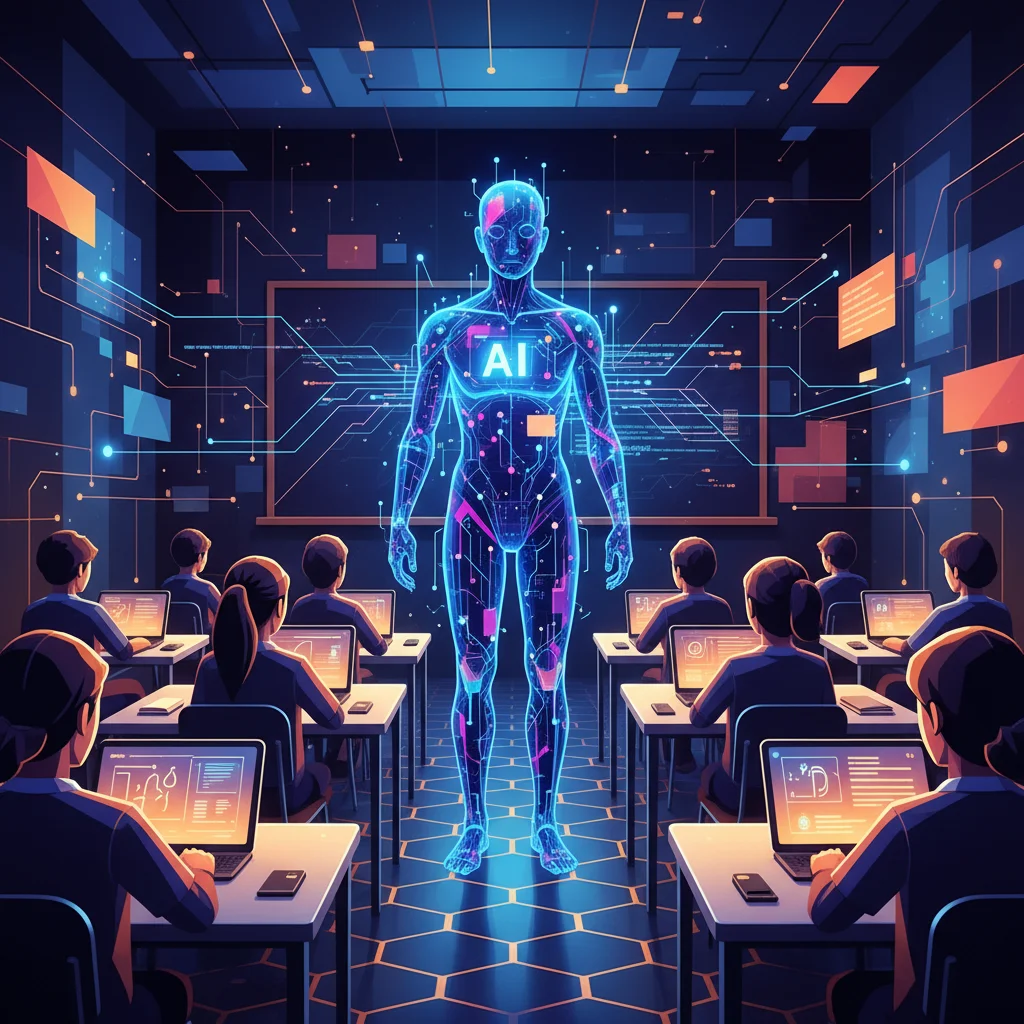
Walk into a classroom today, and you might see something that feels both familiar and futuristic. Students are at their desks, light illuminating their faces—not from an open textbook, but from a tablet. A teacher walks the aisles, but instead of lecturing from the front, she’s engaging one-on-one with a small group. And on those tablets? A silent, powerful revolution is underway. As a recent BBC report highlighted, some children in the United States are now learning with the help of AI-powered applications, turning the traditional one-size-fits-all educational model on its head.
This isn’t science fiction. This is the new reality of EdTech, where artificial intelligence and machine learning are moving from the data center to the elementary school. For developers, entrepreneurs, and tech professionals, this shift represents more than just a new market; it’s a fundamental rethinking of how knowledge is transferred. We’re witnessing the birth of a dynamic, responsive, and deeply personalized educational ecosystem, built on a foundation of sophisticated software, scalable cloud infrastructure, and relentless innovation.
But what does this AI-driven classroom actually look like? How does the technology work? And as we race to automate and optimize learning, what are the critical challenges—from cybersecurity to ethical responsibility—that we must address? Let’s dive deep into the code, the curriculum, and the consequences of the AI revolution in education.
What Does an AI-Powered Classroom Actually Do?
When we talk about “AI in schools,” it’s easy to imagine robotic teachers or dystopian scenarios. The reality is far more practical and, for now, much more subtle. AI is being deployed not to replace teachers, but to augment their capabilities, handling tasks that are time-consuming and creating learning experiences that are impossible to deliver at scale with human power alone.
The core promise of this technology is personalization. For centuries, education has operated on a broadcast model: one teacher, thirty students, one lesson plan. The brightest kids get bored, while those who are struggling fall further behind. AI shatters this model by treating each student as an individual with a unique learning pace and style. This is achieved through several key types of applications, often delivered as SaaS (Software as a Service) products to school districts.
Here’s a breakdown of the most common AI applications making their way into schools:
| AI Application Type | Core Function | Example Use Case |
|---|---|---|
| Adaptive Learning Platforms | Adjusts the difficulty and content of lessons in real-time based on a student’s answers and performance. | A student struggling with fractions in a math app is automatically given simpler problems and a video tutorial, while a student who masters it quickly is advanced to mixed numbers. |
| Intelligent Tutoring Systems (ITS) | Acts as a one-on-one digital tutor, providing step-by-step guidance, hints, and targeted feedback on complex problems. | While writing a history essay, an AI tool provides suggestions on strengthening a thesis statement or prompts the student to consider an alternative source. |
| Automated Assessment & Grading | Uses Natural Language Processing (NLP) and other ML models to grade quizzes, short answers, and even complex essays, providing instant feedback. | A teacher assigns a 200-word reading response. The AI grades it for grammar, structure, and content relevance, freeing the teacher to focus on high-level feedback. |
| Predictive Analytics Tools | Analyzes student performance data to identify at-risk students before they fall significantly behind, flagging them for teacher intervention. | The system notices a student’s quiz scores have dropped 15% (source) over two weeks and alerts their teacher and guidance counselor. |
These tools are fundamentally changing the classroom dynamic. By offloading repetitive tasks like grading and drill-and-practice, AI empowers teachers to become facilitators, mentors, and intervention specialists. The focus shifts from information delivery to fostering critical thinking, collaboration, and creativity—skills that machines can’t replicate.
The AI Cold War: How China is Quietly Winning the Open-Source Revolution
The Tech Stack of Modern Education
For this educational magic to happen, a robust and sophisticated technology stack is required. This isn’t just about a clever algorithm; it’s about building a scalable, secure, and reliable ecosystem. For the developers and tech professionals in our audience, this is where things get interesting.
- Cloud Infrastructure: The entire EdTech revolution is built on the cloud. SaaS platforms from providers like AWS, Google Cloud, and Azure allow startups to deploy their software to millions of students without schools needing to manage on-premise servers. This provides the scalability to handle peak usage (like exam season) and the flexibility to push updates and new features seamlessly.
- Machine Learning Models: At the heart of these platforms are diverse machine learning models. Adaptive learning often uses a form of reinforcement learning, where the algorithm learns the optimal “policy” (i.e., the next best question or piece of content) to maximize a student’s learning outcome. For grading, NLP transformers (similar to what powers ChatGPT) analyze text for coherence, accuracy, and style.
- Data Pipelines and Automation: Every click, every answer, every second spent on a problem is a data point. These systems rely on complex data engineering to ingest, process, and analyze this information in real-time. This automation is what enables the system to respond instantly to a student’s needs. Solid programming in languages like Python, combined with data frameworks like Apache Spark, is essential.
- APIs and Integrations: A successful EdTech app doesn’t live in a vacuum. It must integrate with a school’s existing Student Information System (SIS), learning management system (LMS), and gradebooks. This requires a well-documented, secure API strategy, which is a major focus for EdTech startups aiming for district-wide adoption.
The Double-Edged Sword: Cybersecurity and Ethical Landmines
As we embed this powerful technology into our children’s lives, we must proceed with extreme caution. The very data that makes personalized learning possible also creates a treasure trove of sensitive information, presenting enormous cybersecurity and ethical challenges.
Student data is among the most protected classes of information, governed by laws like FERPA (Family Educational Rights and Privacy Act) in the U.S. EdTech companies are handling not just names and grades, but detailed learning patterns, behavioral data, and potentially even biometric information. A single data breach could be catastrophic. According to a report by the K-12 Cybersecurity Resource Center, there were over 1,600 publicly-disclosed cyber incidents in U.S. schools since 2016 (source), a number that is sure to grow as more digital tools are adopted.
Beyond security, there’s the looming specter of algorithmic bias. Machine learning models are trained on data, and if that data reflects existing societal biases, the AI will learn and perpetuate them. Could an AI grading tool favor certain writing styles, inadvertently penalizing students from different cultural or linguistic backgrounds? Could a predictive analytics tool disproportionately flag students from low-income neighborhoods for intervention, creating a self-fulfilling prophecy? These are not hypothetical questions; they are active areas of research and a critical concern for any startup building these tools. Ensuring fairness, transparency, and accountability in these algorithms is paramount.
The Ultimate Debug: How AI and Startups Are Taking on Human Aging
The Future is Adaptive: What’s Next for AI in the Classroom?
The applications we see today are just the beginning. The pace of innovation in artificial intelligence is staggering, and its impact on education will only deepen. Entrepreneurs and developers should be watching this space closely, as the opportunities are immense.
So, what does the classroom of 2035 look like? Here’s a glimpse into the future, moving from today’s reality to tomorrow’s possibilities.
| Educational Era | Core Technology | Student Experience | Teacher’s Role |
|---|---|---|---|
| Past (c. 1990) | Textbooks, Chalkboards | Passive, standardized, one-size-fits-all. | Lecturer, “Sage on the Stage.” |
| Present (c. 2024) | Cloud, SaaS, Basic AI/ML | Interactive, personalized learning paths, instant feedback. | Facilitator, “Guide on the Side.” |
| Future (c. 2035+) | Generative AI, VR/AR, Affective Computing | Fully immersive, hyper-personalized curricula, AI mentors that adapt to emotional state. | Experience Designer, Mentor, Ethics Coach. |
In the future, we can expect AI to generate dynamic, project-based curricula on the fly, tailored to a student’s passions. Imagine a student who loves video games learning physics by having an AI help them design a game engine, or learning history by engaging in a conversation with an AI-powered simulation of a historical figure. The integration of AI with VR and AR will create immersive learning experiences that are safer, cheaper, and more effective than traditional methods.
This technological leap will redefine what it means to be a student and a teacher. The emphasis will shift from memorizing facts—a task easily handled by AI—to developing uniquely human skills: creativity, collaboration, ethical reasoning, and emotional intelligence. The future of education isn’t about building better test-takers; it’s about cultivating well-rounded, adaptive, and resilient human beings.
The Code Behind the Clothes: Why Shein's AI Empire is on a Collision Course with Europe
The AI-powered tools entering classrooms, as noted by the BBC, are more than just a novelty. They are the leading edge of a seismic shift in education. For tech professionals, this is a call to build responsibly. For entrepreneurs, it’s a field ripe with opportunity to make a real-world impact. And for all of us, it’s a chance to reimagine the fundamental principles of learning. The AI tutor is here, and the lesson is just beginning.