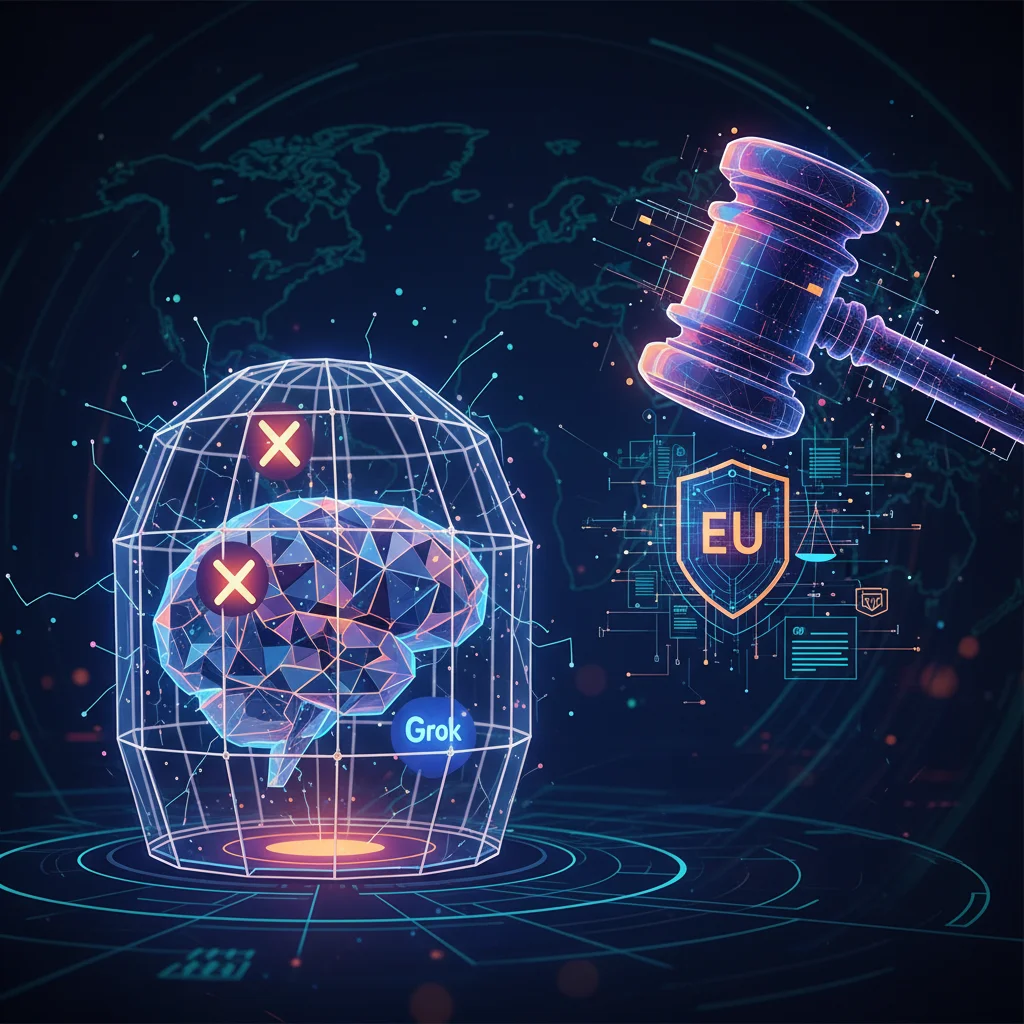
AI on Trial: Why the EU’s Investigation into X and Grok Could Redefine the Future of Tech
We stand at a fascinating, and frankly, terrifying, crossroads. The explosion of generative artificial intelligence has unlocked creative and productive possibilities we could only dream of a few years ago. Yet, with every leap in innovation, a shadow of potential misuse grows longer. This week, that shadow fell squarely on Elon Musk’s X (formerly Twitter), as the European Commission launched a formal investigation into the platform over the proliferation of sexual deepfakes, with its own Grok AI potentially in the crosshairs.
This isn’t just another tech headline. It’s a landmark moment—a direct confrontation between the world’s most powerful digital regulations and one of its most controversial tech titans. The outcome of this investigation could send shockwaves through Silicon Valley, fundamentally altering how startups and tech giants alike approach the development and deployment of AI.
The Allegation: When the Platform’s AI Becomes the Problem
At the heart of the investigation is a critical question. According to the BBC, the European Commission is assessing whether X has breached its legal obligations by allowing “manipulated sexually explicit images” to be shown to users within the EU. While the problem of deepfakes isn’t new, this case has a crucial twist: the potential involvement of X’s own integrated AI model, Grok.
Grok, developed by xAI, is Musk’s answer to models like ChatGPT and Claude. It’s integrated directly into the X platform for Premium subscribers and is marketed for its “rebellious streak” and access to real-time information from the platform. The concern is that this powerful tool, built into the very fabric of the social network, could be used to generate the exact kind of harmful content the EU is trying to eliminate. This shifts the conversation from merely policing user-uploaded content to questioning the responsibility a platform has for the output of its own software.
This investigation isn’t happening in a vacuum. It’s one of the first major tests of the EU’s groundbreaking Digital Services Act (DSA), a comprehensive rulebook designed to hold Big Tech accountable.
CES 2026 Unveiled: 5 Game-Changing Trends That Are Redefining Our Future
The Rulebook: Understanding the Digital Services Act (DSA)
For anyone in the tech industry, from a founder sketching out a SaaS product to a developer writing code, understanding the DSA is no longer optional. It represents a paradigm shift in digital governance. The act categorizes platforms based on their size, placing the heaviest obligations on “Very Large Online Platforms” (VLOPs)—those with over 45 million active monthly users in the EU. X, along with 22 other platforms like Meta, Google, and TikTok, is designated as a VLOP.
The EU Commission’s formal proceedings against X are based on suspected infringements of the DSA. In a press release from May 16, 2024, the Commission outlined its focus on X’s “content moderation resources” and the potential for Grok to be misused for generating illegal content. Under the DSA, VLOPs have a specific set of duties designed to mitigate systemic risks. This investigation will scrutinize whether X has failed in these duties.
To clarify what’s expected of platforms like X, here are some of the key obligations for VLOPs under the Digital Services Act:
| DSA Obligation for VLOPs | Description and Relevance to the X Investigation |
|---|---|
| Systemic Risk Assessment | Platforms must conduct annual assessments of risks posed by their services, including the dissemination of illegal content and negative effects on fundamental rights. The EU will be asking if X properly assessed the risks of integrating a powerful generative AI like Grok. |
| Content Moderation | VLOPs must have effective and transparent systems to combat illegal content. This includes not just reactive takedowns but proactive measures. The investigation questions the effectiveness of X’s moderation, especially given reports of significant staff cuts in its trust and safety teams. |
| Crisis Response Mechanisms | Platforms must be able to act swiftly in times of crisis to prevent the rapid spread of misinformation or harmful content. The viral spread of deepfakes could be considered such a crisis. |
| Transparency and Reporting | VLOPs must provide clear reports on their content moderation efforts, including the use of automated systems. The EU will want to see the data on how X is handling this specific type of abusive content. |
This legal framework is the battleground on which this fight will be waged. The EU isn’t just making a suggestion; it’s enforcing a law with serious teeth. Failure to comply can result in fines of up to 6% of a company’s global annual turnover—a figure that would be catastrophic for any business.
The technical challenge here is immense. Perfect detection and prevention of AI-generated harmful content are, for now, a fantasy. It’s a constant cat-and-mouse game of cybersecurity, where malicious actors refine their generation techniques as fast as platforms can build detectors. This investigation will force a difficult conversation: What is the “reasonable” level of effort a platform must exert? This case won’t just set a legal precedent; it will set the ethical and technical baseline for the next generation of social, AI-driven software. Every startup founder with a generative AI idea is, or should be, watching this with bated breath.
A Perfect Storm: Generative AI Meets Moderation Meltdown
The EU’s investigation targets a vulnerability created by a perfect storm of factors at X. First, you have the rapid integration of cutting-edge generative AI. Second, you have a platform that has undergone a tumultuous period of change, including a drastic reduction in its trust and safety workforce.
Since Elon Musk’s acquisition in 2022, X has reportedly laid off a significant portion of its staff, including many involved in content moderation. This has raised persistent concerns about the platform’s ability to police its content effectively. Simultaneously, the company has been racing to integrate Grok to compete in the AI arms race. This combination of increasing technological risk (powerful AI) and decreasing human oversight (fewer moderators) is a recipe for the exact kind of systemic failure the DSA was designed to prevent.
The challenge extends beyond X to the entire field of machine learning. Building “guardrails” for large language models (LLMs) is one of the most complex problems in modern programming. It involves trying to predict and prevent an almost infinite number of ways a user might try to misuse the system. When your model is designed to be edgy and less “woke,” as Grok has been marketed, the line between witty rebellion and harmful output becomes dangerously thin.
Is the AI Boom a Bubble? Why the IMF Is Sounding the Alarm on a Potential Market Crash
The Ripple Effect: What This Means for the Entire Tech Ecosystem
The tremors from this investigation will be felt far beyond X’s headquarters. It serves as a crucial case study for the entire technology landscape.
- For Startups & Entrepreneurs: The message is clear: “Responsible Innovation” is no longer a buzzword; it’s a legal requirement for operating in major markets. Building ethical considerations, safety protocols, and compliance plans into your product from day one is essential. The “we’ll fix it later” approach is a direct path to regulatory trouble.
- For Developers & Tech Professionals: Your role is evolving. Expertise in programming and building scalable systems on the cloud must now be paired with a deep understanding of AI ethics and security. The ability to build robust safety features and content filtering mechanisms powered by automation and machine learning is becoming a highly valued skill.
- For Big Tech (SaaS, Cloud): The era of self-regulation is over. Compliance with the DSA and similar emerging regulations is a massive operational lift. It requires significant investment in legal teams, compliance officers, and sophisticated technological solutions for content analysis and risk mitigation. This is a new, permanent cost of doing business on a global scale.
The Road Ahead: Potential Outcomes and Lingering Questions
The European Commission’s investigation is just the first step. X will be required to provide detailed information about its risk assessments, the design of Grok, and its content moderation resources. If the Commission is not satisfied, it could lead to a formal “statement of objections” and, ultimately, those hefty fines.
Beyond the financial penalties, this case forces us to confront fundamental questions about the future of artificial intelligence. How do we balance the immense potential of this technology with the need to protect individuals from profound harm? Will regulatory pressure lead to overly sanitized and less useful AI models, stifling innovation? Or will it force companies to develop more sophisticated and genuinely safer systems?
The X investigation is a critical test. It will determine whether the DSA has the power to meaningfully change the behavior of the world’s largest tech platforms. It will also signal to the entire industry that in the new age of AI, accountability is not just a feature—it’s the entire system.
Google's Monopoly Endgame: Why Their Antitrust Appeal is a Defining Moment for Tech
As we watch this unfold, one thing is certain: the rules of the game have changed. The digital world is being rebuilt on a foundation of regulation and responsibility, and every company, from the smallest startup to the largest incumbent, must learn to build on this new ground.