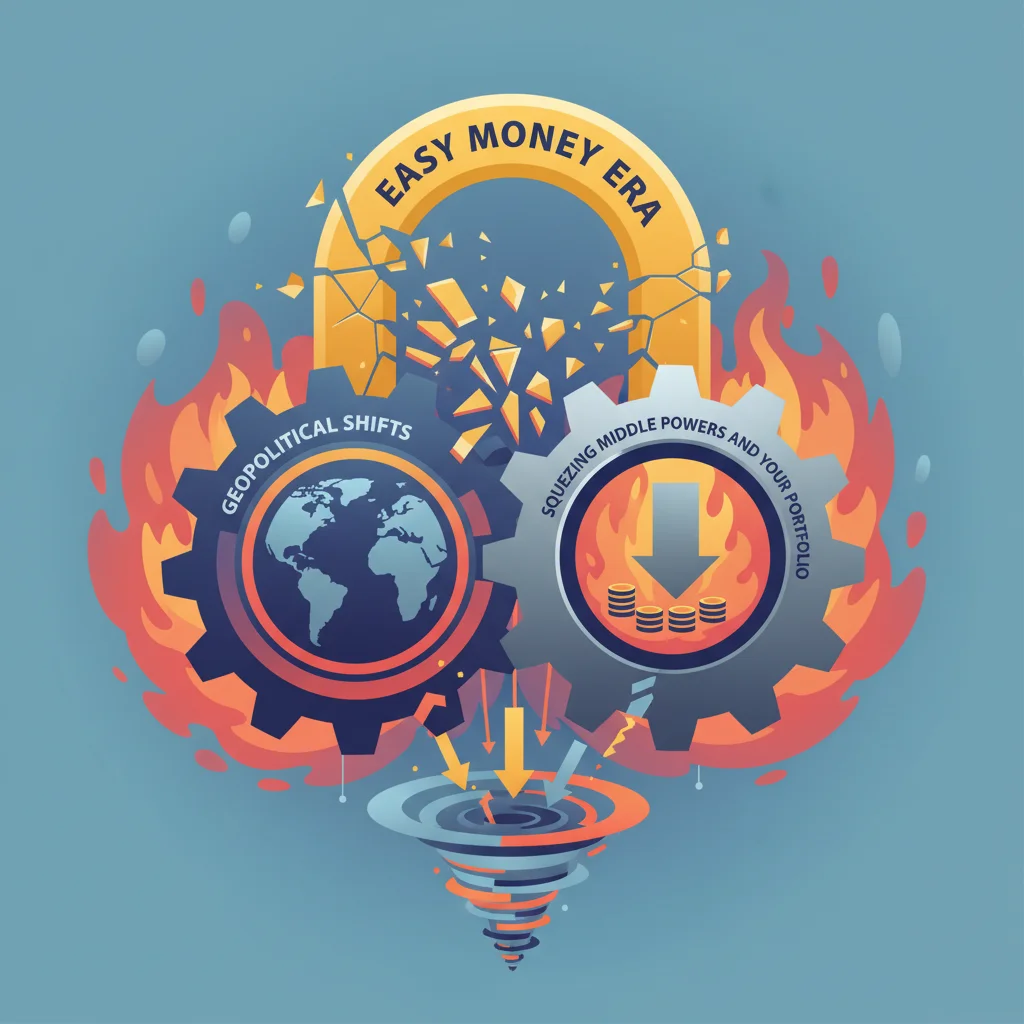
The End of the Easy Money Era: How Geopolitical Shifts Are Squeezing Middle Powers and Your Portfolio
For decades, the global stage operated on a set of predictable rules. After the fall of the Soviet Union, a unipolar world led by the United States ushered in an era of unprecedented globalization. For nations not at the top of the pyramid—the so-called “middle powers” like Brazil, India, Saudi Arabia, and Turkey—this was a golden age. They could leverage economic opportunities from all sides, benefiting from secure international trade routes, a stable global financial system, and the luxury of not having to choose between competing superpowers. It was an era of playing the field, and business was good.
That era is definitively over. As the Financial Times aptly puts it, “Even if you are not interested in the superpowers, they will sooner or later be interested in you (source).” The world is rapidly fracturing into competing blocs, primarily centered around the United States and China. This new bipolar reality is forcing middle powers into uncomfortable positions, and the economic and financial consequences of this squeeze will ripple through every corner of the global economy, directly impacting investors, business leaders, and the future of international finance.
The Golden Age of Strategic Ambiguity
To understand the gravity of the current situation, we must first appreciate what is being lost. The post-Cold War order, for all its flaws, provided a fertile ground for economic growth. It was built on a foundation of American-guaranteed security, particularly the freedom of the seas, which underwrote global trade. This stability allowed middle powers to focus on economics and development without bearing the immense cost of securing their own supply chains.
These nations could simultaneously court investment from Washington, welcome infrastructure projects from Beijing, and sell resources to Europe without facing significant geopolitical blowback. This strategic ambiguity was not a bug; it was a feature of the system. It allowed for a hyper-globalized world where capital and goods flowed with relative freedom, driving down costs and fueling growth in markets worldwide. For those involved in the stock market and international investing, this predictability was a priceless asset, allowing models to focus primarily on economic fundamentals rather than political whims.
The Great Squeeze: When Superpowers Demand Loyalty
The new reality is one of stark choices. The simmering rivalry between the U.S. and China has boiled over into a full-scale strategic competition, touching everything from semiconductors to social media. This forces middle powers to navigate a treacherous landscape where neutrality is increasingly seen as disloyalty.
Consider the immense pressure on nations to choose sides in the technology war. Adopting Huawei’s 5G infrastructure might invite sanctions from the U.S., while rejecting it could anger a primary trading partner in China. This isn’t just a political dilemma; it’s a fundamental challenge to a nation’s economic architecture. According to analysis from the Financial Times, many of these countries are “sleepwalking into a new era of peril,” perhaps underestimating how quickly the benefits of the old order can evaporate.
This pressure extends deep into the world of finance and banking. The “weaponization of the dollar” through sanctions has shown the world how intertwined the global financial system is with U.S. foreign policy. This has spurred conversations about de-dollarization and the creation of alternative payment systems, potentially fracturing the very bedrock of international commerce.
From Unipolar Stability to Multipolar Volatility: The Economic Impact
The transition away from the old global order is not a simple political realignment; it’s a seismic shift with profound implications for the global economy. To fully grasp the magnitude of this change, it’s helpful to compare the key economic and financial features of the bygone era with our current reality.
Below is a table illustrating the fundamental differences that business leaders and investors must now contend with:
| Feature | The “Old” Global Order (c. 1991-2016) | The “New” Geopolitical Reality (Present) |
|---|---|---|
| Dominant Power Structure | Unipolar (U.S. Hegemony) | Bipolar (U.S. vs. China) / Multipolar |
| Global Trade Paradigm | Hyper-globalization, WTO-led rules | Fragmentation, “Friend-shoring,” Protectionism |
| Global Financial System | Dollar-centric, SWIFT dominance | Challenges to the dollar, rise of alternative payment systems (CIPS), sanctions as a primary tool |
| Investment Climate | Focus on economic fundamentals, lower geopolitical risk premium | High geopolitical risk premium, sanction-driven market access, political alignment as a key factor |
| Technology Ecosystem | Generally unified standards (e.g., internet protocols) | “Splinternet,” competing tech ecosystems (e.g., 5G, AI, Fintech) |
This new landscape introduces a level of volatility and uncertainty that the stock market has not had to consistently price in for decades. Supply chains are no longer optimized purely for efficiency but must now account for political allegiance (“friend-shoring”). This shift, as one commentator noted, means the “zone of peace” that underwrote globalization is shrinking, and the economic costs will be substantial.
The 'Farage Clause': Brussels' New Brexit Gambit and Its High-Stakes Impact on the UK Economy
A New Playbook for Investing and Business Strategy
Ignoring this new reality is not an option. Both corporate leaders and individual investors must adapt their strategies to account for a world where geopolitics can trump economics.
For Business Leaders:
- Geopolitical Risk Analysis is Non-Negotiable: Your company’s exposure to geopolitical flashpoints must be a core part of strategic planning. This goes beyond country risk to understanding the entire network of suppliers, partners, and customers.
- Supply Chain Resilience Over Efficiency: The “just-in-time” model is fragile. Building redundancy and diversifying sourcing away from politically sensitive regions is now a cost of doing business.
- Navigating the Tech Divide: Companies operating in the financial technology sector must be particularly aware of diverging standards in data privacy, AI regulation, and digital currencies. Innovations like blockchain may offer solutions for trust in a fragmented world, but they also exist within this competitive landscape.
For Investors:
- The Geopolitical Premium: Valuations must now include a “geopolitical risk premium.” A company with heavy reliance on a single, politically volatile region is riskier than its balance sheet might suggest.
- Thematic Opportunities: This new era creates clear winners and losers. Sectors like defense, cybersecurity, and commodity producers (energy, food, critical minerals) may benefit from rising tensions and the focus on national security.
- Rethinking Emerging Markets: Investing in emerging markets is no longer a monolithic strategy. It requires a nuanced understanding of a country’s political alignment. Is it successfully navigating the U.S.-China rivalry, or is it at risk of being caught in the crossfire? The answer will have a dramatic impact on long-term returns in your trading strategy.
Conclusion: The Price of Nostalgia
The comfortable, predictable world that allowed middle powers—and by extension, the global economy—to flourish is a relic of history. The nostalgia for an era of easy globalization and strategic ambiguity is not just misplaced; it’s dangerous. The new global order is one of friction, competition, and hard choices. Superpower rivalry is no longer a distant headline; it is an active variable impacting everything from the cost of capital to the flow of goods.
For anyone involved in finance, investing, or business, the message is clear: your understanding of macroeconomic trends must now be matched by a sophisticated grasp of geopolitics. The two are inextricably linked, and failing to see the connection is to risk being blindsided by the most powerful force shaping our world today.
Crypto's High-Stakes Gamble: Why the Industry Is Suddenly Fighting the Regulation It Begged For