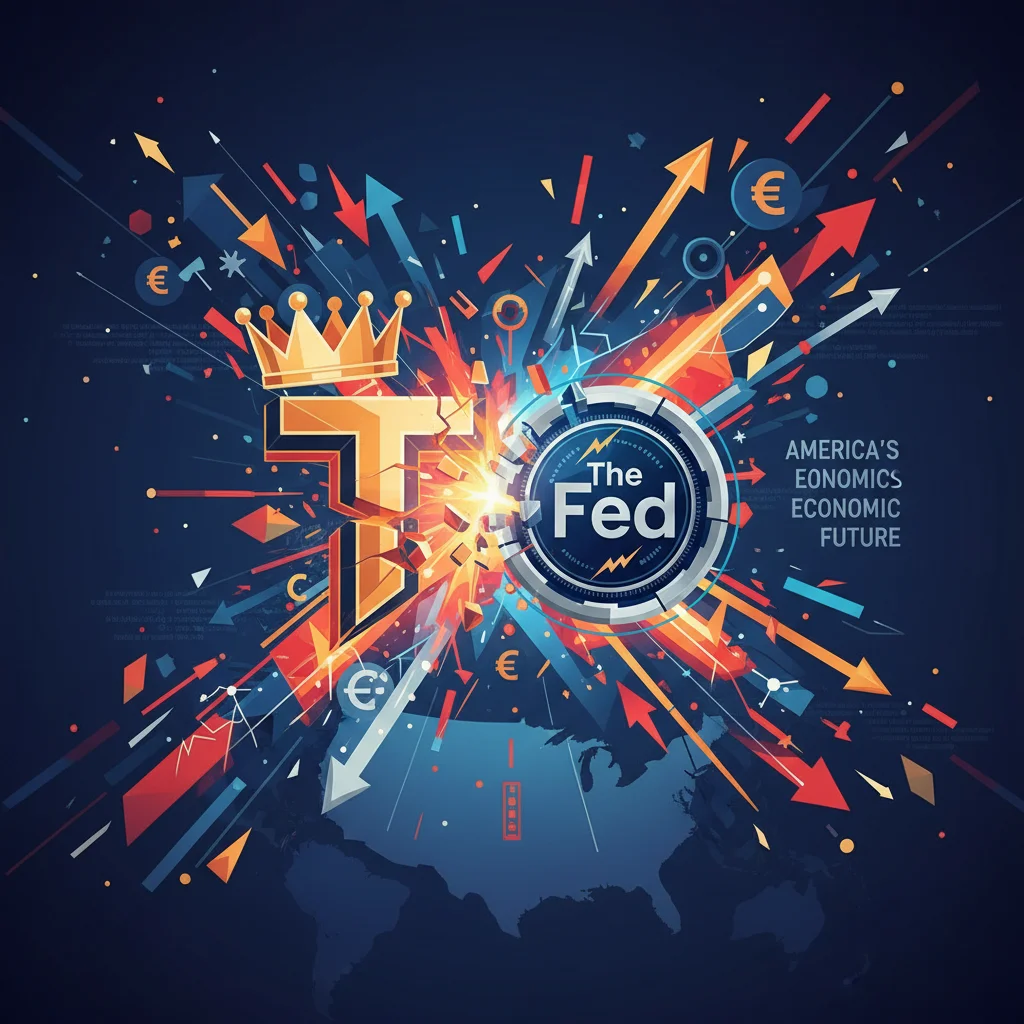
Collision Course: Trump, The Fed, and the High-Stakes Battle for America’s Economic Future
The Unspoken Question Dominating Global Finance
In the intricate world of global finance, where algorithms execute trades in microseconds and economic forecasts are dissected to the decimal point, a decidedly human drama is unfolding. It’s a conflict that pits the institutional sanctity of the world’s most powerful central bank against the sheer force of political will. The central question, whispered in trading pits and debated in boardrooms, is this: If Donald Trump returns to the White House, will the Federal Reserve, under the leadership of Jerome Powell, bow to relentless pressure for lower interest rates?
This isn’t just a political headline; it’s a foundational stress test for the American economy. The outcome will have profound implications for everything from the stock market and your investment portfolio to the future of banking and the trajectory of global economics. As we stand at this crossroads, it’s crucial to understand the forces at play, the data driving decisions, and the potential fallout from a clash between political ambition and monetary policy independence.
The Bedrock of a Modern Economy: Why Fed Independence Matters
Before diving into the political theater, it’s essential to grasp why the Federal Reserve’s independence is considered a cornerstone of modern economics. Established by Congress, the Fed operates under a dual mandate: to foster maximum employment and ensure stable prices. To achieve this delicate balance, the central bank must be able to make unpopular decisions—like raising interest rates to combat inflation—without fear of immediate political retribution.
When a central bank loses its independence, it risks becoming a tool for short-term political gain. History is littered with examples of governments forcing their central banks to print money to finance spending, leading to hyperinflation and economic collapse. A credible, independent Fed provides a vital anchor for the economy, assuring markets and the public that decisions are driven by data, not by election cycles. This stability is the bedrock upon which long-term investing, banking, and commerce are built.
The Canary in the Coal Mine: What One Pensioner's Story Reveals About Our Economic Future
The Trump Doctrine: A Challenge to Central Banking Orthodoxy
Donald Trump has never been shy about his views on the Federal Reserve. During his presidency, he frequently and publicly criticized Chair Jerome Powell—his own appointee—for raising interest rates, arguing that a more dovish policy would have supercharged the stock market and the broader economy. His perspective is clear: interest rates are a powerful lever for short-term economic stimulus, and he believes they should be pulled aggressively to favor growth.
This viewpoint represents a direct challenge to the Fed’s traditional, data-dependent approach. While the Fed was raising rates to preemptively cool an economy it saw as at risk of overheating, Trump saw these moves as a direct impediment to his economic agenda. This history sets the stage for a potential second act. A renewed Trump administration would almost certainly bring a new wave of public pressure, private persuasion, and perhaps even legislative threats aimed at forcing the Fed’s hand. The core conflict is a philosophical one: should monetary policy be a tool for long-term stability or a catalyst for short-term, politically advantageous growth?
Decoding the Data: What the Numbers Are Really Telling the Fed
Politics aside, the Federal Reserve’s decisions are supposed to be guided by economic data. So, what is the current landscape telling them? The picture is complex and, at times, contradictory. Inflation has fallen significantly from its 2022 peaks, but the “last mile” of getting it back to the Fed’s 2% target is proving stubborn. Meanwhile, the labor market remains remarkably resilient, which, while good for workers, can also contribute to inflationary pressures.
Market participants have been on a rollercoaster of expectations. At the start of the year, traders were pricing in as many as six or seven interest rate cuts for 2024. Now, that optimism has been drastically curtailed. According to recent market data, investors are now betting on just one or two cuts this year, a reflection of the stickier-than-expected inflation reports (source). This divergence between initial hope and current reality highlights the challenge the Fed faces.
To illustrate the shifting sentiment, consider the market’s pricing of rate cuts over time:
| Time Period | Market Expectation for 2024 Rate Cuts | Underlying Economic Driver |
|---|---|---|
| Early 2024 | 6-7 Cuts Expected | Belief that inflation was rapidly declining. |
| Mid-2024 | 1-2 Cuts Expected | Persistent inflation data and strong employment figures. |
| Fed’s Official Projection | Median of 3 Cuts (as of early 2024) | A more cautious, data-dependent official stance. |
This table makes it clear: the Fed must navigate not only political winds but also the volatile expectations of the financial markets, all while staying true to the economic data.
The Price of Protection: How Trump's Transactional Foreign Policy is Reshaping the Global Economy
Beyond the Fed: Global Cues and Corporate Bellwethers
While the Fed-Trump dynamic dominates headlines in the U.S., global markets are watching a range of other critical indicators. For instance, upcoming UK inflation data will be a key test for the Bank of England and could influence the timing of its own rate cuts, creating ripples across the international banking and finance landscape (source). A coordinated global easing cycle is far from certain, adding another layer of complexity for investors.
On the corporate front, all eyes are on bellwether companies like Nvidia. The chipmaker’s upcoming earnings report is seen as a referendum on the entire artificial intelligence boom. A strong report could further fuel the tech-led market rally, while any sign of weakness could send shockwaves through the stock market. As a critical engine of modern financial technology, Nvidia’s performance is a proxy for investor appetite for growth and innovation. In fact, its valuation has become so significant that it has been a primary driver of S&P 500 returns, making its financial health a matter of macroeconomic importance (source).
The Rise of Alternatives: Fintech, Blockchain, and a New Financial Order?
This intense politicization of central banking doesn’t exist in a vacuum. It coincides with the rise of a parallel financial ecosystem powered by financial technology, or fintech. The principles of decentralized finance (DeFi), built on blockchain technology, are fundamentally about creating systems that are transparent, programmatic, and resistant to the influence of any single entity—be it a bank or a government.
While still a nascent and volatile space, the appeal of a financial system governed by code rather than by political appointees could grow stronger if trust in traditional institutions like the Fed begins to wane. The debate over the Fed’s independence serves as a powerful, real-world case study for the value proposition of blockchain. If the public perceives that the levers of the economy are being manipulated for political ends, the search for alternatives will only intensify, potentially accelerating the adoption of new forms of trading and banking that operate outside the traditional sphere.
The Ghost in the Kitchen: How Big Chains Are Disrupting the Market and What It Means for Investors
Conclusion: An Institution at a Crossroads
The Federal Reserve stands at one of the most critical junctures in its history. It is caught between its mandate to guide the economy based on impartial data and the looming specter of a political firestorm. For investors, business leaders, and anyone involved in finance, the path forward is fraught with uncertainty. Will the Fed hold the line, risking the wrath of a powerful political figure to preserve its long-term credibility? Or will it bend, providing a short-term economic boost at the cost of its most valuable asset: its independence? The answer will not only define Jerome Powell’s legacy but will also shape the landscape of the American and global economy for years to come.