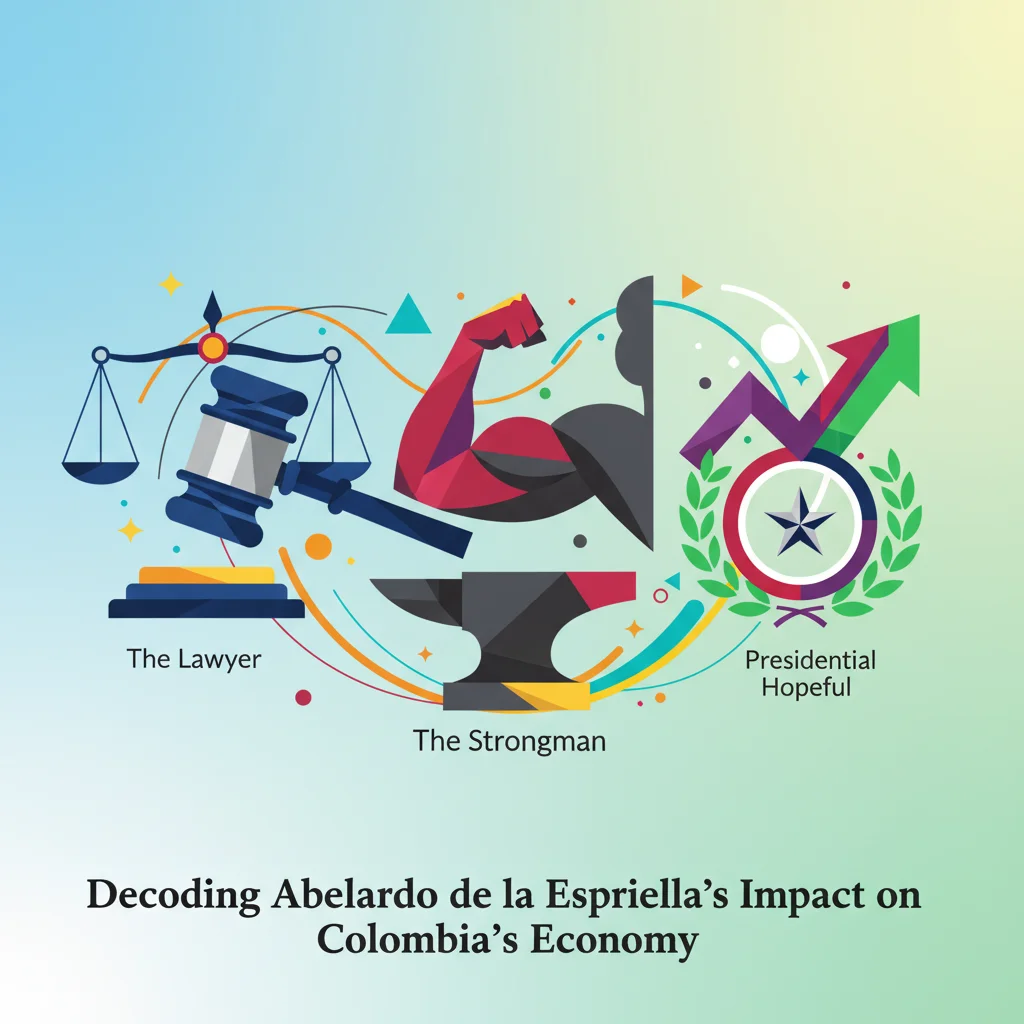
The Lawyer, The Strongman, The Presidential Hopeful: Decoding Abelardo de la Espriella’s Impact on Colombia’s Economy
In the high-stakes world of Colombian politics, a new and formidable figure is capturing national attention, not from the halls of Congress, but from the courtroom. Abelardo de la Espriella, a man known for his flamboyant style, operatic pursuits, and a client list that reads like a who’s who of controversy, has set his sights on the Casa de Nariño, Colombia’s presidential palace. A criminal defense lawyer who has represented figures linked to drug traffickers and an ally of Venezuela’s Nicolás Maduro, de la Espriella is pitching himself as the “iron-fist” leader Colombia needs to restore order and prosperity. For investors, business leaders, and anyone with a stake in Latin America’s fourth-largest economy, his rise from legal gladiator to presidential contender raises a critical question: What would a de la Espriella presidency mean for Colombia’s financial future?
This is not merely a political curiosity; it’s a potential paradigm shift that could redefine the country’s investment landscape. As Colombia navigates economic headwinds and deep political polarization, the appeal of a strongman candidate promising stability is undeniable. However, for those focused on long-term growth, the implications for the nation’s economy, stock market, and the burgeoning fintech sector are complex and demand careful analysis.
From Controversial Courtrooms to the Campaign Trail
To understand Abelardo de la Espriella’s political platform, one must first understand his career. He is arguably one of Colombia’s most famous—and infamous—lawyers. His firm has taken on a series of high-profile, polarizing cases, building a reputation for aggressive tactics and a willingness to defend the indefensible. His most notable client, as highlighted by the Financial Times, was Alex Saab, a Colombian businessman accused by the U.S. of being the chief dealmaker for Venezuelan President Nicolás Maduro. Defending such a figure, deeply entangled in a regime that has decimated its own economy, is a bold move that speaks volumes about de la Espriella’s approach to power and influence.
His client history is a tapestry of Colombia’s recent turbulent past, including former paramilitaries and individuals accused of corruption. Yet, he frames this experience not as a liability, but as a unique qualification. In his view, he has stared into the abyss of Colombia’s deepest problems and understands the criminal underworld in a way traditional politicians do not. This narrative forms the bedrock of his presidential pitch: a promise to bring an uncompromising sense of order to a nation weary of instability. His campaign slogan, “Order and Opportunity,” is a direct appeal to a populace frustrated with crime and economic uncertainty.
An “Authoritarian-Lite” Prescription for the Economy
De la Espriella’s political philosophy can be described as “authoritarian-lite,” blending right-wing populism with a pro-business veneer. He champions a strong military, harsh penalties for criminals, and a streamlined state. While the specifics of his economic policy remain broad, the underlying message is clear: create a secure and stable environment, and investment will follow. He envisions a Colombia where the rule of law is absolute, a message that can be seductive to foreign investors tired of navigating regulatory ambiguity and security risks.
However, the methods proposed to achieve this order are a source of significant concern for those monitoring the health of democratic institutions. His rhetoric often dismisses established political processes in favor of decisive, unilateral action. For the world of finance and investing, this presents a classic high-risk, high-reward scenario. A government that can swiftly cut through red tape and crush security threats could, in the short term, boost market confidence. But a leader who disregards institutional checks and balances could just as easily change tax laws, expropriate assets, or alter contracts by decree, creating a climate of profound long-term uncertainty that could cripple the banking and financial technology sectors.
To better understand the potential impacts, let’s break down the core tenets of his likely platform and their implications for the business community.
| Proposed Policy Pillar | Stated Goal | Potential Economic & Investment Impact |
|---|---|---|
| “Mano Dura” (Iron Fist) on Crime | Drastically reduce street crime, drug trafficking, and guerrilla activity through overwhelming force. | Positive: Improved security could lower operational costs for businesses and attract FDI in sectors like tourism and logistics. Negative: Potential for human rights abuses could trigger international sanctions and scare away ESG-focused investors. |
| Pro-Business Deregulation | Cut bureaucratic red tape, simplify the tax code, and create favorable conditions for large-scale enterprise. | Positive: Could stimulate the stock market and encourage domestic and foreign capital investment. Negative: Risks eroding labor and environmental protections; benefits may concentrate in established industries, stifling innovation in areas like fintech. |
| Judicial & State Reform | Overhaul the justice system and centralize executive power to enable swift decision-making. | Positive: A more efficient state could accelerate infrastructure projects and legal resolutions. Negative: Weakening judicial independence is a major red flag for investors, as it undermines contract enforcement and the rule of law—the bedrock of a stable economy. |
| Nationalist Economic Stance | Prioritize Colombian industries and potentially renegotiate trade agreements to be more favorable. | Positive: Could boost domestic manufacturing and agriculture in the short term. Negative: Protectionist policies could harm international trading relationships and invite retaliatory tariffs, disrupting supply chains. |
Colombia at a Crossroads: Stability vs. Institutional Integrity
Colombia’s economy has shown resilience, but it faces significant challenges, including high inflation, social inequality, and a complex post-conflict transition. The current leftist government of Gustavo Petro has unnerved some corners of the market with its proposals for sweeping reforms in healthcare, pensions, and the energy sector. This political climate creates an opening for a figure like de la Espriella, who positions himself as the antithesis of the current administration—a return to order, tradition, and unapologetic capitalism.
His supporters, including some in the business elite, see him as a necessary disruptor. They believe his deep understanding of the “real” Colombia, gained from his legal battles, makes him uniquely suited to fix its problems. He is a former supporter of the influential right-wing ex-president Álvaro Uribe, and he taps into a powerful vein of conservative thought that prioritizes security above all else. According to a poll cited by the FT, while he remains a long shot, his name recognition is growing, and his message is resonating.
For the international financial community, the key variable is institutional strength. Will Colombia’s independent judiciary, central bank, and constitutional court be able to moderate the ambitions of a president with an authoritarian bent? Or would a de la Espriella administration succeed in centralizing power, creating a less predictable environment for investing? The answer will determine whether Colombia continues on its path as an attractive emerging market or becomes another case study in the economic volatility that often accompanies populist rule.
Silver's Dizzying Rally: Why Your Old Silverware Is Now a Hot Investment
The Verdict for Investors
Abelardo de la Espriella’s potential transition from power lawyer to president is one of the most compelling political stories developing in Latin America. He is a master of public relations, cultivating an image of immense wealth, culture (he is a trained opera singer), and power. He has even launched his own brand of wine and luxury Italian goods, marketing a lifestyle of success that he promises to bring to the nation (source).
While his candidacy is still in its early stages, he should not be underestimated. His ability to command media attention and tap into public frustration is a potent combination. For now, investors and financial professionals should place him on their risk radar. His rise is a barometer of the political mood in Colombia and a sign that the country may be heading for a dramatic showdown between vastly different visions for its future.
The core tension is clear: the market’s short-term desire for order versus the long-term necessity of democratic stability and predictable governance. As the election cycle progresses, the substance behind de la Espriella’s “Order and Opportunity” slogan will be scrutinized. The future of Colombia’s economy, and the returns of those invested in it, may well hang in the balance.

Related Posts

Wanted: A Chief Innovation Killer—The Perils of Over-Regulation in Finance
The Unseen Battle for Your Wallet: Why Political Meddling with the Fed is a Threat to Economic Stability