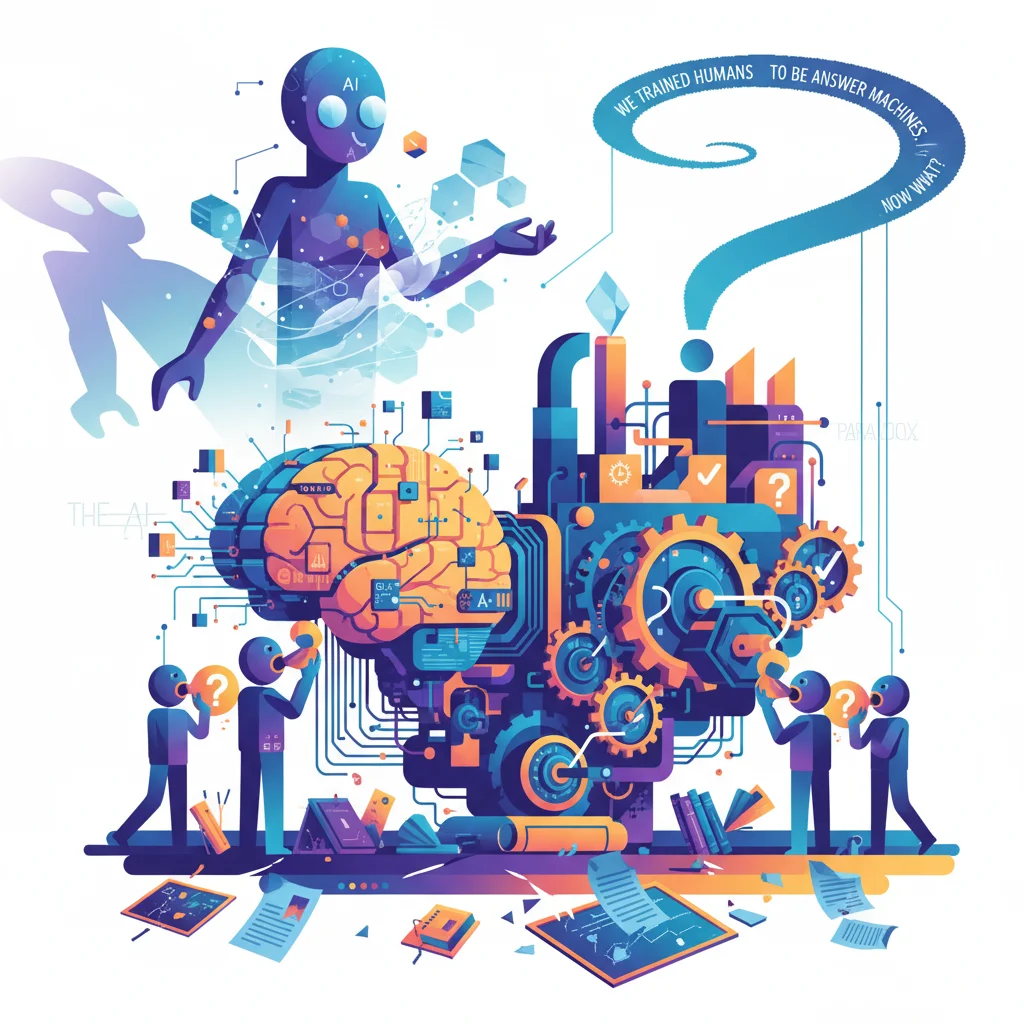
The AI Paradox: We Trained Humans to Be Answer Machines. Now What?
For decades, our entire educational and professional structure has been a finely tuned engine designed to produce one thing: the perfect answer. From standardized tests to university essays and boardroom presentations, the goal has been to train humans to deliver polished, well-structured, and authoritative responses on demand. We’ve been programming ourselves to be flawless “answer machines.”
Then, in what feels like an overnight revolution, the real machines showed up. The rise of powerful large language models (LLMs) and generative artificial intelligence has created a fascinating and unsettling paradox. The very skill we spent a lifetime perfecting—the ability to synthesize information and produce a convincing answer—has been automated. AI learned our best trick, and it does it faster, at a greater scale, and without needing a coffee break.
This isn’t just an academic dilemma; it’s a fundamental challenge to the future of work, innovation, and human value itself. If a piece of software can replicate the primary output of a highly educated human, what are we supposed to do now? It’s time to unpack how we got here and, more importantly, where we go next.
The Human Answer Machine Factory
Think back to your time in school. The system was built on a foundation of questions and answers. The teacher had the questions, the textbook had the answers, and your job was to be the conduit. The measure of success was the quality of your output. As the Financial Times aptly puts it, universities became experts at training students “to produce polished responses on demand” (source). The five-paragraph essay, the timed exam, the case study analysis—all are drills in rapid, structured answer generation.
This “automation” of human thought processes served a purpose in the industrial and early information ages. It created a reliable workforce capable of executing known procedures and communicating in a standardized way. We were building a human cloud computing network, where each person was a node trained to process and return specific information packets. This approach filtered into the corporate world, where the quickest person with the most confident answer in a meeting was often seen as the smartest. We rewarded the performance of knowledge, not necessarily the pursuit of it.
Enter the AI: The Ultimate Answer Machine
Generative AI platforms, delivered through slick SaaS interfaces, are the logical conclusion of this philosophy. They have ingested a vast corpus of human-generated text and, through complex machine learning models, have become masters of statistical pattern matching. They don’t “know” anything in the human sense, but they are exceptionally good at predicting the next most plausible word in a sequence, creating sentences and paragraphs that are often indistinguishable from human output.
This new technology has effectively automated the “polished response.” The skills that once took years of education to develop can now be accessed via an API call. Why spend hours drafting a market summary when an AI can generate a comprehensive one in seconds?
Let’s compare the two “answer machines” we’ve created:
| Attribute | The Human “Answer Machine” | The AI “Answer Machine” (LLM) |
|---|---|---|
| Training Data | Decades of formal education, textbooks, lectures, and life experience. | Vast internet-scale datasets (e.g., Common Crawl, Wikipedia, books). |
| Processing Speed | Hours, days, or weeks, depending on the complexity of the query. | Seconds to minutes. |
| Core Mechanism | Cognition, memory recall, critical reasoning, and synthesis. | Statistical pattern recognition and next-token prediction. |
| Weakness | Bias, fatigue, emotional reasoning, and knowledge gaps. | “Hallucinations” (plausible nonsense), lack of true understanding, and source amnesia. |
| Cost of Output | High (salary, benefits, education costs). | Extremely low (fractions of a cent per query). |
The table makes the business case for AI starkly clear. For tasks that require the generation of structured, plausible-sounding text based on existing information, the machine is now superior in speed and cost-efficiency. This reality should be a wake-up call for every entrepreneur, developer, and professional.
OpenAI's Big Gamble: Why Ads in ChatGPT Signal a New Era for AI
The Ghost in the Machine: AI’s Plausible Nonsense
While AI’s ability to generate answers is impressive, it has a critical flaw: it has no concept of truth. An LLM is a master of imitation, not verification. It can generate text that is grammatically perfect, stylistically appropriate, and utterly wrong. This phenomenon, often called “hallucination,” is the Achilles’ heel of the answer machine paradigm.
The FT article highlights that these systems are designed to produce “plausible-sounding bullshit” (source). This creates significant risks. In the world of programming, it might suggest a faulty code snippet. In business, it could produce a market analysis based on non-existent data. From a cybersecurity perspective, it can be weaponized to create highly convincing phishing emails or misinformation at an unprecedented scale.
This is where human intelligence must reassert its value. An AI can give you an answer, but it can’t tell you if that answer is wise, ethical, or even true. It lacks the context, the domain expertise, and the critical judgment to verify its own output. The most valuable professional in the age of AI isn’t the one who can generate an answer the fastest, but the one who can best interrogate the answer provided by the machine.
The Great AI Chip Standoff: Why China Just Put Nvidia's H200 on Ice
Rebooting Human Intelligence: The Skills That Matter Now
If generating answers is now a low-value, automated task, where should we focus our energy? The path forward requires a deliberate shift away from the skills of the answer machine and toward the skills that AI cannot replicate. This is the new premium in the talent market.
- Mastering the Art of the Question: The quality of an AI’s output is entirely dependent on the quality of the prompt. The ability to frame a problem, ask insightful, probing questions, and define the parameters of an inquiry is now a superpower. This is the foundation of all true innovation.
- Radical Critical Thinking: We must move from being consumers of information to being expert validators. This means constantly questioning sources, cross-referencing data, identifying hidden biases in AI-generated content, and understanding the limitations of the models themselves. As one educator noted, the challenge is that students often “can’t tell the difference between what’s plausible and what’s true” (source). Teaching this difference is the new literacy.
- Creative Synthesis and Originality: AI is excellent at remixing what already exists. It is not, however, capable of a truly original thought or a groundbreaking creative leap. The ability to connect disparate ideas from different fields, to imagine something that does not yet exist, and to build a novel solution from scratch remains a profoundly human endeavor. This is the heart of every successful startup.
- Contextual and Ethical Judgment: An AI can analyze a dataset, but it can’t understand the human context behind it. It can suggest a business strategy, but it can’t weigh the ethical implications for a community. Wisdom, empathy, and ethical reasoning are the ultimate differentiators, providing the guardrails for powerful technology.
The future of work is not a battle against the machines. It’s a race to cultivate the skills that complement them. We need to stop training people to be second-rate computers and start educating them to be first-rate humans.
Conclusion: Beyond the Answer
We stand at a crossroads. For a century, we built an education system and a corporate culture that glorified the “answer machine.” That model is now obsolete. The arrival of powerful AI has done us a favor: it has exposed the limitations of our old paradigm and forced us to redefine what makes human intelligence valuable.
The challenge for educators, entrepreneurs, and developers is to embrace this shift. We must build new systems for learning and working that reward curiosity over certainty, questions over answers, and wisdom over mere information. The answer machines are here, and they work for us now. Our job is to figure out what to ask them.
The .1 Billion Voice: How ElevenLabs is Redefining AI and Becoming a Tech Unicorn