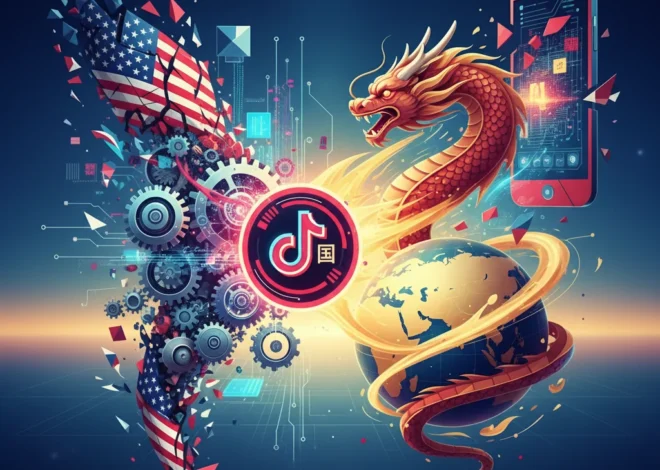
The TikTok Tipping Point: A New Era for Global Tech, Finance, and Investing
In the intricate dance of global commerce, few stories encapsulate the collision of technology, finance, and geopolitics as powerfully as the ongoing saga of TikTok. What began as a platform for viral dance challenges and short-form video has become the epicenter of a geopolitical earthquake, forcing a fundamental re-evaluation of the rules governing the international technology landscape. The recent U.S. legislation mandating that TikTok’s Chinese parent company, ByteDance, either divest its U.S. operations or face a nationwide ban is far more than a challenge to a single app. As the BBC notes, this marks a potential new reality for the global ambitions of all of China’s tech champions.
For investors, finance professionals, and business leaders, this is not a distant political drama; it is a critical inflection point. It signals a paradigm shift where national security concerns are reshaping market access, redrawing investment maps, and fundamentally altering the risk calculus for cross-border ventures. Understanding the deep financial and economic undercurrents of this situation is essential for navigating the volatile but opportunity-rich landscape of the 21st-century global economy.
The Anatomy of a Geopolitical Showdown
At its core, the U.S. government’s action against TikTok is rooted in concerns over data security and potential foreign influence. Lawmakers have voiced fears that the personal data of millions of American users could be accessed by the Chinese government, and that the platform’s powerful content algorithm could be manipulated for propaganda purposes. This legislative move, the “Protecting Americans from Foreign Adversary Controlled Applications Act,” represents one of the most significant challenges to a foreign technology company in U.S. history.
From ByteDance’s perspective, the ultimatum is an existential threat to its most lucrative market. The company has consistently stated that it has never shared U.S. user data with the Chinese government and would not do so if asked. To allay fears, it established Project Texas, a $1.5 billion initiative to house American user data on U.S. soil, managed by U.S. tech giant Oracle. However, for Washington, these measures were insufficient. The resulting legislation has thrust ByteDance, a private company with a valuation estimated to be north of $250 billion, into an unprecedented and precarious position.
This conflict is not just about one company. It’s a stress test for the entire globalized tech ecosystem and has profound implications for the world of finance and investing.
Financial Tremors: Beyond ByteDance’s Balance Sheet
The immediate financial impact on ByteDance is staggering. A forced sale would likely happen at a steep discount, stripping the company of its crown jewel asset, while a ban would obliterate a massive revenue stream. This uncertainty has already cast a long shadow over any future IPO plans, which were once anticipated to be one of the largest in stock market history.
However, the ripple effects extend far beyond a single corporate valuation. The situation introduces a new, potent variable into financial modeling: acute geopolitical risk. This has several key consequences for the broader market:
- Uncertainty for U.S. Tech in China: Companies like Apple, Tesla, and Qualcomm, which have significant manufacturing or sales operations in China, now face a heightened risk of retaliatory measures. Investors must now price in the possibility of regulatory crackdowns, consumer boycotts, or operational disruptions in the Chinese market, impacting their stock market performance.
- Devaluation of Chinese Tech Stocks: Chinese technology firms listed on U.S. exchanges (like Alibaba, JD.com, and Pinduoduo) face increased scrutiny. The TikTok precedent may lead investors to apply a “geopolitical discount” to these stocks, fearing they could be the next targets. This could dampen foreign investment and make it harder for Chinese firms to access global capital markets.
- A Chilling Effect on Venture Capital: The era of seamless cross-border tech investing between the U.S. and China may be over. Venture capital and private equity firms will now think twice before funding startups with ambitions to bridge both markets. This could stifle innovation and lead to a balkanized financial technology (fintech) landscape, where separate ecosystems develop in isolation.
The New “Geopolitical Glass Ceiling” for Global Tech
For other ambitious Chinese tech companies like Shein, Temu, and a future generation of fintech and AI innovators, the TikTok saga establishes a daunting precedent. It suggests the existence of a new “geopolitical glass ceiling” that can cap their growth in Western markets, regardless of their commercial success or technological prowess. This fundamentally alters the strategic playbook for global expansion.
The table below outlines the shifting strategic considerations for Chinese tech firms aiming for a global footprint, contrasted with their Western counterparts.
| Strategic Consideration | Implications for Chinese Tech Champions | Traditional Approach for Western Tech |
|---|---|---|
| Market Entry Strategy | Must now prioritize geopolitical risk assessment over market size. May require complex corporate restructuring (e.g., separate non-Chinese entities) from day one. | Primarily focused on product-market fit, localization, and competitive analysis. Corporate structure is a secondary concern. |
| Data Governance & Sovereignty | Data localization (storing data within a country’s borders) becomes a non-negotiable, high-cost requirement. Must prove independence from home government. | Adherence to local regulations (like GDPR) is standard, but the presumption of state control is not a primary barrier. |
| Capital & Investing | Reliance on Western capital markets (e.g., NASDAQ, NYSE) becomes a liability. May need to seek funding from non-aligned financial centers. | Access to global capital markets is a key advantage, with IPOs in New York or London seen as a pinnacle of success. |
| Public Relations & Lobbying | Requires massive, sustained investment in government relations and public trust campaigns in every major Western market to preemptively counter national security narratives. | Lobbying is standard, but it’s typically focused on commercial interests (e.g., taxation, antitrust) rather than proving national allegiance. |
Beyond the Farmgate: The Brutal Economics of the Milk Price Crisis
A New Playbook for International Finance and Economics
The TikTok situation is a wake-up call, forcing a rewrite of the playbook for international investing, banking, and corporate strategy. The abstract concept of “geopolitical risk” has now become a tangible, balance-sheet-altering factor that must be actively managed.
First, due diligence in cross-border M&A and investments must now include sophisticated geopolitical analysis. Legal and financial assessments are no longer enough. Understanding the political climate, potential for sanctions, and the national security posture of all involved nations is paramount. This elevates the role of political risk consultants and changes the very nature of international trading and deal-making.
Second, we may see the rise of new investment corridors and a reconfiguration of global capital flows. As direct U.S.-China tech investment becomes more fraught, capital may be redirected to neutral or “swing” regions like Southeast Asia, India, and Latin America. These markets could become the new battlegrounds for tech supremacy, offering immense growth opportunities for investors who understand the local dynamics. This shift will have a major impact on the global economy, creating new centers for financial technology and innovation.
Finally, this crisis could inadvertently spur innovation in decentralized technologies. The core of the conflict is a lack of trust over centralized data control. While not a silver bullet, technologies like blockchain offer a potential architectural alternative for building global platforms where trust is distributed rather than concentrated in a single corporate or national entity. Forward-thinking leaders in banking and finance should be exploring how decentralized identity and verifiable credentials could solve the next generation of geopolitical tech challenges.
The Milk Market Meltdown: Why a Dairy Crisis is a Red Flag for the Global Economy
Conclusion: Navigating the New Reality
The confrontation between the U.S. and TikTok is a landmark event that transcends corporate rivalry. It is a defining moment in the evolution of the global economy, marking a clear shift from an era of unbridled technological globalization to one of strategic competition and digital sovereignty. For China’s tech champions, the path to global dominance is now fraught with political obstacles that their Western counterparts have never faced in the same way.
For those in finance, investing, and business, the lesson is clear: the world has changed. The clean separation between markets and politics is a relic of a bygone era. The ability to analyze, anticipate, and strategize around geopolitical currents is no longer a niche skill but a core competency. The TikTok saga may be about one app today, but the precedents it sets will shape the flow of capital, the structure of markets, and the very architecture of the global digital economy for decades to come.