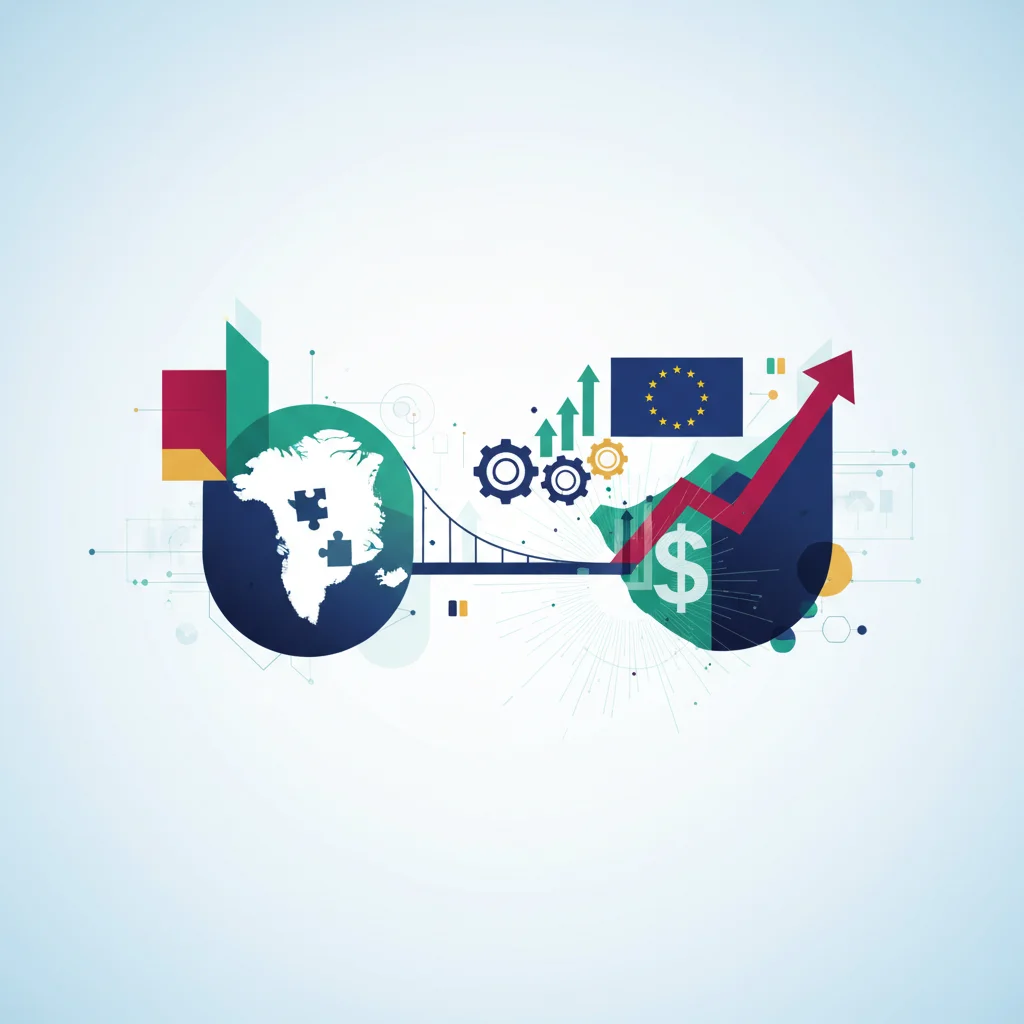
Beyond the Greenland Gaffe: Decoding the EU’s Push for Economic Stability with the US
In the world of global diplomacy and high-stakes economics, catalysts for change can come from the most unexpected places. Recently, a diplomatic spat over the proposed sale of Greenland, of all things, pulled back the curtain on the deeply fractured state of US-European Union trade relations. When US President Donald Trump abruptly canceled a state visit to Denmark following their refusal to discuss selling the autonomous territory, it wasn’t just a diplomatic faux pas; it was the final straw that prompted European leaders to convene in Brussels. Their goal, as outlined in a summit following the incident, was not retaliation, but a desperate search for one of the most valuable commodities in modern finance: stability.
The summit, as reported by the Financial Times, aimed to chart a course for the “stabilisation” of a transatlantic economic partnership that has been battered by years of unpredictable tariffs, political pressure, and escalating rhetoric. For investors, business leaders, and anyone with an eye on the global economy, this meeting was about far more than a canceled trip. It was a critical attempt to de-risk the world’s largest economic relationship and restore a semblance of predictability to a market teetering on uncertainty.
The Iceberg’s Tip: How a Diplomatic Spat Exposed Deep Economic Fissures
To understand the gravity of the Brussels summit, one must first appreciate the context of the preceding years. The Trump administration’s “America First” policy ushered in a new era of transactional, and often confrontational, trade relations. The long-standing alliance between the US and the EU, once a bedrock of the global economic order, was systematically tested. This period was characterized by a series of aggressive trade maneuvers that left European industries and policymakers scrambling.
The most significant of these were the tariffs imposed in 2018. Citing national security concerns, the US levied a 25% tariff on steel and a 10% tariff on aluminum imports from a host of countries, including its European allies. The EU vehemently disputed the national security justification and, in response, implemented retaliatory tariffs on iconic American products like Harley-Davidson motorcycles, bourbon, and blue jeans, as reported by institutions like the Peterson Institute for International Economics. This tit-for-tat escalation created a chilling effect on transatlantic trading and investment.
Below is a summary of the key trade disputes that formed the backdrop for the EU’s push for stabilisation:
| Trade Action / Dispute | US Position / Action | EU Response / Impact | Key Affected Sectors |
|---|---|---|---|
| Steel & Aluminum Tariffs (2018) | Imposed 25% tariff on steel and 10% on aluminum, citing national security. | Retaliatory tariffs on ~$3 billion of US goods. Disputed the legal basis at the WTO. | Metals, Manufacturing, Automotive, Consumer Goods |
| Automotive Tariff Threats | Threatened tariffs of up to 25% on European cars and auto parts. | Warned of massive retaliation, which would have severely impacted the German economy. | Automotive, Supply Chains, Industrial Manufacturing |
| Airbus-Boeing Subsidies | Long-standing WTO dispute; US authorized to impose tariffs on EU goods over Airbus subsidies. | EU later authorized to impose its own tariffs over Boeing subsidies. | Aerospace, Agriculture (wine, cheese), Luxury Goods |
| Digital Services Tax (DST) | Threatened tariffs against France and other EU nations planning to tax US tech giants. | Proceeded with national-level taxes while seeking an OECD-level global solution. | Technology, Financial Technology, E-commerce |
This constant state of economic tension made long-term business planning nearly impossible. The threat of new tariffs acted as a tax on investment, forcing companies to delay capital expenditures, rethink supply chains, and brace for impact on their bottom lines. This uncertainty was a significant headwind for the global stock market, contributing to periods of intense volatility.
xAI Under Fire: Lawsuit Exposes a Multi-Trillion Dollar Question for AI Investors
The Brussels Strategy: What Does “Stabilisation” Actually Mean?
When European leaders gathered in Brussels, their objective was not to escalate the conflict but to de-escalate it. “Stabilisation,” in this context, is a carefully chosen term. It does not imply a comprehensive new free trade agreement like the stalled Transatlantic Trade and Investment Partnership (TTIP). Instead, it signifies a more modest, yet urgent, set of goals:
- Preventing Further Escalation: The primary goal was to halt the cycle of action and reaction. This meant securing assurances, however informal, that the threatened tariffs on European automobiles—a move that would devastate the German economy—would remain off the table.
- Creating a Dialogue Framework: The EU sought to establish more reliable channels of communication to resolve disputes before they spiral into public tariff threats. This is a fundamental element of risk management in international relations and finance.
- Finding Common Ground: Despite the tensions, the US and EU share common economic challenges, particularly concerning the trade practices of China. A core part of the stabilisation strategy was to shift the focus from internal disputes to building a united front on issues like intellectual property theft and state-subsidized competition. According to joint statements from the era, this was a key area of potential cooperation.
- Reaffirming the Rules-Based Order: While acknowledging the new political reality, the EU aimed to gently pull the US back towards institutions like the World Trade Organization (WTO) as the proper venue for arbitrating disputes, rather than unilateral tariff actions.
This strategy is fundamentally defensive. It’s about protecting the European economy from further shocks and creating enough certainty for businesses to continue to invest, hire, and grow. It’s a shift from ambitious, expansive trade policy to pragmatic economic damage control.
The Broader Impact on the Global Economy and Your Portfolio
The state of the US-EU trade relationship is not an abstract political drama; it has direct and profound consequences for the global financial system, from institutional banking to retail investing.
For the Stock Market: Trade uncertainty is a primary driver of market volatility. When the world’s two largest economic blocs are in conflict, it creates headwinds for multinational corporations, disrupts supply chains, and dampens consumer and CEO confidence. Sectors like automotive, industrials, agriculture, and technology are on the front lines. A move towards stabilisation, conversely, removes a significant element of risk, which is often greeted with relief by the stock market. A calmer trade environment allows investors to focus on fundamentals like earnings and economic growth rather than political whims.
For Investors: The key takeaway from this period is the heightened importance of geopolitical risk analysis in any sound investing strategy. A portfolio’s performance can be swayed by tariff announcements and diplomatic fallouts. This environment favors diversification, not just across asset classes but also geographically. It may also lead investors to prefer companies with more resilient, localized supply chains or those in sectors less exposed to international trade disputes.
For the Future of Finance and Technology: While the immediate focus is on traditional goods, the next frontier of trade is digital. Future agreements will inevitably tackle complex issues like data flows, digital taxes, and the regulation of financial technology (fintech). A stable foundational relationship is a prerequisite for making progress on these sophisticated 21st-century challenges. Innovations in blockchain could one day revolutionize supply chain management and cross-border payments, but their adoption requires a cooperative and predictable regulatory framework between major economic partners. The current push for basic stabilisation is the necessary groundwork for these future advancements.
Solving for Alpha: The Hidden Financial Lessons in Your Daily Crossword
A Fragile Truce or a New Foundation?
The EU’s summit in Brussels marked a pivotal moment—a conscious effort to step back from the brink and inject a dose of predictability into a chaotic global trade landscape. The Greenland incident, while bizarre, served as a powerful reminder of how quickly diplomatic whims could translate into severe economic consequences.
For business leaders and financial professionals, the quest for stabilisation is the most important storyline to watch. While the tensions have not vanished, the shift in focus from confrontation to management is a significant development. The future of the global economy depends on the ability of its largest players to manage their disagreements constructively. Whether this push for stability builds a lasting foundation or merely papers over the cracks remains to be seen, but for a market starved of certainty, it was a welcome, and necessary, first step.

Related Posts
The £1.5 Billion Green Failure: A Case Study in Government Waste, Investment Risk, and the Future of ESG

The Greenland Gambit: How a Geopolitical Pivot Could Reshape Global Markets