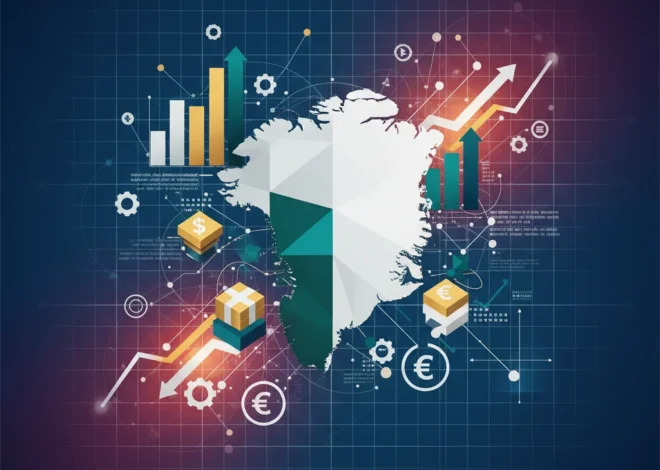
The Greenland Gambit: Unpacking the Financial Shockwaves of a Geopolitical Bombshell
In the summer of 2019, the world of international diplomacy and finance was jolted by a headline that seemed more suited to a historical textbook than a modern newsfeed. Then-US President Donald Trump expressed a serious interest in “acquiring” Greenland, the world’s largest island and an autonomous territory of Denmark. The proposal was swiftly and unequivocally rejected by Danish officials, with Prime Minister Mette Frederiksen calling the idea “absurd.”
While the story provided fodder for late-night comedy, the underlying implications were anything but a joke. As diplomats scrambled and Denmark began deploying more troops to the Arctic, economists and investors were forced to confront a new and unsettling variable. This was not just a diplomatic spat; it was a stark reminder that in the 21st century, the tectonic plates of geopolitics can shift without warning, sending tremors through the global economy and financial markets.
This article delves beyond the sensational headlines to analyze the Greenland incident as a critical case study for investors, finance professionals, and business leaders. We will explore the strategic motivations behind the offer, dissect the potential economic fallout, and examine the long-term lessons for navigating an increasingly unpredictable world of investing and international finance.
Beneath the Ice: The Strategic and Economic Prize
To understand the financial implications, one must first grasp why Greenland suddenly became a focal point of US interest. The island’s value is a powerful combination of strategic geography and untapped natural wealth, a combination that is becoming exponentially more critical in the modern era.
Geopolitical Chessboard: The Arctic’s Strategic High Ground
Greenland is the geographical linchpin of the North Atlantic and Arctic. For decades, it has hosted the Thule Air Base, the US military’s northernmost installation, which is a critical component of its missile warning and space surveillance network. In an era of renewed great-power competition with Russia and China, control over this “Arctic anchor” is of paramount strategic importance.
Furthermore, as climate change accelerates the melting of polar ice, new and faster shipping lanes like the Northwest Passage are opening up. The nation that controls the gateways to these routes holds immense leverage over global trade and naval movements. The US proposal can be seen as a preemptive move to solidify its influence in a region where both Russia and China have been aggressively expanding their presence. China, styling itself as a “near-Arctic state,” has been investing heavily in the region through its “Polar Silk Road” initiative, a move that has raised alarms in Western capitals (source).
The UK Mortgage Market's Turning Point: Why a "Boom" Could Reshape the Economy
Economic Treasure Chest: Resources in a Warming World
The economic value proposition is equally compelling. Greenland’s ice sheets are believed to cover vast reserves of valuable resources, including oil, gas, gold, diamonds, and, most critically, rare earth elements (REEs). REEs are essential for modern financial technology and countless high-tech applications, from smartphones and electric vehicles to advanced defense systems. With China currently dominating the global REE supply chain, securing an alternative source is a matter of economic and national security for the United States.
The following table provides a snapshot of Greenland’s immense, yet largely untapped, potential.
| Asset Category | Description & Estimated Value |
|---|---|
| Rare Earth Elements (REEs) | Significant deposits, including Kvanefjeld, one of the world’s largest undeveloped REE projects. Vital for high-tech manufacturing and the green energy transition. |
| Oil & Gas | The U.S. Geological Survey estimates the region could hold up to 50 billion barrels of undiscovered oil and natural gas (source). |
| Strategic Location | Control over emerging Arctic shipping routes (Northwest Passage & Transpolar Sea Route), potentially reshaping global trading. |
| Freshwater Reserves | The Greenland Ice Sheet contains about 10% of the world’s freshwater reserves, a resource of growing strategic importance. |
The Financial Fallout: From Market Jitters to Sovereign Risk
The immediate reaction in financial circles was one of uncertainty. While the “purchase” itself was never a realistic possibility, the aggressive posture from the US and the resulting diplomatic fallout created tangible economic risks that reverberated through the stock market and credit markets.
A Hit to the Danish Economy and European Stability
For Denmark, the incident was a direct threat to its economic stability. Economists immediately warned of a potential “growth hit,” as detailed by the Financial Times. The reasoning was twofold. First, the diplomatic spat with a key ally and trading partner created uncertainty that could chill investment and trade. Second, the event highlighted the need for increased defense spending in the Arctic, diverting funds from other sectors of the economy and potentially straining the national budget.
This kind of geopolitical pressure can have a real impact on a nation’s sovereign credit profile. International investors and banking institutions closely monitor such events. A sustained period of instability or a perceived weakening of a country’s sovereignty could lead to higher borrowing costs and a less favorable environment for foreign investment.
The Hypothetical Finance of a 21st-Century Land Deal
While purely speculative, it’s a fascinating thought exercise for finance professionals: how would such a transaction even be structured today? The Louisiana Purchase in 1803 cost the U.S. $15 million. The Alaska Purchase in 1867 was $7.2 million. Acquiring Greenland would likely be a multi-trillion-dollar affair.
Financing such a deal would be a monumental challenge for the global financial system. It would likely involve the issuance of unprecedented amounts of sovereign debt, intricate negotiations between central banks, and the creation of special purpose vehicles to manage the transfer. This is where modern financial technology could theoretically play a role. Could a permissioned blockchain be used to create an immutable and transparent ledger of mineral and land rights, ensuring that the indigenous people of Greenland receive a fair and perpetual stake in the island’s future wealth? While far-fetched, it highlights how advanced fintech could be applied to solve complex problems in sovereign finance.
A Dangerous Precedent: Why a Political Attack on the Fed Has Former Chairs Sounding the Alarm
Lessons for the Modern Investor and Business Leader
The Greenland gambit, though ultimately unsuccessful, serves as a powerful lesson in the interconnectedness of geopolitics, economics, and financial markets. It underscores several key takeaways for navigating the modern investment landscape.
- Geopolitical Risk is Back: For decades, globalization seemed to smooth over many geopolitical fault lines. That era is over. Investors must now actively price in the risk of sudden diplomatic crises, trade wars, and territorial disputes.
- Resources are the New Frontier: The global competition for critical resources—from rare earth minerals to freshwater—is intensifying. Companies and countries that control these assets will hold significant power. This creates both risks and opportunities for commodity trading and resource-focused investment funds.
- The Arctic is a Hotspot: The Arctic is no longer a frozen wasteland but a burgeoning arena for economic and military competition. Developments in this region will have a direct impact on shipping, energy, and defense sectors worldwide.
Ultimately, the bizarre proposal to buy Greenland was a wake-up call. It peeled back the veneer of diplomatic norms to reveal the raw strategic and economic calculations that are increasingly driving statecraft. For those in the world of finance, it was a stark reminder that the most significant market risks may not appear in an earnings report or a central bank statement, but in a single, unexpected headline that redraws the map of the world.
The Coffee Bean Economy: How Micro-Communities Are Becoming the Next Frontier in Strategic Investing
Navigating this new reality requires a more holistic approach to analysis—one that integrates political science with traditional economics and market data. The winners in the coming decades will be those who understand that a tweet from a world leader or a military maneuver in a remote sea can move markets just as profoundly as any interest rate decision.

Related Posts
UK’s Unexpected Fiscal Breather: Decoding the December Borrowing Drop and Its Impact on the Economy
The Greenland Gambit: How a Geopolitical Pivot Could Reshape Global Markets