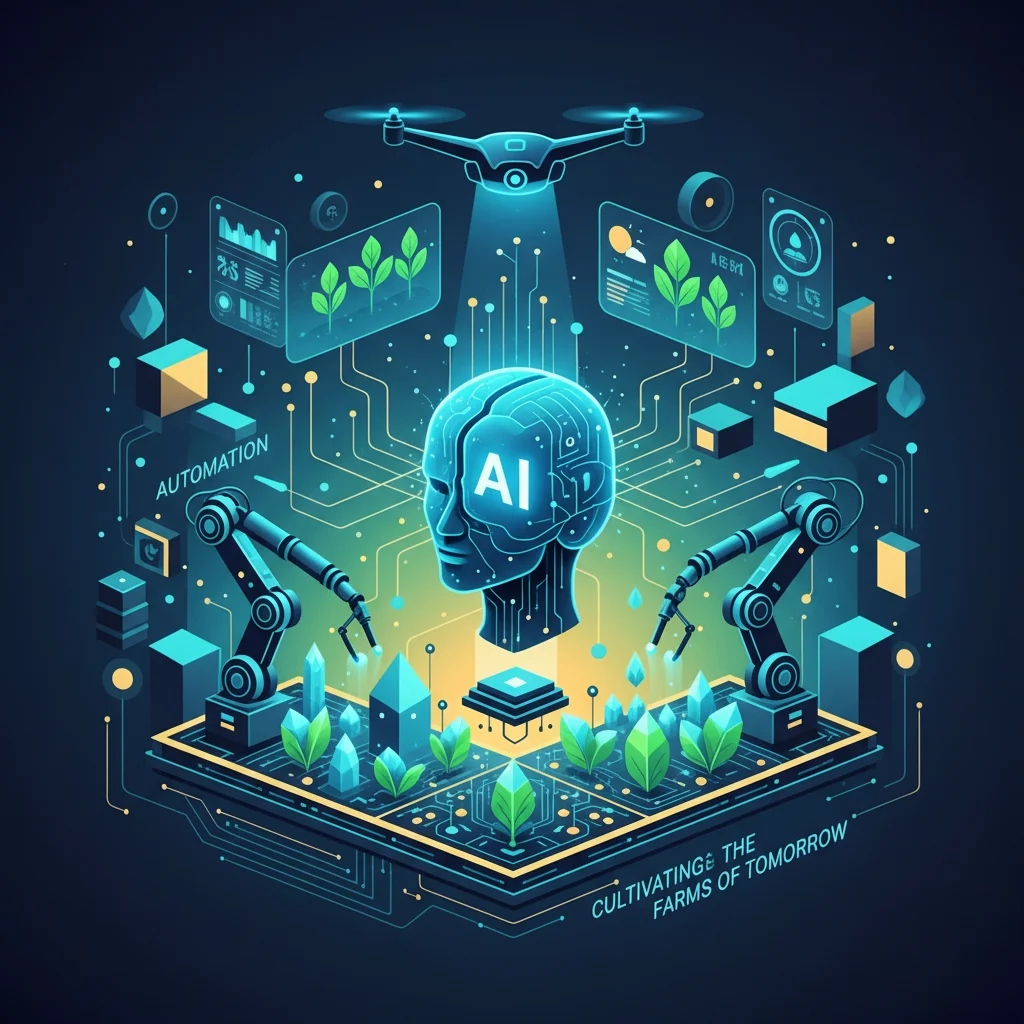
The Digital Harvest: How AI, Automation, and Software Are Cultivating the Farms of Tomorrow
Picture a farm. What comes to mind? Rolling green hills, a classic red barn, a farmer on a trusty old tractor? For generations, that image has held true. But today, a quiet revolution is taking place in those very fields—a revolution powered not by horsepower, but by processing power. The farm of the future is here, and it’s less about dirt-caked overalls and more about data-driven decisions. Welcome to the world of “tech-dense” farming, where a host of new technology is transforming one of humanity’s oldest professions into one of its most innovative.
This isn’t just about getting a shiny new tractor. It’s a fundamental shift towards a system where every seed, every drop of water, and every square inch of soil is monitored, analyzed, and optimized. At the heart of this transformation are the technologies that define our modern era: artificial intelligence, the cloud, sophisticated software, and widespread automation. For developers, entrepreneurs, and tech professionals, the agricultural sector—or AgriTech, as it’s now known—has become one of the most exciting and impactful frontiers for innovation.
Why Farming Needs a Digital Upgrade
The stakes have never been higher. The global population is projected to reach nearly 10 billion by 2050, and feeding everyone will require a staggering increase in food production. Yet, we face immense challenges: climate change, water scarcity, soil degradation, and a shrinking agricultural workforce. The old ways of farming, while noble, are simply not equipped to solve these 21st-century problems at scale.
This is where technology steps in, not to replace the farmer, but to empower them with superhuman capabilities. The goal is to create a system of precision agriculture—a hyper-efficient approach that uses technology to ensure crops and soil receive exactly what they need for optimum health and productivity. This means more yield from less land, with a significantly smaller environmental footprint.
The AgriTech Stack: Deconstructing the Modern Farm
A tech-dense farm operates like a sophisticated, large-scale IoT (Internet of Things) network. It’s a complex ecosystem of hardware and software working in concert. Let’s break down the key layers of this new agricultural stack.
1. The Eyes and Ears: Sensors, Drones, and IoT
The foundation of any smart system is data. In modern farming, this data comes from a vast network of sensors. In-ground sensors monitor soil moisture, pH levels, and nutrient content in real-time. Weather stations on the farm provide hyperlocal forecasts. Drones and satellites equipped with multispectral cameras fly overhead, capturing data that the human eye can’t see, like plant health, water stress, and pest infestations. Every data point is a crucial piece of the puzzle, transmitted wirelessly to a central hub—typically a cloud-based platform.
2. The Brains: AI, Machine Learning, and Cloud Computing
All this raw data would be overwhelming for any human to analyze. This is where artificial intelligence and machine learning (ML) come into play. Powerful algorithms, often running on scalable cloud infrastructure, sift through terabytes of information to identify patterns and generate actionable insights. For example:
- Predictive Analytics: An AI model can analyze weather data, soil moisture, and historical trends to predict the optimal time to plant or harvest. It can also forecast potential disease outbreaks, allowing farmers to take preventative action instead of reacting after the damage is done.
- Computer Vision: Drones and on-the-ground robots use machine learning-powered cameras to distinguish between crops and weeds with surgical precision. This allows for targeted micro-doses of herbicide—or even no herbicide at all, with robots physically removing the weeds.
- Resource Optimization: ML algorithms can create a dynamic irrigation schedule that gives each plant the exact amount of water it needs, no more, no less, drastically reducing water consumption.
The Dishwasher Dilemma: Why Your Robot Butler is Still Stuck in the Lab
3. The Hands: Automation and Robotics
Once decisions are made, automation takes over the physical labor. Self-driving tractors use GPS to plow, plant, and till fields with centimeter-level accuracy, operating 24/7 without fatigue. Robotic arms, guided by AI, can identify and pick ripe fruit, a task that has traditionally been incredibly labor-intensive.
A fantastic example of this is the UK-based startup Small Robot Company. Their system uses small, lightweight robots named “Tom,” “Dick,” and “Harry” to digitize the field and then autonomously seed and weed with incredible precision. This approach not only reduces soil compaction caused by heavy tractors but also dramatically cuts down on chemical use. Their work has shown the potential to increase yields by as much as 45% (source), a testament to the power of targeted, automated intervention.
4. The Command Center: Farm Management Software (FMS)
Tying everything together is the software. Modern farms are run from a tablet or laptop using sophisticated Farm Management Software, often delivered via a SaaS (Software-as-a-Service) model. This makes powerful technology accessible without a massive upfront investment. These platforms provide a dashboard that visualizes all the data from sensors, drones, and robots. A farmer can monitor crop health, control irrigation systems, and dispatch autonomous vehicles from anywhere with an internet connection. The complex programming behind these platforms is what translates raw data into a simple, intuitive user interface for the farmer.
To truly grasp the difference, let’s compare the operational metrics of a traditional farm versus a tech-dense farm.
| Metric | Traditional Farming | Tech-Dense Farming |
|---|---|---|
| Water Usage | Flood or blanket sprinkler irrigation | AI-optimized, sensor-driven drip irrigation (up to 50% less water) |
| Pesticide/Herbicide Use | Broadcast spraying across entire fields | Targeted micro-spraying or robotic removal (up to 90% less chemical) |
| Data for Decisions | Experience, historical almanacs, visual inspection | Real-time data from soil sensors, drones, and predictive AI models |
| Labor | Highly manual, physically demanding | Focused on system management, data analysis, and technology oversight |
| Yield Potential | Dependent on weather and broad interventions | Optimized per-plant, leading to higher, more consistent yields |
The Uncaged AI: Why Ofcom's Investigation into Musk's Grok is a Watershed Moment for Tech
The Unseen Risk: Cybersecurity on the Connected Farm
As farms become smarter, they also become more vulnerable. Every connected sensor, every autonomous tractor, every cloud-based management platform is a potential entry point for malicious actors. The field of agricultural cybersecurity is rapidly emerging as a critical concern, and for good reason.
Imagine the consequences:
- A hacker could take control of a fleet of autonomous combines, shutting down a harvest at a critical time.
- They could manipulate irrigation or fertilization systems, destroying a crop.
- Sensitive data, such as yield maps and soil health information—which represents a farm’s competitive advantage—could be stolen and sold.
- At a national level, a coordinated attack on a country’s tech-dense farms could pose a genuine threat to its food supply.
For startups and developers in this space, building robust cybersecurity into their products from day one is not just a feature; it’s a fundamental requirement. Secure coding practices, end-to-end encryption, and regular vulnerability assessments are essential to building trust and ensuring the resilience of our future food systems. According to some experts, the next frontier in farming will involve just as much digital defense as it does crop defense (source).
Two Heads, One Throne: Why the Co-CEO Model is Tech's New Power Play
The Future is Ripe with Innovation
The AgriTech revolution is just getting started. The fusion of biology and information technology is paving the way for even more groundbreaking advancements. We’re seeing the rise of vertical farms in urban centers, which use hydroponics and AI-controlled LED lighting to grow produce year-round with 95% less water. Gene-editing technologies like CRISPR are being used to develop crops that are more resilient to drought and disease. The next generation of AI will move beyond prediction to prescription, not just telling a farmer what’s wrong but providing a complete, automated solution.
For entrepreneurs, this field is a fertile ground for opportunity. There is a need for better data interoperability standards, more efficient robotics, and more powerful analytical software. The challenge is immense, but the reward is even greater: a sustainable, secure, and abundant food future for everyone.
The image of farming is indeed changing. The red barn may soon have solar panels on its roof, and the farmer might be launching a drone from their tablet instead of driving a tractor. It’s a future built on code, data, and connectivity—a true digital harvest that promises to feed the world.

Related Posts
The £40 Heating Bill: How a Garden Shed Is Disrupting Data Centre Economics and Creating a New ESG Investment Frontier

Google’s Nuclear Gambit: Why AI’s Colossal Energy Appetite is Rebooting the Atomic Age