China’s Economic Paradox: Why 5% GDP Growth Masks a Deeper Story
A Tale of Two Economies: Unpacking China’s 2025 Growth
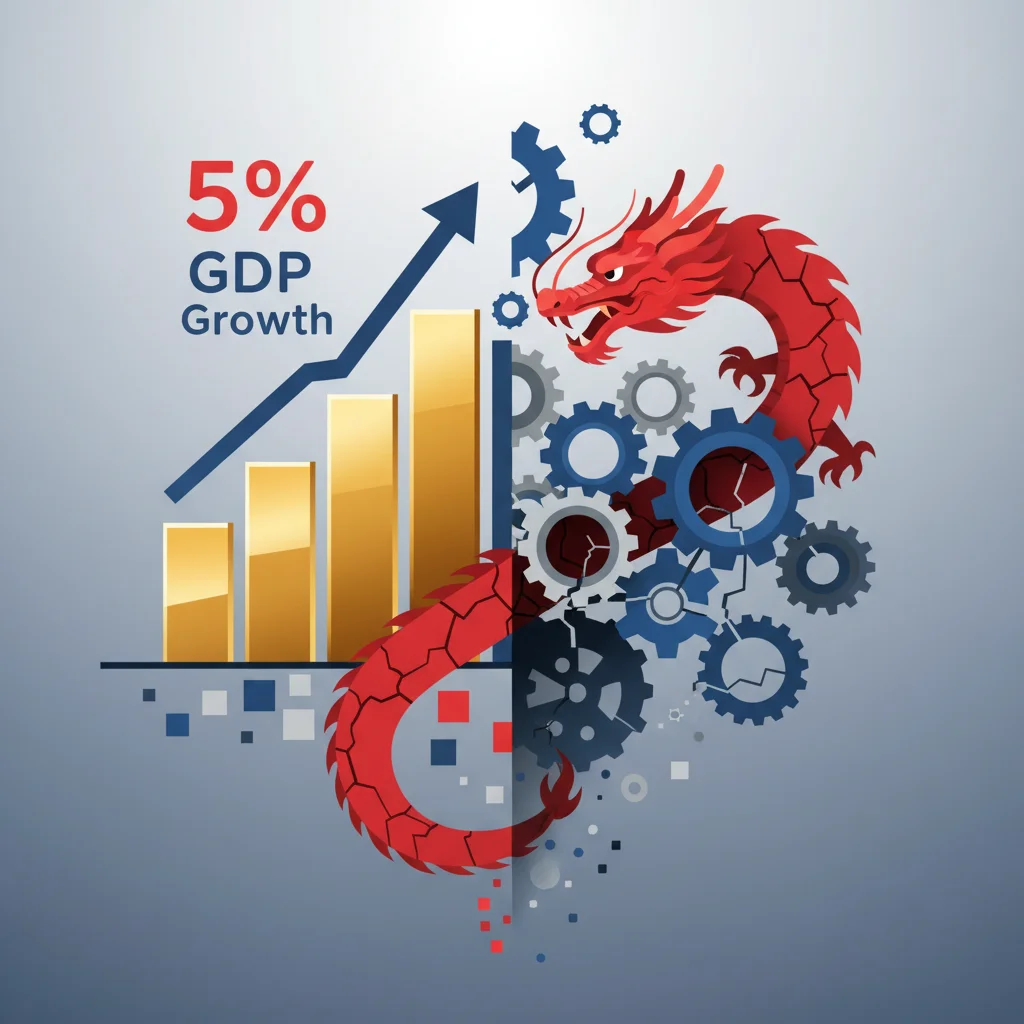
At first glance, the numbers coming out of Beijing paint a picture of steady recovery and economic strength. China’s National Bureau of Statistics reported that the nation’s Gross Domestic Product (GDP) expanded by a respectable 5 percent in 2025, meeting the government’s ambitious annual target. For global investors and finance professionals, this figure might suggest a return to normalcy for the world’s second-largest economy. However, a deeper dive into the data reveals a starkly divided economic landscape—a narrative of a booming, export-driven industrial sector papering over the cracks of a fragile and hesitant domestic market.
This divergence isn’t just an academic footnote; it’s a critical signal for anyone involved in international business, investing, or economics. The headline growth is fueled by a surge in foreign sales, while the pillars of the domestic economy—consumer spending and real estate—continue to falter. This article will dissect this complex reality, exploring the drivers behind China’s export machine, the persistent weakness at home, and the profound implications for the global stock market, international trade, and future investment strategies.
The Roaring Dragon: China’s Export Juggernaut
The primary engine powering China’s 2025 GDP figure is its formidable export sector. While other major economies grapple with inflation and sluggish production, Chinese factories are operating at full throttle, shipping an unprecedented volume of goods across the globe. This isn’t just about cheap textiles and toys anymore; the growth is concentrated in high-value, technologically advanced sectors.
Three key areas stand out:
- Electric Vehicles (EVs): Chinese EV manufacturers have achieved a dominant position through a combination of state subsidies, technological innovation, and economies of scale. In 2025, EV exports reportedly jumped by over 45% year-on-year, flooding markets in Southeast Asia, Latin America, and even making significant inroads in Europe.
- Green Technology: From solar panels to wind turbine components and battery storage systems, China has solidified its role as the world’s green-tech workshop. This dominance is a result of long-term industrial policy and control over critical mineral supply chains.
- Advanced Electronics: Despite geopolitical tensions and tech restrictions, China continues to be a crucial supplier of consumer electronics and intermediate components, benefiting from its deeply integrated supply chains.
This export boom is a double-edged sword. On one hand, it generates crucial foreign currency, supports employment in manufacturing hubs, and showcases the country’s industrial might. On the other, it’s stoking significant trade tensions. The European Union and the United States are increasingly concerned about what they perceive as unfair competition driven by state support, leading to talks of new tariffs and trade barriers. The success of China’s export model may inadvertently accelerate economic decoupling and reshape global trading alliances.
London's Gilded Cage: Why the Capital's Property Market Is Leading in Losses
The Achilles’ Heel: A Faltering Domestic Engine
While the export data shines, the domestic picture is far more subdued. The hoped-for “revenge spending” boom post-pandemic never fully materialized, and Chinese consumers remain cautious. This hesitancy is rooted in several deep-seated structural issues that continue to plague the internal economy.
The most significant drag remains the protracted crisis in the property sector. Once a primary driver of growth and a cornerstone of household wealth, the real estate market is now a source of anxiety. The fallout from major developer defaults has shattered confidence, leading to falling property values and a sharp decline in new construction. According to recent figures, investment in real estate development contracted by another 9% in 2025, marking a third consecutive year of decline.
This weakness is clearly visible when comparing different economic indicators. The table below illustrates the stark contrast between the external and internal-facing parts of the economy.
| Indicator | Growth Rate (YoY) | Implication |
|---|---|---|
| Overall GDP Growth | 5.0% | Target met, but masks underlying issues. |
| Export Growth (in USD terms) | 12.5% | The primary driver of the headline GDP figure. |
| Retail Sales Growth | 2.8% | Significantly below pre-pandemic levels, indicating weak consumer confidence. |
| Fixed Asset Investment | 3.2% | Held back by the deep slump in property investment. |
| Youth Unemployment (16-24) | 15.1% | A persistent structural problem weighing on social stability and spending. |
This data highlights a fundamental imbalance. An economy cannot rely on foreign customers indefinitely while its own 1.4 billion consumers keep their wallets shut. The weakness in domestic demand suppresses inflation, raises fears of deflation, and limits opportunities for service-sector businesses and international brands operating within China.
Solving the Financial Puzzle: A Crossword-Clue Guide to the Modern Economy
Beijing’s Policy Tightrope
Chinese policymakers are now walking a precarious tightrope. They face a classic economics dilemma: how to stimulate domestic demand without re-inflating a property bubble or taking on excessive debt. The People’s Bank of China (PBOC) has been hesitant to unleash the kind of massive monetary stimulus seen in Western countries, fearing financial instability.
Several options are on the table, each with its own risks:
- Direct Consumer Stimulus: Issuing consumption vouchers or direct cash handouts could provide a short-term jolt to retail sales. However, leaders have traditionally been reluctant to pursue this path, preferring to channel funds through state-led investment.
- Aggressive Monetary Easing: Deeper cuts to interest rates could encourage borrowing and investment. But with rates already low, the effectiveness is questionable, and it could put further pressure on the yuan and the banking sector’s profitability.
- Structural Reforms: The most impactful but most difficult path involves strengthening the social safety net, which would encourage households to save less and spend more. This, however, is a long-term project with no immediate payoff.
In the realm of financial technology, Beijing is also leveraging its central bank digital currency (e-CNY) for targeted stimulus, but its scale remains too small to fundamentally shift consumer behavior. Meanwhile, the use of blockchain for enhancing supply chain transparency in the booming export sector is a quiet but significant development, improving efficiency in global trading operations.
What This Means for Your Portfolio and Business Strategy
For the global investor, business leader, and finance professional, China’s bifurcated economy requires a nuanced and discerning approach. The days of betting on broad-based Chinese growth are over. A sector-specific strategy is now essential.
For Investors:
- Be Selective: The Chinese stock market is not a monolith. Companies in the EV supply chain, green technology, and high-end manufacturing that are globally competitive may present opportunities.
- Be Wary of Domestic Exposure: Firms reliant on Chinese consumer spending, particularly in real estate, retail, and hospitality, face significant headwinds until confidence returns.
- Monitor Policy: Any significant shift in Beijing’s stimulus policy could create market-moving events. Keep a close eye on announcements from the PBOC and the State Council.
For Business Leaders:
- Re-evaluate the Chinese Consumer: Companies selling into China may need to adjust their growth forecasts and strategies to account for a more price-conscious and cautious consumer base.
- Prepare for Increased Competition: Businesses competing with Chinese firms on the global stage should anticipate continued price pressure and rapid innovation, particularly in the green tech and EV sectors. Foreign direct investment into China has also slowed as companies diversify their supply chains, a trend likely to continue (source).
The Investor's Overload: Why a Financial Digital Detox is Your Best Asset
Conclusion: A Growth Figure That Asks More Questions Than It Answers
China’s achievement of its 5% GDP growth target in 2025 is a testament to the sheer power of its industrial sector. Yet, this success story is dangerously one-sided. The underlying weakness in the domestic economy—driven by the property crisis and low consumer confidence—presents a significant risk to long-term stability and growth. The path forward is uncertain and fraught with difficult policy choices.
For the rest of the world, this is a moment for careful observation and strategic thinking. The dynamics of China’s economy will shape everything from global trade and inflation to stock market performance and geopolitical alignments. Understanding the paradox behind the 5% headline figure is the first step toward navigating the complex and challenging economic landscape that lies ahead.