An Unlikely Alliance: Why Apple Is Swallowing Its Pride to Power Siri with Google AI
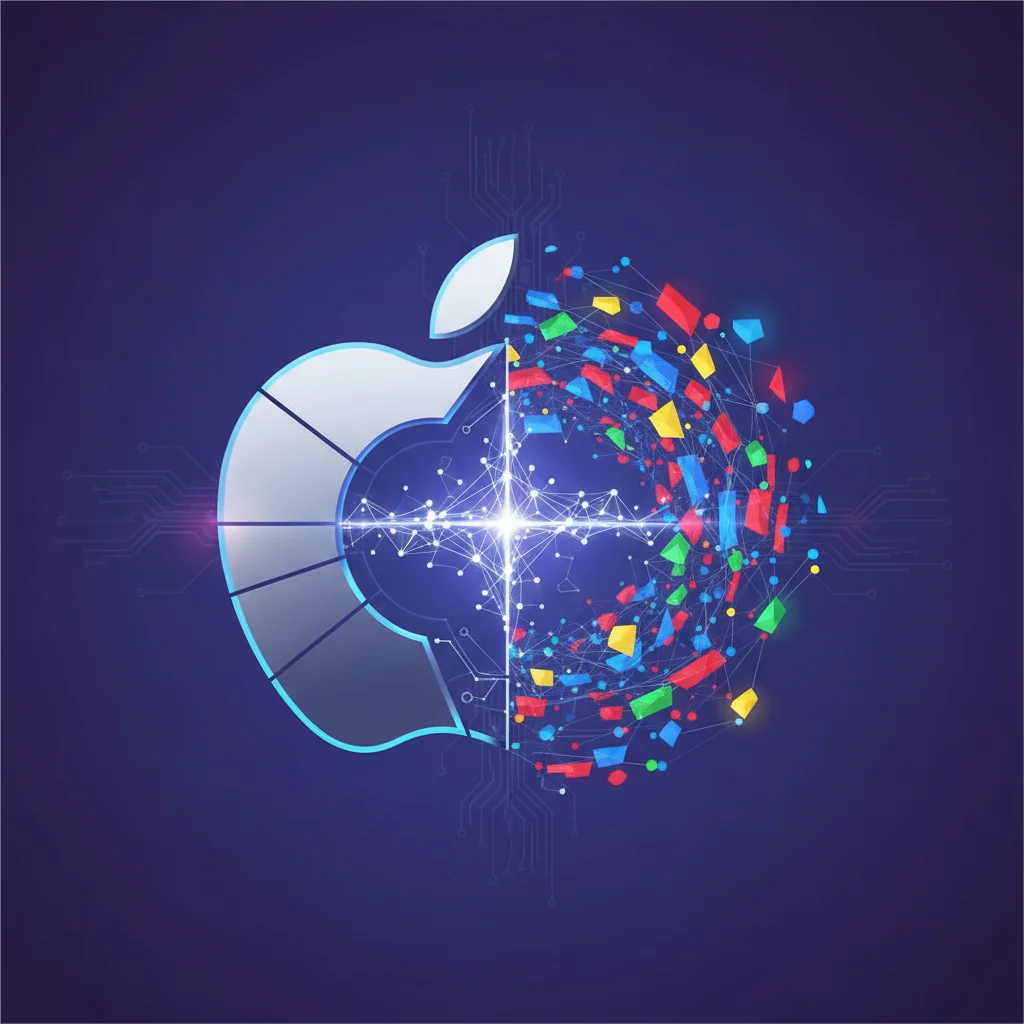
In the high-stakes world of technology, some partnerships seem destined, while others feel like a plot twist from a Hollywood blockbuster. The latest news shaking Silicon Valley falls squarely into the latter category: Apple, the fiercely independent titan of tech, is reportedly in talks to license Google’s Gemini AI engine to power a supercharged new version of Siri. For anyone who has followed the decades-long rivalry between these two giants, this is the equivalent of Coke licensing Pepsi’s formula.
On the surface, it’s a bombshell. According to Bloomberg, who first broke the story, the potential deal would integrate Google’s powerful generative AI models directly into the iPhone’s operating system, likely in the upcoming iOS 18. This move signals a seismic shift in Apple’s strategy and serves as a stark admission: when it comes to the generative AI arms race, the most valuable company in the world has fallen behind. But this isn’t just a story of failure; it’s a masterclass in pragmatism and a glimpse into the future of software, automation, and the very devices in our pockets.
Let’s unpack what this partnership really means, why it’s happening now, and the profound implications for developers, startups, and the entire tech ecosystem.
The Echo in the Room: Siri’s Stagnation and Apple’s AI Problem
Remember when Siri first launched in 2011? It felt like science fiction. A personal assistant in your phone that you could talk to. It was a genuine moment of innovation. Yet, over a decade later, while the world of artificial intelligence has leaped forward with models like ChatGPT and Google’s own Gemini, Siri often feels stuck in the past, adept at setting timers but fumbling more complex queries.
So, where did Apple go wrong? The answer lies in a philosophical, and technical, divide. Apple has built its empire on a foundation of user privacy and on-device processing. This approach is fantastic for security and speed on simple tasks. Your Face ID data, for example, stays locked away in a secure enclave on your iPhone, never touching a remote server. This commitment to privacy is a core part of their brand and a major selling point.
However, cutting-edge generative AI thrives on the opposite principle: massive datasets and colossal computing power, both of which live in the cloud. Training a large language model (LLM) like Gemini requires crunching petabytes of data from the open internet on tens of thousands of specialized chips running for months. It’s a brute-force approach that is fundamentally at odds with Apple’s walled-garden, privacy-first ethos. While Apple has been quietly developing its own on-device models, they simply can’t compete with the raw power and knowledge of a cloud-based behemoth for complex, generative tasks.
This has left Apple in a precarious position. As Samsung launches “Galaxy AI” (powered by Google Gemini) and Microsoft injects Copilot into every corner of Windows, the iPhone, the pinnacle of consumer tech, risks looking dumb by comparison. The pressure to deliver a truly intelligent Siri has become immense.
The Empathy Illusion: How AI is Quietly Reshaping Our Most Human Trait
Google’s Trojan Horse: What Gemini Brings to the iPhone
Enter Google. While Apple was perfecting silicon and user experience, Google was obsessively mapping the world’s information and pioneering the foundational technologies of modern AI. From the Transformer architecture that underpins all modern LLMs to its massive cloud infrastructure, Google has been playing the long game in artificial intelligence for years.
Gemini is the culmination of that effort. It’s not just a text-based model; it’s multimodal, meaning it can understand and process information across text, images, audio, and video. Integrating this into iOS could instantly give Siri the brain transplant it so desperately needs. Imagine a Siri that can:
- Summarize a long email thread and draft a reply for you.
- Create a custom itinerary for your trip based on your calendar and flight confirmations.
- Help you with programming by generating code snippets on the fly.
- Analyze a photo of your pantry and suggest recipes.
This isn’t just about better voice commands; it’s about fundamentally changing the iPhone into a proactive, intelligent partner. For consumers, the benefits are obvious. But what does the strategic landscape look like? Here’s a comparison of their current positions:
The table below outlines the core strengths and weaknesses of each company’s approach to AI, highlighting why a partnership, however unlikely, makes strategic sense.
| Feature | Apple’s AI Approach | Google’s AI Approach |
|---|---|---|
| Primary Focus | On-device processing, user privacy, tight hardware/software integration | Cloud-based processing, large-scale data analysis, open information access |
| Key Strength | Unmatched on security and privacy; fast for simple, local tasks | State-of-the-art model performance; vast knowledge base; multimodal capabilities |
| Core Weakness | Lacks the power for complex, generative tasks; limited by on-device data | Potential privacy concerns; reliance on internet connectivity |
| Business Model | Sell premium hardware and services | Sell ads and cloud services (SaaS) fueled by data |
| Flagship Model | Internal, smaller models (e.g., “Ajax” framework) | Gemini (Pro, Ultra, Nano) |
Implications for the Ecosystem: Developers, Startups, and Cybersecurity
A deal of this magnitude sends ripples across the entire industry. It’s not just about two giants shaking hands; it’s about reshaping the very platform on which millions of developers and startups build their businesses.
A New Frontier for Developers and Automation
For developers, a super-smart Siri could be a game-changer. If Apple exposes Gemini’s capabilities through new APIs, it could unlock a new wave of innovation in app development. Imagine fitness apps that can offer dynamic coaching based on your real-time performance, or productivity apps that can automate complex workflows with a simple voice command. This could be the most significant evolution for the App Store since its inception, pushing the boundaries of software and automation.
For startups, this levels the playing field. Instead of needing to build or license expensive AI models themselves, they could potentially tap into Gemini’s power on the world’s most lucrative mobile platform. This could lead to an explosion of AI-native applications and services, creating new market opportunities overnight.
Humanoid Robots: Why China's Latest Leap Forward Should Have Silicon Valley on High Alert
The Cybersecurity and Privacy Tightrope
Herein lies the trillion-dollar question: How can Apple—the self-proclaimed champion of privacy—pipe user data to Google, a company whose business model is built on data? The answer will likely be a hybrid approach. Simple, personal requests (“Text my wife I’m running late”) would be handled by Apple’s on-device machine learning models. More complex, generative queries (“Find me the best Italian restaurants in this neighborhood and book a table for two”) would be passed to Google’s cloud infrastructure.
Apple will undoubtedly build a formidable privacy layer around this. We can expect to see techniques like data anonymization, on-device query filtering, and potentially leveraging technologies like Google’s “Private Compute Core” to create a secure sandbox for AI processing. For the cybersecurity community, this will be a fascinating case study in balancing functionality with security. A single misstep could damage Apple’s brand irreparably, something the company is acutely aware of. Analysts note that while consumers will welcome the upgrade, it underscores Apple’s own struggles in the AI domain.
The Beginning of the End Game for AI
This potential Apple-Google alliance is more than just a business deal; it’s a consolidation of power and an acknowledgment of the new realities of the AI era. Building a state-of-the-art foundational model is now an impossibly high bar to clear, requiring nation-state levels of investment in talent, data, and infrastructure. This reality is forcing even the biggest players to choose between building, buying, or partnering.
Apple has chosen to partner, at least for now. It’s a move that will instantly make its flagship product more competitive and delight hundreds of millions of users. It also entrenches Google’s position as a dominant force in artificial intelligence, making its models the “Intel Inside” for the world’s most popular smartphone.
The road ahead is complex. Antitrust regulators will surely be watching closely, and competitors like Microsoft and Amazon will be forced to recalibrate their strategies. But one thing is clear: the race for AI dominance is forcing old rivals into new and unexpected alliances, and the very definition of a “tech company” is being rewritten in real-time. Siri may finally be about to get smart, and it’s doing so by learning a valuable lesson from its creators: sometimes, to win, you have to be willing to ask for help.
Inside the X-ecutive Suite: Who Really Runs Elon Musk's "Everything App"?