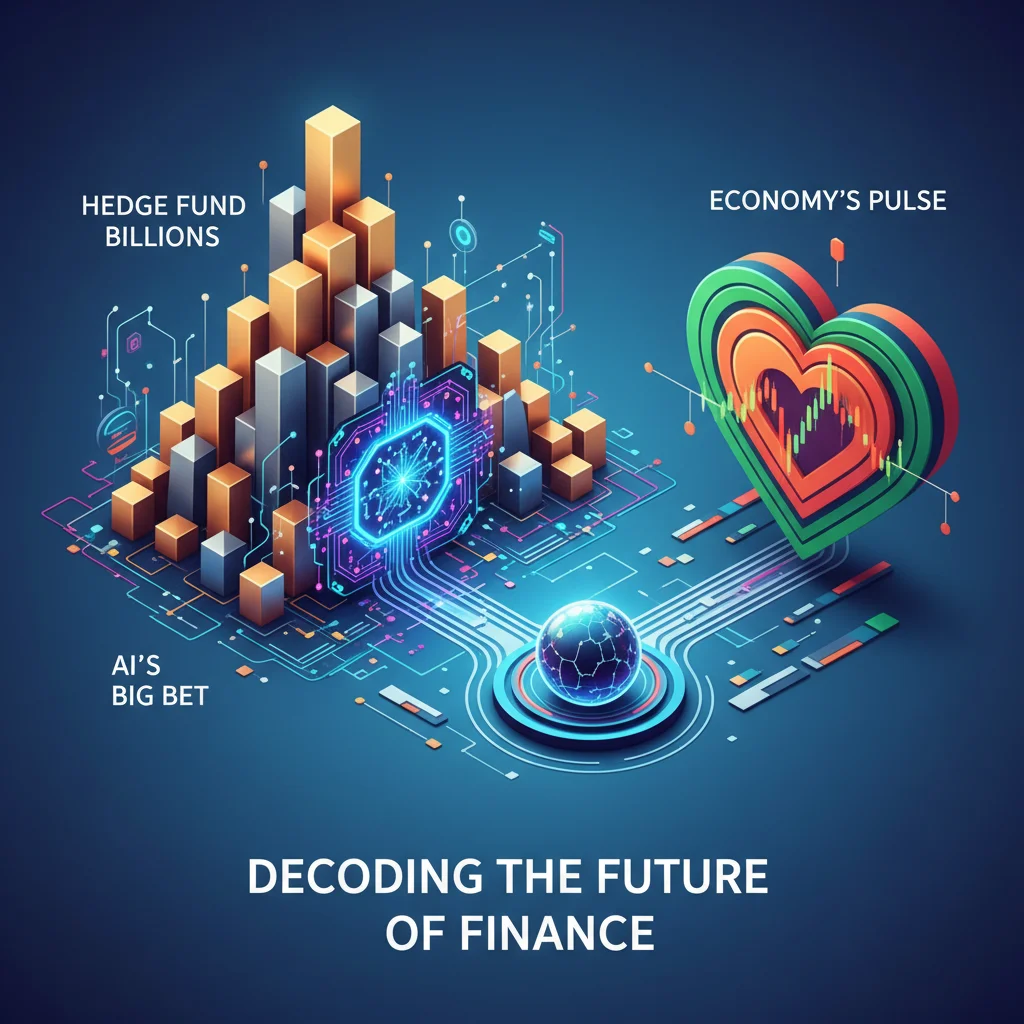
Hedge Fund Billions, AI’s Big Bet, and the Economy’s Pulse: Decoding the Future of Finance
In the world of high finance, a single number can sometimes tell a story of staggering proportions. That number, recently reported by the Financial Times, is the colossal payday of a hedge fund titan, a figure that sits in stark contrast to another, more abstract force gathering on the horizon: an industry-wide “reckoning” with artificial intelligence. Add to this mix the persistent drumbeat of US economic data that keeps global markets on edge, and you have the three core pillars shaping the future of investing, trading, and wealth itself.
This isn’t just a story about a single paycheck or a new piece of software. It’s about the fundamental tension at the heart of modern finance: the enduring power of human intuition and star power versus the relentless, data-driven logic of the machine. It’s a narrative that unfolds against the backdrop of a complex global economy where every data point can trigger a tidal wave of market movement. In this analysis, we will dissect these powerful trends, exploring what they mean for the stock market, the banking industry, and anyone with a stake in the future of our economy.
The Billion-Dollar Payday: A Relic or a Resurgence?
The world of asset management has always been known for its outsized rewards, but recent figures have brought the scale of this wealth into sharp focus. Sir Chris Hohn, the activist investor behind the TCI fund, recently secured one of the largest annual paydays on record for a UK-based executive, reportedly taking home an estimated $600 million (source). This kind of compensation, while astonishing, is a direct result of the traditional hedge fund model, typically built on the “2 and 20” fee structure—a 2% management fee on total assets and a 20% cut of any profits generated.
When you’re managing tens of billions of dollars, this model can generate immense personal fortunes, particularly in years of strong performance. Proponents argue that this is the ultimate form of meritocracy; high-risk, high-reward investing that aligns the manager’s interests with their clients’. A massive payday is simply the prize for delivering exceptional returns that outperform the market. However, critics point to a different side of the coin. They question whether any single individual’s contribution warrants such a sum and highlight the growing chasm of wealth inequality. Furthermore, they ask a crucial question for investors: does paying these fees truly guarantee superior performance over time compared to lower-cost index funds?
The era of the “star manager” is built on the idea that certain individuals possess a unique genius—an intuition or insight that allows them to navigate the complexities of the stock market better than anyone else. This payday suggests that, for now, the market is still willing to pay a premium for that perceived genius. But as technology advances, the very definition of financial genius is being challenged.
Geopolitical Shockwaves: Why Maduro's Capture Sent Gold Soaring and What It Means for Your Portfolio
The AI Reckoning: Is Wall Street Ready for its Tech Tsunami?
While human fund managers are cashing record-breaking checks, a quieter but far more profound revolution is underway. The asset management industry is bracing for what the Financial Times calls an AI “reckoning” (source). For years, financial technology, or fintech, has been chipping away at the old guard of banking and finance. Algorithmic trading and quantitative analysis are nothing new. However, the advent of sophisticated generative AI and large language models (LLMs) represents a quantum leap forward.
This isn’t merely about automating back-office tasks anymore. AI is now being deployed at the very core of the investment process. It can analyze millions of data points in seconds—from earnings reports and economic indicators to satellite imagery of parking lots and social media sentiment. This technology promises to identify patterns and opportunities that are simply invisible to the human eye. The potential applications are transforming the industry from top to bottom.
To understand the depth of this shift, consider the evolution of key tasks in asset management:
| Traditional Asset Management Task | AI-Powered Approach |
|---|---|
| Fundamental Analysis | AI scans and synthesizes thousands of company reports, news articles, and regulatory filings in minutes to produce a sentiment score and risk assessment. |
| Portfolio Construction | Machine learning algorithms run complex simulations to create optimized portfolios based on an investor’s specific risk tolerance and goals. |
| Risk Management | AI systems monitor global market data in real-time, stress-testing portfolios against thousands of potential economic scenarios to predict and mitigate risk. |
| Client Reporting | Generative AI creates personalized, easy-to-understand performance reports and market commentaries for individual clients automatically. |
The implications are enormous. AI could lead to more efficient markets, lower fees for investors, and the democratization of sophisticated financial strategies. However, it also raises critical questions. What happens to the thousands of human analysts whose jobs are now being automated? How do regulators oversee “black box” trading algorithms whose decisions are not fully understood? And can an AI truly replicate the long-term strategic vision and contrarian thinking of a legendary investor like Warren Buffett or the aggressive activism of a Chris Hohn?
The Economic Compass: Why US Jobs Data Still Shakes the Market
Amidst the internal industry shifts of blockbuster pay and AI integration, the entire financial world remains tethered to the fundamentals of the real economy. As the FT article notes, all eyes remain on key economic indicators like the US jobs report (source). For investors and finance professionals, these reports are more than just numbers; they are the primary signal shaping the decisions of the world’s most powerful central bank, the US Federal Reserve.
Here’s why a single report on employment can cause such volatility in the stock market:
- Inflation and Interest Rates: A “hot” jobs report (high job growth, rising wages) can signal an overheating economy. This increases fears of inflation, which in turn pressures the Federal Reserve to raise or maintain high interest rates to cool things down. Higher rates make borrowing more expensive for companies and consumers, often acting as a brake on stock market growth.
- Consumer Spending: A strong labor market means more people have disposable income, which fuels consumer spending—the engine of the US economy. This is generally good for corporate profits.
- Recession Fears: Conversely, a surprisingly weak jobs report can stoke fears of a recession, causing investors to sell off riskier assets like stocks and flee to the safety of government bonds.
The market’s reaction is often nuanced. What appears to be good news (more jobs!) can be interpreted as bad news if it means the Fed will be more aggressive on interest rates. This delicate dance between economic data and monetary policy creates the day-to-day, and sometimes hour-to-hour, volatility that both human traders and AI algorithms must navigate. It is the macroeconomic canvas upon which the dramas of individual fortunes and technological disruption are painted.
The Concert Economy: Deconstructing the Billion-Dollar Business of Live Music
Connecting the Dots: A New Financial Ecosystem
These three forces—extreme human compensation, the rise of intelligent machines, and the primacy of macroeconomic data—are not happening in isolation. They are interconnected threads weaving a new financial ecosystem.
Think about it: the performance that leads to a nine-figure payday for a hedge fund manager is increasingly reliant on sophisticated technology and quantitative models. The very AI systems being developed are trained on decades of historical economic data, including the jobs reports that continue to drive market sentiment. An AI trading model might react to a jobs report in microseconds, executing trades far faster than any human ever could, potentially amplifying market volatility.
This convergence is where the future of finance lies. The industry is moving beyond simple human-led trading or basic algorithmic execution. We are seeing the rise of hybrid models where human oversight guides AI’s immense processing power. This new paradigm touches every corner of the industry, from high-frequency trading and risk management to the development of new fintech platforms that use AI to offer personalized financial advice. While not yet mainstream in asset management, technologies like blockchain also loom as a potential disruptor, promising to revolutionize how assets are traded, settled, and recorded, adding another layer of technological change to the mix.
Sanctions, Strategy, and Steady Prices: Why Venezuelan Oil Sanctions Didn't Shake the Market
Conclusion: Navigating the Crossroads of Finance
The world of asset management is at a pivotal crossroads. It is a place where the time-honored tradition of the star manager, rewarded with unimaginable wealth, directly intersects with the disruptive force of artificial intelligence that threatens to redefine the very nature of financial expertise. Both of these internal industry dynamics are constantly being shaped and tested by the powerful, external force of the global economy.
For those navigating this landscape, the path forward requires a new kind of awareness.
- For Investors: The key is to look beyond past performance. It’s crucial to ask how your fund managers are adapting. Are they integrating technology to enhance their process, or are they relying on old models that may soon be obsolete?
- For Finance Professionals: The message is clear: adapt or be left behind. Technical literacy, data science skills, and an understanding of AI are no longer optional extras but core competencies for a successful career in modern finance.
- For Business Leaders: The innovations in financial technology will have ripple effects across all industries. Faster, more efficient, AI-driven capital markets will change how companies raise money, manage risk, and plan for the future.
The bumper payday of one individual is a captivating headline, but the real story is the tectonic shift happening beneath the surface. It is a shift from human intuition to data-driven insight, from manual processes to intelligent automation, and from isolated expertise to a hybrid, human-machine collaborative future. How the industry manages this transition will determine who reaps the rewards in the next chapter of finance.