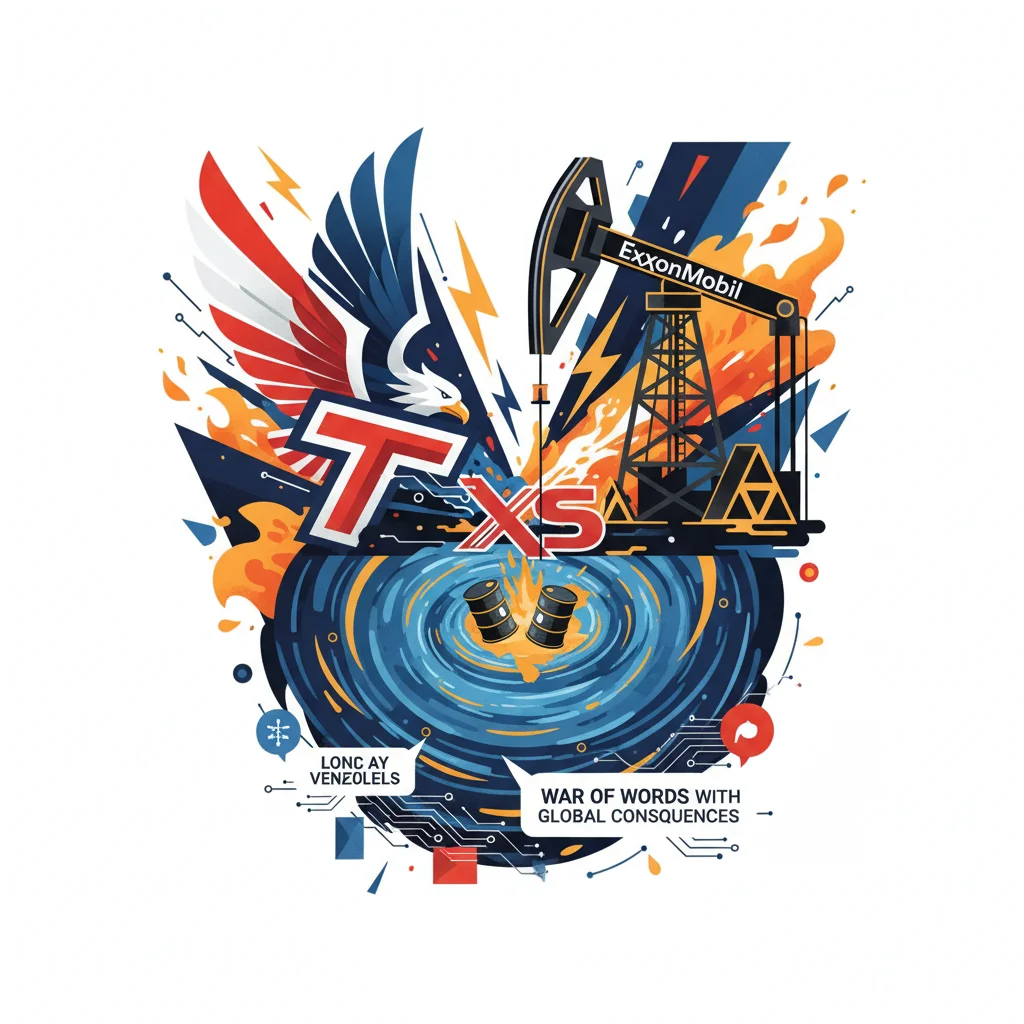
Clash of Titans: Trump, Exxon, and the High-Stakes Gamble for Venezuelan Oil
A War of Words with Global Consequences
In the high-stakes world where global politics and corporate finance intersect, few confrontations are as charged as a former—and potentially future—U.S. President publicly clashing with the chief executive of one of the world’s largest energy corporations. This is precisely the scenario that unfolded when Donald Trump threatened to block ExxonMobil from re-engaging with Venezuela, a nation sitting atop the world’s largest proven oil reserves but crippled by political turmoil and economic collapse. The conflict, sparked by Exxon CEO Darren Woods’ cautious stance on investing in the South American country, peels back the curtain on the immense complexities facing multinational corporations and the powerful influence of political rhetoric on the global economy.
The original report from the Financial Times detailed Trump’s pointed criticism of Woods, essentially telling the oil giant that without his political backing, any future venture into Venezuela would be a non-starter. This isn’t just a fleeting headline; it’s a critical case study in political risk, corporate strategy, and the future of energy markets. For investors, finance professionals, and business leaders, understanding the undercurrents of this dispute is essential for navigating an increasingly volatile global landscape. It raises fundamental questions about the balance of power between governments and corporations and the future of international investing.
The Roots of Caution: Why Exxon is Wary of Venezuela
To appreciate the gravity of the situation, one must understand why a company like Exxon, whose business is built on taking calculated risks to find and extract oil, would be so hesitant about Venezuela. Darren Woods’ skepticism is not unfounded; it’s rooted in a painful history and a pragmatic assessment of present dangers. Venezuela, despite its immense oil wealth, is a textbook example of sovereign risk.
The primary concern is the country’s long and troubled history of resource nationalism. In 2007, under the late President Hugo Chávez, Venezuela nationalized vast swathes of its oil industry, seizing assets from international giants like Exxon and ConocoPhillips. Exxon fought a protracted legal battle for years, eventually winning a multi-billion dollar arbitration award, though collecting on such judgments from a hostile state is another challenge entirely. This history of expropriation has left deep scars and serves as a stark reminder of the potential for a government to change the rules of the game overnight.
Beyond historical precedent, the current operational environment is abysmal. Venezuela’s state-owned oil company, PDVSA, has suffered from years of mismanagement, corruption, and a lack of investment. Its infrastructure—from pipelines to refineries—is in a state of severe decay. According to the U.S. Energy Information Administration, Venezuelan crude oil production has plummeted from over 3 million barrels per day in the late 1990s to around 800,000 barrels per day in early 2024. Restarting operations would require tens of billions of dollars in capital expenditure and years of work, all under an unstable and unpredictable political regime.
The table below illustrates the dramatic decline in Venezuela’s oil output, highlighting the scale of the challenge any investor would face.
| Year | Average Crude Oil Production (Million Barrels per Day) | Key Events |
|---|---|---|
| 2000 | 3.12 | Pre-Chávez nationalization era |
| 2007 | 2.66 | Major oil assets nationalized, including Exxon’s |
| 2013 | 2.49 | Nicolás Maduro assumes presidency |
| 2019 | 0.79 | U.S. imposes strict sanctions on PDVSA |
| 2023 | 0.78 | Slight recovery amid temporary sanctions relief |
Source: Data compiled from OPEC and U.S. EIA reports.
The New Gold Rush: Why Investing in Recycled Magnets is a Geopolitical Masterstroke
Trump’s “America First” Doctrine Meets Corporate Reality
From Donald Trump’s perspective, his threat is a logical extension of his “America First” approach to foreign and economic policy. This doctrine prioritizes national interests and seeks to leverage U.S. power to dictate terms in international relations and commerce. In this view, a U.S. corporation’s actions abroad should align with the strategic goals of the U.S. government—or at least, the goals of its leader.
Trump’s calculus may involve several factors. First, it’s a display of political strength, signaling to both domestic and international audiences that he can and will exert control over major U.S. industries. Second, it could be a negotiating tactic aimed at the Venezuelan regime, implying that any future economic normalization would have to go through him. Third, it reflects a transactional worldview where corporate access to foreign markets is a privilege granted by the government, not a right. This fundamentally challenges the traditional free-market principles that have long guided U.S. corporate expansion.
The implications for the stock market are significant. Political uncertainty is a major driver of volatility. When the potential leader of the world’s largest economy threatens to block the operations of a blue-chip company, it introduces a new layer of risk that investors must price in. This isn’t just about Exxon (ticker: XOM); it sends a chilling message to every multinational corporation that their long-term strategic plans could be upended by a single political decree.
The Broader Implications for Finance and Geopolitics
The standoff over Venezuela has ripple effects that extend far beyond the two main players. For the world of finance, it underscores the paramount importance of geopolitical risk analysis. Sophisticated investors and financial institutions are increasingly using advanced data analytics and financial technology to model and hedge against such political risks. The days of evaluating an international investment solely on its economic fundamentals are long gone.
The situation also highlights the complex role of sanctions in modern economics. While the U.S. has used sanctions to pressure the Maduro regime, their effectiveness is a subject of intense debate. They have undoubtedly crippled Venezuela’s economy and its ability to profit from its oil, but they have not yet led to the desired political change. In fact, some analysts argue that harsh sanctions can be counterproductive, pushing targeted nations closer to U.S. adversaries like China and Russia. The controversy even touches upon the world of blockchain, as the Maduro regime famously launched the “Petro” cryptocurrency in a failed bid to circumvent the traditional banking system and U.S. financial controls—a fascinating, albeit unsuccessful, case study in the geopolitical use of digital assets.
Beyond the Acronym: Why 'TACO' is a Multibillion-Dollar Word in Global Finance
For the global energy market, the “Venezuelan question” remains a massive variable. With the world’s largest reserves, a stable and productive Venezuela could significantly alter global supply dynamics, potentially lowering prices and reducing the influence of OPEC+. However, as this conflict shows, unlocking that potential is fraught with political peril. Any major oil company considering a move into Venezuela must not only secure a deal with the government in Caracas but also ensure it has the political blessing of Washington—a complex, two-front negotiation that could collapse at any moment.
The U.S. itself has a vested interest. A stable, democratic, and oil-producing Venezuela in its own hemisphere would be a massive strategic asset. It could reduce U.S. reliance on oil from the Middle East and other less stable regions. A recent temporary easing of sanctions by the Biden administration, allowing Chevron to expand its operations, signaled a pragmatic approach aimed at boosting supply. Trump’s hardline stance represents a starkly different strategy, prioritizing political pressure over economic engagement (source).
The Tariff Trap: Why U.S. Trade Policy Is Being Undermined by a Hidden Economic Force
Conclusion: A New Era of Political Risk in Global Business
The public dispute between Donald Trump and ExxonMobil is a microcosm of a larger trend: the re-emergence of aggressive nation-state politics as a primary risk factor in international business. The incident serves as a powerful reminder that in today’s world, political capital can be just as crucial as financial capital. Exxon’s caution is a lesson in corporate prudence, learned from costly experience. Trump’s threat is a demonstration of how populist nationalism can directly challenge the autonomy of multinational corporations.
For anyone involved in international finance, trading, or corporate strategy, the key takeaway is clear: geopolitical risk is no longer a niche concern but a central element of any investment thesis. The path to unlocking Venezuela’s vast oil wealth remains blocked not by geological challenges, but by a complex web of political ambition, historical grievances, and economic desperation. Until those tangled threads are unwound, the world’s largest oil reserves will remain a tantalizing but treacherous prize.

Related Posts
The Unseen Tax: How Soaring Energy Prices Are Reshaping the American Economy and Your Portfolio
The Venezuelan Wildcard: How a Geopolitical Shift Could Fuel a Bonanza for Indian Oil Refiners