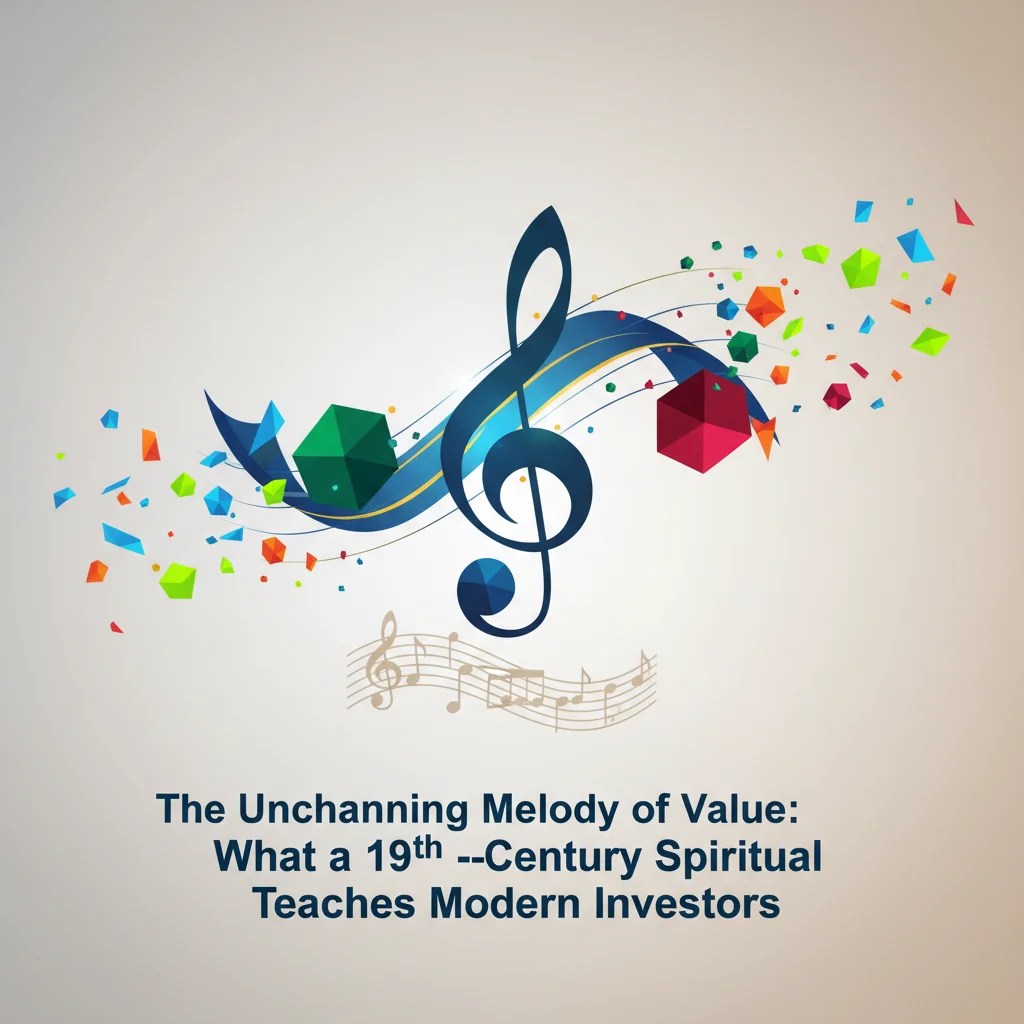
The Unchanging Melody of Value: What a 19th-Century Spiritual Teaches Modern Investors
In the vast and often cacophonous world of modern finance, we are conditioned to look for signals in numbers—quarterly earnings reports, stock market fluctuations, and the complex algorithms that drive high-frequency trading. We build our strategies on data, on quantifiable metrics, and on the relentless pursuit of alpha. But what if one of the most profound lessons in long-term value, resilience, and market adaptation comes not from a Wall Street analyst, but from a 19th-century spiritual born in the cotton fields of the American South?
The song is “Mary Don’t You Weep.” For many, its melody is a familiar echo, a cornerstone of gospel music. For others, it’s the foundational inspiration for Paul Simon’s transcendent classic, “Bridge Over Troubled Water.” Yet, its journey from a coded message of hope among enslaved peoples to a global anthem is a powerful allegory for the principles that govern our modern economy and investment philosophies. It’s a story about an asset with an incorruptible intrinsic value, one that has weathered unimaginable volatility, found new markets, and delivered compounded returns for generations. It teaches us that the most enduring investments are often built not on spreadsheets, but on a powerful, resonant story.
The Genesis of an Anthem: Forging Intrinsic Value in a Brutal Economy
To understand the song’s power, we must first understand the brutal economy from which it emerged. The antebellum South was a system built on a grotesque financial instrument: the human body as collateral. In this context, enslaved African Americans created their own parallel economy of culture, faith, and communication. Spirituals were a central currency in this economy—they were vessels for theology, coded messages for escape, and, most importantly, a means of preserving humanity in a system designed to strip it away.
“Mary Don’t You Weep” was forged in this crucible. Its lyrics, referencing the biblical story of Mary of Bethany weeping at her brother Lazarus’s tomb before Jesus raises him from the dead, were a direct message of hope: even in the face of death and utter despair, divine deliverance is possible. The line, “Pharaoh’s army got drownded,” was not merely a biblical retelling; it was a potent and subversive prophecy. As noted in the Financial Times, this lyric served as a direct and defiant message that oppressors would ultimately face justice.
In the language of finance, the creators of this spiritual were minting an asset with unparalleled intrinsic value. It wasn’t tied to a commodity or a fiat currency; its value was pegged to the most stable and sought-after asset in human history: hope. While the formal economy around them was built on volatility and inhumanity, this cultural asset was designed for resilience. Its “fundamentals” were sound because they addressed a universal human need.
The Python's Portfolio: Why "Trust in Me" is the Most Dangerous Song in Finance
The Compounding Power of a Message: Market Adoption and Generational Alpha
A truly great investment doesn’t just hold its value; it finds new markets and its returns compound over time. The “value proposition” of “Mary Don’t You Weep” proved to be extraordinarily adaptable. A century after its creation, the song was adopted as a major anthem of the Civil Rights Movement. The “Pharaoh” was no longer a literal slave master, but the systemic injustice of segregation and racial violence. The promise of deliverance resonated with a new generation fighting a different, yet related, battle for freedom.
Performances by groups like The Swan Silvertones and The Caravans brought the song to a national audience. The 1959 recording by The Swan Silvertones, featuring the powerful ad-libs of singer Claude Jeter, became a definitive version (source). Each performance was like a new investment round, infusing the original asset with new energy and expanding its reach. This wasn’t just survival; it was growth. The song’s cultural “stock” was soaring, proving its ability to generate alpha across different historical periods.
This journey from a niche, coded communication to a mainstream anthem offers a critical lesson for today’s investors and business leaders. The products, technologies, and ideas that endure are those that solve a fundamental problem and can adapt their “story” to new contexts. Below is a table illustrating the song’s evolving market and its financial parallel.
| Historical Era | Primary Context & Meaning | Modern Financial Analogy |
|---|---|---|
| Pre-Civil War (c. 1860s) | Spiritual consolation and coded message of hope for enslaved peoples. | Intrinsic Value Creation: Developing a core asset based on a fundamental, unmet need (hope, resilience). |
| Civil Rights Era (1950s-1960s) | A public anthem of protest and a cry for justice against segregation. | Market Adoption & Growth: The asset finds a larger, addressable market and its value compounds through wider use. |
| Late 20th Century (1970s) | Artistic inspiration for secular music, notably Paul Simon’s “Bridge Over Troubled Water.” | Product Diversification / API: The core asset is used as a platform (API) for creating new, successful products. |
| Modern Era (21st Century) | A cultural touchstone representing resilience, featured in films like Spike Lee’s BlacKkKlansman. | Legacy Asset / Blue-Chip Brand: The asset achieves a “blue-chip” status, recognized for its enduring value and historical significance. |
From Spiritual to Simon: Adaptation, Innovation, and the Fintech Parallel
Perhaps the most fascinating chapter in the song’s life is its influence on popular music. Paul Simon was directly inspired by Claude Jeter’s ad-lib, “I’ll be your bridge over deep water if you trust in my name,” from The Swan Silvertones’ recording. This line became the seed for “Bridge Over Troubled Water,” a song that would go on to win five Grammy Awards in 1971 (source) and become one of the most beloved songs of the 20th century.
This is a masterclass in innovation. Simon didn’t simply cover the original spiritual; he took its core emotional thesis—a promise of support in times of trouble—and built a new, secular structure around it. He adapted the message for a new audience, a new time, and a new market. This is precisely the model of modern financial technology. Fintech didn’t invent the core concepts of banking, lending, or payments. Instead, it took the fundamental “message” of traditional finance and built a new, more accessible, and technologically advanced “structure” around it. Companies like Stripe and Square are the “Bridge Over Troubled Water” to the traditional banking system’s “Mary Don’t You Weep.” They took a powerful, existing idea and made it resonate with a new generation.
This process of adaptation highlights a key principle for success in any industry, from music to finance: the ability to honor a core value while innovating on its delivery. The message of support in Simon’s song is the same as the spiritual’s, but the user interface is entirely different. The best fintech platforms do the same, preserving the core function of a financial service while radically improving the user experience.
The Phoenix Economy: Why Corporate Japan Must Conquer its 30-Year Trauma to Thrive
Lessons for the 21st-Century Leader
The journey of this simple spiritual offers a rich tapestry of lessons for anyone navigating the complexities of the modern economy. Its endurance is not an accident; it is a feature of its design. Here are three key takeaways:
1. Invest in Enduring Narratives, Not Fleeting Trends.
In a world of meme stocks and speculative trading, it’s easy to get caught up in fleeting narratives. “Mary Don’t You Weep” reminds us that true value is found in stories that address timeless human needs: hope, community, and resilience. When evaluating a company, a technology like blockchain, or an investment, look beyond the short-term hype. Ask yourself: What is the fundamental story here? Does it solve a real, enduring problem?
2. True Innovation is Adaptation.
The leap from a spiritual to a pop classic to a civil rights anthem demonstrates that the most powerful innovations are often reinterpretations of a core truth. The next disruptive force in financial technology won’t necessarily be a brand new invention, but a brilliant new application of an existing principle. The challenge is not always to invent, but to re-imagine.
3. Find the Signal in the Noise.
For those who first heard it, the song was a clear signal of hope amidst the overwhelming noise of oppression. For investors and traders today, the challenge is similar: to distinguish the fundamental signals of a company’s health and long-term potential from the daily noise of stock market chatter. This requires a deep understanding of the core value proposition, not just the surface-level price action.
In the final analysis, “Mary Don’t You Weep” is more than a song. It is a testament to the idea that value, when built on a foundation of authentic human truth, can withstand any market crash, outlast any economic cycle, and compound its returns in ways we can scarcely imagine. It is the ultimate blue-chip asset, a melody of resilience that continues to pay dividends more than 150 years after its creation.