Trump’s 10% Credit Card Rate Cap: Economic Lifeline or Financial Chaos?
The $1 Trillion Question: A Radical Proposal to Cap Credit Card Interest
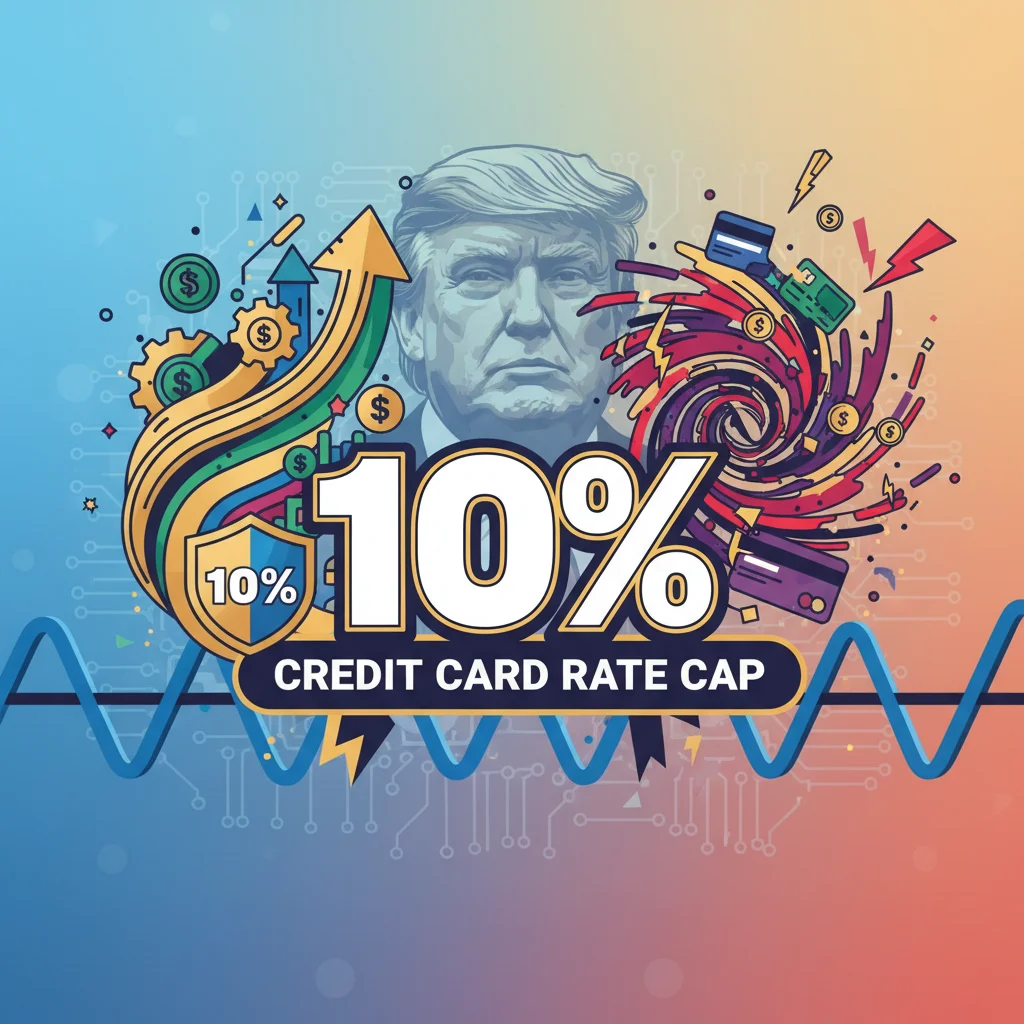
In a move that sent ripples through the worlds of finance and politics, former President Donald Trump recently called for a dramatic intervention in the consumer credit market: a federally mandated cap of 10% on credit card interest rates. The proposal, as reported by the Financial Times, was characteristically bold and light on specifics, suggesting a one-year limit to be implemented on January 20th of the coming year. While the political motivations may be clear, the economic implications of such a policy are far more complex and warrant a deep, analytical dive.
This isn’t just a political soundbite; it’s a proposal that strikes at the heart of the modern banking and financial technology ecosystem. For millions of Americans grappling with high-interest debt, the idea of a 10% cap sounds like a long-overdue lifeline. For the banking industry, investors, and the stock market, it represents a potential seismic shift that could upend a business model that has been in place for decades. To understand the potential fallout, we must first grasp the staggering scale of consumer credit in the United States today.
An Economy Built on Credit: The Current Landscape
The conversation around interest rates is meaningless without understanding the environment in which it’s happening. American consumers are currently navigating a landscape of historically high borrowing costs. The average credit card Annual Percentage Rate (APR) has soared, now hovering well above 20% for many consumers. This surge is partly a consequence of the Federal Reserve’s aggressive campaign to curb inflation by raising its benchmark interest rate, which directly influences the prime rate that banks use to set their own lending terms.
The result is a mountain of debt. Total U.S. credit card balances surpassed an astonishing $1.13 trillion in the fourth quarter of 2023, according to the Federal Reserve Bank of New York. This isn’t just an abstract number; it represents a significant financial burden on households, impacting everything from daily spending to long-term investing goals.
To illustrate the disparity in borrowing costs, consider how rates vary based on creditworthiness:
| Credit Score Range | Typical Average APR | Risk Profile for Lenders |
|---|---|---|
| Excellent (720-850) | 18% – 22% | Low Risk |
| Good (690-719) | 21% – 25% | Moderate Risk |
| Fair (630-689) | 25% – 29% | Higher Risk |
| Poor (<630) | 28% – 36% | Highest Risk |
This system, known as risk-based pricing, is the fundamental pillar of consumer lending. Lenders argue that higher interest rates for less creditworthy borrowers are necessary to compensate for the increased risk of default. A flat 10% cap would shatter this model, forcing a complete re-evaluation of who can access credit and on what terms.
King Henry II's Sour Grapes: A 12th-Century Lesson in Modern Finance and Supply Chain Risk
The Domino Effect: Unintended Consequences for the Economy
If a 10% interest rate cap were to become law, the effects would cascade through every corner of the financial world, impacting consumers, banks, and the broader economy in profound and often counterintuitive ways.
1. The Consumer Credit Crunch
While a rate cap seems pro-consumer on the surface, its most immediate effect would likely be a severe contraction of credit availability. Faced with a legally mandated ceiling on their potential returns, banks and fintech lenders would have no financial incentive to lend to anyone deemed a moderate or high risk. The math is simple: if a lender can’t charge an interest rate that adequately covers the statistical probability of default for a certain group of borrowers, they will stop lending to that group entirely.
This means millions of Americans with fair or poor credit scores—the very people who are often most reliant on credit cards to manage expenses—could find their applications denied and existing credit lines reduced or closed. The policy intended to help the most vulnerable could inadvertently cut them off from the financial system, potentially pushing them towards less-regulated and more predatory lending options like payday loans.
2. A New Business Model for Banking and Fintech
The credit card industry is a major profit center for banks. A 10% cap would decimate this revenue stream. In response, institutions would scramble to recoup lost profits. We could expect to see:
- Soaring Annual Fees: Cards that are currently free would likely introduce significant annual fees.
- The End of Rewards Programs: The economics of cashback, points, and travel miles are subsidized by interest payments from revolving balances. With that income stream slashed, rewards programs would become unsustainable.
- A Barrage of New Service Charges: Expect fees for everything from late payments (which are already capped) to balance transfers and cash advances to increase dramatically.
This would also have a chilling effect on the financial technology sector. Many fintech innovations in lending rely on sophisticated algorithms to price risk more accurately. A blunt instrument like a rate cap would render much of this technology moot, potentially stifling innovation in a dynamic sector of the economy.
The Financial Polymath: Why Solving for 'X' in Today's Economy is Like a Crossword Puzzle
3. Ripples in the Stock Market and Broader Economy
Investors would react swiftly. The stock prices of major banks and credit card issuers like Capital One, Discover, and American Express would likely face immense pressure. The uncertainty would ripple through the entire financial sector of the stock market. Furthermore, since consumer spending accounts for roughly 70% of U.S. economic activity, a sudden credit crunch could put a powerful brake on the economy, potentially slowing growth or even tipping it towards a recession.
Historical Precedent and Legal Hurdles
The idea of capping interest rates is not new. For centuries, societies have had “usury laws” designed to prevent excessive interest charges. However, the modern U.S. credit card industry was born from deregulation. A landmark 1978 Supreme Court decision, Marquette Nat. Bank of Minneapolis v. First of Omaha Service Corp., allowed national banks to “export” the interest rate laws of their home state to customers nationwide. This led banks to headquarter their credit card operations in states with lax or non-existent usury laws, like South Dakota and Delaware, effectively creating a national, lightly regulated market.
Overriding this precedent would require a significant act of Congress. It could not be accomplished by a simple executive order. The legislative battle would be monumental, pitting powerful banking lobbies against consumer advocacy groups. The complexity of financial law and the deeply entrenched nature of the current system make any swift change, especially by a politically charged January 20th deadline, highly improbable.
The Cola Wars Reignited: A Financial Deep Dive into Ambani's Challenge to Coke and Pepsi
Conclusion: A Critical Conversation, A Flawed Solution
Donald Trump’s proposal to cap credit card interest rates at 10% has successfully ignited a conversation about a genuine source of financial hardship for millions of Americans. The burden of high-interest debt is a significant drag on household wealth and a critical issue for the nation’s economic health.
However, the proposed solution, in its current form, is a blunt instrument that threatens to cause more harm than good. The predictable consequences—a severe credit crunch for those who need it most, the evisceration of the rewards ecosystem, and a potential shock to the banking system and the broader economy—suggest that the cure could be far worse than the disease. True solutions to consumer debt will likely require a more nuanced approach, focusing on financial education, promoting competition in the banking and fintech sectors, and creating policies that encourage responsible lending and borrowing, rather than a top-down price control that ignores the fundamental economics of risk.
For investors, business leaders, and financial professionals, this proposal serves as a stark reminder of how quickly political winds can shift, threatening to reshape the regulatory landscape. While this specific cap may be unworkable, the underlying public sentiment it represents is a powerful force that will continue to influence the future of finance, banking, and financial technology for years to come.